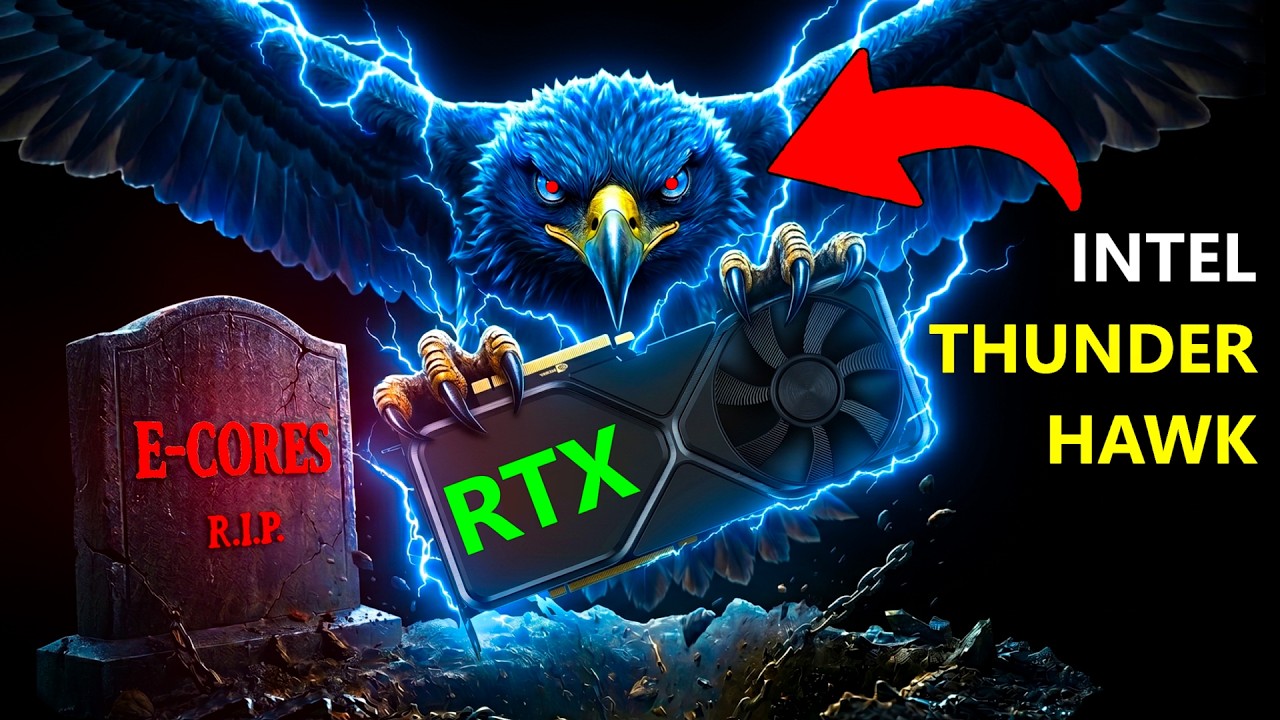
Intel has been in the news quite a lot in recent times, and for once, all for the right reasons. Panther Lake and the Arrow Lake refresh chips are top-notch, and at long last, orders are coming in for its foundry services. And if a leaked roadmap for its future desktop and laptop chips is anything to go by, Intel will be a headline story for many years to come.
Admittedly, though, deciphering the claimed roadmap from the YouTube channel Moore's Law is Dead takes a fair bit of processing, if you pardon the pun. As mentioned up top, Intel's current chip lineup primarily consists of Arrow Lake (ARL, desktop and laptop) and Panther Lake (PTL, laptop and handheld).
Naturally, these will be replaced by the next generation of microarchitectures, and first up will be Nova Lake (NVL), which is expected to make some kind of an appearance toward the end of the year. That much we already know directly from Intel, but there have been plenty of additional leaks and rumours to fill in the gaps.
After NVL, the alleged roadmap suggests that we'll see Razer Lake, though many SKUs will actually just be rebranded Nova Lake chips. After that, Titan Lake will make an appearance, replacing PTL, and this is where things begin to get interesting.
Ever since Alder Lake in 2021, its 12th Gen Core architecture, Intel has employed a hybrid approach to its consumer processor designs. Alongside the powerful and power-hungry 'Performance' cores, there are clusters of compact and power-sipping 'Efficient' cores. That will still be the case with Nova Lake and Razer Lake, but both this roadmap and previous rumours suggest that the separate core approach will be gone.
While this is being labelled as a 'unified' core design, MLID is suggesting that while there will still be P- and E-cores, Intel will be taking a leaf from AMD's book and the cores will be architecturally identical. It's just that the 'E-cores' will be more compact and lower clocked, as you see with some Ryzen laptop chips that have Zen 5 and Zen 5c cores.

Still with me? Good. On the desktop side of things, the successor to Nova Lake and Razer Lake will be Hammer Lake (cue endless Stop! It's hammer time! memes). Not only will this introduce a second generation of the unified core architecture, but it's also claimed that HyperThreading, Intel's simultaneous multithreaded system, will make a return.
It was dropped for Arrow Lake to help ensure the chips stuck within the targeted power window, and truth be told, you wouldn't notice that it's missing, given how well the Core Ultra 7 270K Plus performs in multicore tasks.
Additionally, the majority of Hammer Lake desktop models will be 'P-core' only, just as AMD doesn't use its compact cores in socketed Ryzen chips. Oh, and speaking of sockets, here's the final head-spinner: Nova Lake, Razer Lake, and Hammer Lake will apparently all use the same LGA 1954 socket, though whether that includes the massive cache, dual compute tile variants is unknown at this stage.

I've only briefly touched on what the roadmaps have to tell us, as the rest of the details are somewhat complex and confusing, and I'll need more than one cup of coffee to make sense of it all.
Although the RAMpocalypse is doing its very best to completely ruin PCs for everyone right now, perhaps by the time Intel's unified chips come to market, things will be a lot better. Maybe even back to normal—whatever normal is these days. If that comes to pass, and you've held off from upgrading until then, you could be in for a treat when it comes to picking your next gaming CPU.
1. Best overall:
AMD Ryzen 7 9800X3D
2. Best budget:
AMD Ryzen 5 5500
3. Best mid-range:
Intel Core Ultra 5 250K Plus
4. Best high-end:
AMD Ryzen 9 9950X3D
5. Best AM4 upgrade:
AMD Ryzen 7 5700X3D
6. Best CPU graphics:
AMD Ryzen 7 8700G