





Our Verdict
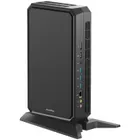
The A9 Max is a curious thing. What Geekom has managed to pack into this tiny substructure is wild. That GPU and CPU combo is next level, but the one thing it forgot to add was a second RAM stick. As a result, the real-world performance severely lags behind its competitors at half the cost.
For
- Remarkably clean design
- Solid CPU performance
- Surprisingly cool & quiet
- Impressive connectivity
Against
- Base memory configuration is a major concern
- Priced far too high
- Beaten by machines, nearly half the cost
PC Gamer's got your back Our experienced team dedicates many hours to every review, to really get to the heart of what matters most to you. Find out more about how we evaluate games and hardware.
Honestly, I want to like the Geekom A9 Max, I really do. From a pure design perspective, the hardware, the engineering behind it, the connectivity bundled into this thing, it's on another level. And it's just a bloody pretty thing at that, at least as far as Mini PCs go. You'd think it'd be a shoo-in for our best SFF PC list, without question. But there's a catch, because of course there is.
I may as well rip the band-aid off right now. It's the memory. I can already see the PR team squirming as they read that sentence, and it genuinely does pain me to say it, I promise. Geekom has decided to ship the A9 Max AI with a single stick of 32 GB DDR5 @ 5600 MT/s. And that is a decision that has effectively starved AMD's Radeon 890M of any modicum of the performance it can actually generate. I know this because I have extensively tested this hardware most recently, in Acemagic's Mini PC Retro X5, which, like-for-like, practically has the same spec, bar a smaller SSD, and a slightly older CPU.
The performance impact that this one tiny decision has had on the overall architecture is nuts, and combined with the wildly high price tag being what it is, it's by far the thing that's decimated that review score. If Geekom turned around tomorrow and popped 2x 16 GB sticks in this config instead of this single-channel nonsense, I can happily tell you right now, the score would bounce up by a good 15%, because in almost every other way, the A9 Max is excellent.
CPU |
AMD Ryzen AI 9 HX 470 |
Cores | Threads |
12 | 24 |
Clock speed |
up to 5.2GHz |
GPU |
AMD Radeon 890M |
RAM |
32GB (1x32GB) DDR5-5600 |
Storage |
2 TB Kingston OM8TAP42048K1-A00 PCIe 4.0 (2x PCIe 4.0 M.2 slots available) |
Rear I/O |
2x 2.5Gb ethernet, 1x USB 2.0 Type-A, 1x USB 3.2 Gen 2 Type-A, 2x USB 4.0 Type-C, 2x HDMI 2.1, DC-in |
Front I/O |
4x USB 3.2 Gen 2 Type-A, SD Card Reader, 3.5 mm audio out |
Power |
120 W |
Dimensions |
135 x 132 x 46mm |
Price |
£1,600 | $1,799 (as configured) |
Buy if...
✅ You need a compact AI-focused workhorse: The A9 Max has some serious engineering chops. Chuck an extra DRAM stick in here and an SSD, and you're looking at one mean local LLM solution or workstation.
Don't buy if...
❌ You're a gamer: Without a second stick of RAM by default, the A9 Max lacks the memory bandwidth to compete with machines half its cost.
And, breathe. I'll get back to that in a minute. Still, for £1,600 in the UK or $1,800 US, it's generally not a bad offering (memory aside). You get that 32 GB RAM capacity, a 2TB Kingston PCIe 4.0 SSD (it's not the best), AMD's Ryzen AI 9 HX 470 CPU, A Radeon 890M iGPU, and a hell of a lot of connectivity.
The chip itself is relatively new on the scene, only really landing with us in January of this year. Though it's effectively a refreshed Strix Point (HX 370 series) chip, still built out of the same silicon architecture as its predecessor. You get those four Zen 5 cores, and eight Zen 5c cores for a fat 12/24 multi-threaded config, and it's all still built on the back of TSMC's 4 nm process as well. What's different? Well… clock speeds have been bumped ever so slightly up (with an extra 100 MHz on boost), oh, and the "biggest" update comes in the form of the NPU, which has seen its performance flick up to 86 TOPS versus its predecessor's 80 (huzzah, our AI datacenter worries are finally solved).
Connectivity is wild, too. There's so much here if you're looking for a lightweight workstation that's not brimming with a dedicated GPU and full-fat processor. There's no less than five USB 3.2 Gen2 Type-A, two USB 4.0 Type-Cs, twin 2.5 Gbe, along with support for twin HDMI 2.1 ports, as well as the other bells and whistles you'd expect. No Thunderbolt, of course, but you do get WiFi 7 and Bluetooth 5.4.
Alright, I'm going to give you some numbers now, and they're quite clearly bad. But, it's important that we all collectively have context on this before I act like a wailing harpie and impale this memory situation into the dirt with my shiny shiny words (honestly, it's a miracle I get paid for this).
So, we test our SFF PCs (with iGPUs) at 1080p on the medium graphical preset. For this little wee dissection, I'm going to be using that Acemagic X5 I mentioned earlier for comparison. It has the same Radeon GPU, the same memory speed, memory capacity, a better SSD (albeit smaller), and practically the same CPU for what it's worth (technically, the A9 Max has a better chip here). On average, across all our test titles, with and without upscaling, across five separate games, separate engines, separate developers, the A9 Max landed just 23.1 fps. The Retro X5, with its dual-channel memory, 47.6 fps.


1080p gaming performance
| Product | Value |
|---|---|
| Geekom A9 Max | 9 Avg FPS, 7 1% Low FPS |
| Acemagic Retro X5 | 20 Avg FPS, 16 1% Low FPS |

It's not a limitation that sits solely with gaming, either. In 7-Zip, compression and decompression were markedly slower, multi-core performance in CineBench was down too, and the only times it did beat out the HX 370 was in single-threaded tasks, where memory bandwidth is less of a thing. Not exactly a riveting score sheet then. Even 3DMark's Storage benchmark came out significantly slower, which I can't believe even for a second is entirely down to the drive being just that much sloppier than the EXT X200E found in the X5 is.
Synthetic CPU performance
| Product | Value |
|---|---|
| Geekom A9 Max | 119 Single-core index score, 1101 Multi-core index score |
| Acemagic Retro X5 | 107 Single-core index score, 1169 Multi-core index score |
Just to be doubly sure, I re-ran the whole benchmark suite, and triple-checked GPU frequencies, temps and power draw throughout that process too, noting down average frequencies as well (not typically something we report on for these machines). The X5 maxed out at 2,764 MHz and 2,100 MHz on average, at 60 degrees and with 50 W on max draw. The A9, 3,100 MHz at max, 2,300 MHz on average, with a top temp of 63 degrees and 55 W of power usage. By all accounts, then, the GPU itself was running at full tilt, but was just starved of memory bandwidth.
Geekom knows about this, too. In fact, I was pre-briefed that this was a decision it had made in advance. The justification being that it provides end-users with the option to expand their memory solution later down the line with an additional stick of 32 GB. Which, yeah, okay, I don't necessarily disagree with.
Geekom also notes that, actually, the performance drops are only in synthetic benchmarks, and don't affect real-world performance. Which I do disagree with.


You can quite clearly see that this does massively impact real-world results. In fact, more so than in the synthetic tests, by my calculations. What's particularly frustrating about all this is that nowhere on the product pages (at least at time of writing) does it suggest that the A9 Max ships with a single stick. It's all "dual-channel compatible", "up to 128 GB", or "32 GB RAM", "High-speed memory".
It's a difficult thing to just accept, because the truth of it is the A9 Max is an outstanding piece of design. It's cool, quiet, and it's clear that the CPU in particular is seriously potent, particularly in localised AI applications if that's your jam. The sad reality is, we've already seen what this hardware can do; it just came in a beige box at half the price.
1. Best overall:
Minisforum AtomMan G7 PT
2. Best budget:
Minisforum Venus UM790 Pro
3. Best pure gaming:
Asus ROG NUC 970
4. Best compact:
Geekom AX8 Pro
5. Best looking:
Ayaneo Retro Mini AM02
6. Best iGPU for gaming:
Beelink SER9
7. Best for AI:
Framework Desktop
The A9 Max is a curious thing. What Geekom has managed to pack into this tiny substructure is wild. That GPU and CPU combo is next level, but the one thing it forgot to add was a second RAM stick. As a result, the real-world performance severely lags behind its competitors at half the cost.

