Our Verdict
This is the most luxurious and satisfying laptop I've ever used, and by my reckoning it has cemented itself firmly alongside the likes of the Razer Blade as a premium, sleek gaming machine. Unfortunately, it is also incredibly expensive and has one particularly pesky problem in the form of audio latency from its default audio device, making it a big ask for the price unless you only use your own USB headset/earphones.
For
- Gorgeous and sleek
- Satisfying keyboard and trackpad
- Lovely, fast OLED
- High-end performance
- Non-obnoxious fan noise
Against
- Incredibly expensive
- Better performance for the price elsewhere
- Audio latency using default device
PC Gamer's got your back Our experienced team dedicates many hours to every review, to really get to the heart of what matters most to you. Find out more about how we evaluate games and hardware.
If there were ever a laptop design to be right "up my alley", as we brits like to say, it would be this one. That's because it makes its sacrifices in exactly the right places to deliver something genuinely portable, sleek, elegant, and satisfying to use both for gaming and work.
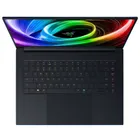
The MSI 'Stealth' laptop looks to have been reimagined along these MacBook or Razer Blade-esque lines—and successfully so—featuring a giant touchpad, thin aluminium form factor, subtle upward-facing speakers, and a spacious screen.
It's not just a looker, though, as MSI has crammed an RTX 5080 mobile GPU into it, making for genuine high-end performance. It has, however, had to be power-limited to play nicely with the slim chassis, meaning you're not getting quite the performance you could get out of a chunkier laptop for the same very expensive price or cheaper.
Buy if...
✅ You use your laptop in public: This thing definitely looks the part alongside MacBooks and other such suave devices, with its aluminium frame and giant trackpad.
✅ You use a USB headset: I didn't have any of the audio latency issues I noticed when using USB earphones/headset.
Do not buy if...
❌ You like to game using the laptop speakers: I noticed definite audio latency over the default audio device with this laptop, which can be annoying in shooters, for instance.
❌ You just want raw performance: This laptop looks gorgeous and is very portable for a 16-inch machine, but you can get more high-end horsepower for less if you don't mind something chunkier.

This is the most luxurious and satisfying laptop I've ever used, and by my reckoning it has cemented itself firmly alongside the likes of the Razer Blade as a premium, sleek gaming machine. Unfortunately, it is also incredibly expensive and has one particularly pesky problem in the form of audio latency from its default audio device, making it a big ask for the price unless you only use your own USB headset/earphones.
MSI Stealth 16 AI+ B3W Features
CPU |
Intel Core Ultra 9 386H |
NPU |
50 TOPS |
Graphics |
RTX 5080 mobile (125 W) |
Memory |
32 GB DDR5-5600 |
Storage |
1 TB SSD |
Screen size |
16-inch |
Screen type |
OLED |
Resolution |
2560 x 1600 |
Refresh rate |
240 Hz |
Ports |
1x 3.5 mm audio (combo), 2x USB-A 3.2 Gen2, 2x Thunderbolt 4, 1x HDMI 2.1, 2.5 Gb Ethernet |
Wireless connectivity |
Wi-Fi 7, Bluetooth 6 |
Battery |
90 Wh |
Dimensions |
354 x 246 x 16.65–19.99 mm |
Weight |
1.99 kg |
Price |
After powering on the laptop for the first time, I was immediately impressed by how it feels to use. The trackpad doesn't require much force to press but just enough so you're not accidentally pressing it, and it has a very satisfying click. I didn't have many problems with accidentally moving the cursor while typing because of the size of the trackpad, but it did happen occasionally.
'Satisfying' is also the word I'd use to describe the pleasantly tactile chiclet keyboard. This keyboard has four-zone RGB that I set to solid white to match the classy look.
There's also a decent selection of ports on the Stealth, including two Thunderbolt 4, a HDMI, and even an Ethernet port. This, I found to be particularly impressive given the sleek form factor.

Sleek, that is, and very shiny thanks to its 240 Hz OLED. It's of the 16:10 variety, too, which is the best kind as it gives you plenty of space for browsing and so on. I'd say 16-inch with a 16:10 aspect ratio is pretty much ideal for a laptop, especially one like this that's also slim and portable. The OLED panel itself is fantastic, too, with plenty of contrast thanks to the true blacks and vibrant colours. And of course the smooth 240 Hz certainly doesn't hurt in those games that can push frame rates up that high.
Specs-wise, this particular version gives you only the choice of the Core Ultra 9 386H for the processor, but you can choose between an RTX 5070, 5070 Ti, or 5080 version. The latter two come with 32 GB of DDR5 RAM, but the RTX 5070 version comes with just 16 GB. All configs except for one 2 TB version comes with 1 TB of storage.
The version I tested has 1 TB of storage, 32 GB of DDR5-5600 memory, and an RTX 5080 mobile. The RTX 5080 here has a big asterisk: it's a nerfed—ie, power-limited—version of the GPU. With a max draw of just 125 W, that's 50 W less juice than you get with a full-fat RTX 5080 mobile like the one in the Lenovo Legion 7i Pro Gen10, the current best high-performance gaming laptop. That's a sacrifice made to keep things so slim, as is the choice of CPU which sacrifices some top-end compute performance for efficiency.

So far so good, but there is one area that unfortunately rains all over the parade, and that's audio. The problem isn't the sound quality or volume, as things are great in both these respects—clear, punchy (though not as bassy as standalone speakers, of course), and plenty loud.
The problem is latency and glitching, though mainly the former. Initially the speakers would spit every now and then, but that seemed to clear up after using the laptop for a while. I'm not sure why that is, given I had Windows update paused, but whatever the reason, I was glad when it stopped.
The persistent problem was poor audio latency. There is a delay between my in-game action (such as shooting) and the sound coming through. It's about the same level of delay as I experience using Bluetooth earphones without any low-latency mode enabled. It only happens over the default audio device, not when I plug in a new USB device like my earphones with USB-C DAC.

That leads me to believe it might be a problem with the default audio device drivers, and after checking various (x) discussions (x) online it seems like the problem could be with Nahimic, however I cannot confirm this. I can say that I tried different methods to disable and uninstall the drivers, which didn't work, and I also uninstalled the Norton antivirus that comes bundled with the laptop just to see if that was the issue, but that didn't resolve it. MSI says it is looking into the issue, but so far I haven't heard any results of this investigation.
To be clear, using the speakers is fine for listening to music and for playing casual, non-shooter games, but for playing shooters the latency is definitely noticeable, meaning a separate USB audio device might be necessary. Though saying that, when testing a different MSI laptop, even switching to a different device didn't resolve the latency, though it strangely did with the Stealth.
MSI Stealth 16 AI+ B3W Performance
Given the high-end components sitting inside this MSI Stealth 16 AI+ B3W, it was never going to fail at churning out frames. You'd have to severely throttle an RTX 5080 laptop GPU for it to be unable to deliver playable performance. But for the Stealth's price tag we want more than just 'playable', so let's see how it does.
1080p gaming performance
This chart shows average and 1% low frame rate results in various tested games at 1080p resolution
| Product | Value |
|---|---|
| MSI Stealth 16 AI+ | RTX 5080 (125 W) | 55 Avg FPS, 32 1% Low FPS |
| Asus ROG Zephyrus G16 (2026) | RTX 5080 (135 W) | 52 Avg FPS, 39 1% Low FPS |
| Lenovo Legion 7i Pro Gen10 | RTX 5080 (175 W) | 68 Avg FPS, 38 1% Low FPS |
| Framework 16 | RTX 5070 | 43 Avg FPS, 33 1% Low FPS |

1600p (native) gaming performance
This chart shows average and 1% low frame rate results in various tested games at 1600p (native) resolution
| Product | Value |
|---|---|
| MSI Stealth 16 AI+ | RTX 5080 (125 W) | 34 Avg FPS, 22 1% Low FPS |
| Asus ROG Zephyrus G16 (2026) | RTX 5080 (135 W) | 31 Avg FPS, 24 1% Low FPS |
| Lenovo Legion 7i Pro Gen10 | RTX 5080 (175 W) | 40 Avg FPS, 28 1% Low FPS |
| Framework 16 | RTX 5070 | 18 Avg FPS, 8 1% Low FPS |
At both 1080p and 1600p (native) resolution, the power-limited RTX 5080 in the Stealth 16 AI+ tends to churn out more frames than an RTX 5070 mobile but fewer frames than an unrestricted RTX 5080 mobile. There are exceptions in my testing, though these are most likely due to the CPUs in the different laptops I compared the Stealth to. If you play mainly CPU-intensive games, you might do better with a HX chip (and a thicker laptop) rather than an H one like this.
Real-world gaming performance
This chart shows average and 1% low frame rate results in various tested games at 1600p resolution with Quality upscaling enabled, and frame gen where applicable
| Product | Value |
|---|---|
| MSI Stealth 16 AI+ | RTX 5080 (125 W) | 97 Avg FPS, 53 1% Low FPS |
| Asus ROG Zephyrus G16 (2026) | RTX 5080 (135 W) | 95 Avg FPS, 79 1% Low FPS |
| Lenovo Legion 7i Pro Gen10 | RTX 5080 (175 W) | 124 Avg FPS, 83 1% Low FPS |
| Framework 16 | RTX 5070 | 75 Avg FPS, 58 1% Low FPS |
In terms of real-world gaming performance, ie, performance with upscaling and/or frame gen enabled, this laptop performs very well, running not too far behind a laptop with the full-fat RTX 5080 mobile. In terms of actual frame rates, in most games expect well above 60 fps on ultra settings, with ray tracing enabled, at native resolution.
And of course expect even better than this when you lower your game settings down below max, as this will net you frame rates high enough to make good use of that 240 Hz refresh rate. Not to mention lower latency, too, because frame gen does better in terms of latency when the starting frame rate is higher.
Extreme vs Balanced mode
Comparing gaming performance, frequency, and temps for Extreme Performance (+ Apex) mode vs Balanced mode.
| Attribute | MSI Stealth 16 AI+ | MSI Stealth 16 AI+ (Balanced mode) |
|---|---|---|
| 3DMark Time Spy Extreme | 8646 | 7238 |
| Metro Exodus Enhanced Edition (1080p Ultra) | 102 | 89 |
| Gaming temperatures | 92 | 83 |
| GPU stats | 2079 | 1607 |
While the above tests were done with the laptop in Extreme Performance mode, I also tried out the laptop in Balanced mode, which limits frequencies and temps a little and keeps the fans quieter. If you're playing graphically intensive games, I really wouldn't recommend this as the drop in performance is quite significant. It drops frame rates by about 15–20%, turning it more decidedly into something like an RTX 5070 machine, and the fan noise reduction isn't really worth that. But for less demanding games where you don't need that extra 15+%, it's a good shout.
I also tried disabling the 'Apex Mode' which pushes things to the max, even above the 'Extreme Performance' defaults, but I found there to be little in it, just a 1-3% decrease in performance and basically no change in max temps, just 1 °C lower for the GPU.
Overall, I'm pretty impressed with how this Stealth performs given its sleek form factor and pleasant-sounding fans (they do get loud, just not in an obnoxious way). You're getting better performance than an RTX 5070 laptop in a form factor that's usually reserved for more mid-range and less thermally expulsive internals. If you want the best performance possible from a high-end machine, this isn't it, but if you're willing to sacrifice a little for the sleek design, it's stellar.
System performance
The laptops are here tested against intensive benchmarks that mostly test the CPU, but also the GPU, for productivity tasks.
| Product | Value |
|---|---|
| MSI Stealth 16 AI+ | Intel Core Ultra 9 386H | RTX 5080 (125 W) | 105.399 Compressing (GIPS), 98.828 Decompressing (GIPS) |
| Asus ROG Zephyrus G16 (2026) | Intel Core Ultra 9 386H | RTX 5080 (135 W) | 117.88 Compressing (GIPS), 100.88 Decompressing (GIPS) |
| Lenovo Legion 7i Pro Gen10 | Intel Core Ultra 9 275HX | RTX 5080 (175 W) | 162.454 Compressing (GIPS), 184.259 Decompressing (GIPS) |
| Framework 16 | AMD Ryzen AI 9 HX 370 | RTX 5070 | 108.822 Compressing (GIPS), 128.355 Decompressing (GIPS) |
Productivity-wise, the story is very much the same. It's a high-end laptop, but the CPU that MSI has opted for compromises in raw horsepower to keep things light and efficient enough for the slim design.
The Core Ultra 9 257HX in the Legion 7i Pro Gen10 runs rings around the Core Ultra 9 386H in this laptop in some benchmarks (Cinebench an 7Zip) and performs just moderately better in the rest. The Stealth's Intel chip does outperform the AMD Ryzen AI 9 HX 370 in the Framework 16, though. It's far from a bad chip, just know that you can get better if you're willing to opt for a chunkier and potentially louder laptop.
MSI Stealth 16 AI+ B3W Thermals
Real-world gaming temperatures
Gaming temperature results recorded during multiple Metro Exodus EE runs
Gaming temperatures
| Product | Value |
|---|---|
| MSI Stealth 16 AI+ | Intel Core Ultra 9 386H | RTX 5080 (125 W) | 92 Avg CPU (°C), 100 Max CPU (°C), 81 Avg GPU (°C), 87 Max GPU (°C) |
| Asus ROG Zephyrus G16 (2026) | Intel Core Ultra 9 386H | RTX 5080 (135 W) | 72 Avg CPU (°C), 98 Max CPU (°C), 69 Avg GPU (°C), 77 Max GPU (°C) |
| Lenovo Legion 7i Pro Gen10 | Intel Core Ultra 9 275HX | RTX 5080 (175 W) | 94 Avg CPU (°C), 105 Max CPU (°C), 74 Avg GPU (°C), 79 Max GPU (°C) |
| Framework 16 | AMD Ryzen AI 9 HX 370 | RTX 5070 | 65 Avg CPU (°C), 73 Max CPU (°C), 68 Avg GPU (°C), 71 Max GPU (°C) |
Both the Intel processor and the Nvidia GPU in the Stealth 16 AI+ B3W can get pretty toasty, whether gaming or doing productivity tasks. That being said, I've definitely seen some Intel chips get hotter. The GPU, on the other hand, reaches higher max temps than others I've seen, but still stays under 90 °C and well within safe limits.
Importantly, the underside of the laptop doesn't get too hot other than right at the back near the screen, behind the stand-off ridge. If you position the laptop right, you can keep that part from touching your legs when you have it on your lap, but if you don't get it right, be prepared to feel the burn. Ditto touching above the Function keys, which gets very hot while the rest of the keyboard area stays just warm.

And when it comes to the fans, these are fantastic (ba dum tsh). They get loud when they're working hard, but no louder than other gaming PCs I've heard when pushing things to the max. The difference here is they have nary a semblance of whine to them, just a pleasant whoosh, like a desk fan on a warm summer's day.
Turning the performance profile down to Balanced, the same timbre is maintained but things obviously get a little quieter. It's not night-and-day, though, and as I said previously, I'd rather get the extra frames. Only if I'm trying to hear audio out of the speakers would I lower things down to Balanced—with headphones on that have a good seal around them, the fans on Extreme Performance mode aren't audible while gaming anyway.
MSI Stealth 16 AI+ B3W Aesthetics
I was immediately surprised by just how sleek and subtle the Stealth 16 AI+ B3W is. MSI's choice here makes for exactly my cup of tea because I like my laptops to be ones I'm not afraid to take out at a cafe or around less gamer-accepting folk (you know the ones).
The 'Stealth' in its name, then, for me means it can fly somewhat under the radar as a gaming machine when I'm out and about (assuming I have the RGB turned off), but reveal its true gaming power when I get home. And in this sense it definitely succeeds, even given the power limitation caveat mentioned in the section above.

It might seem a little greedy of me, given how well it delivers on the understated, professional look, but I think it could have potentially leaned even further in this direction. For instance, it could have got rid of the subtle embossed pattern on the lid entirely, like how Asus does with its TUF A14, another laptop I love.
That being said, the MSI is almost all the way there, and I really can't complain. Subtle metal styling and a giant trackpad just does it for me.
MSI Stealth 16 AI+ B3W Software
MSI's software is nothing to write home about, but it's fine. Just fine, nothing more, nothing less. I like that you get to choose which modules to install, so you can only keep what you need running. For me, that was just the RGB lighting control and performance mode selections. The interface is clean, if not very aesthetically pleasing. It's not the most intuitive to navigate given the different add-on module sections/names, but once you get used to it it's (you guessed it) fine.


Other than that, the laptop came with Norton installed, which is worth uninstalling, in my opinion. I don't see much need for anything other than Microsoft Defender these days, and if I were going to have another antivirus on there I'd go for ESET, but that's a personal choice. Norton let me uninstall it pretty easily, at any rate.
MSI Stealth 16 AI+ B3W Battery life
Battery life
Testing how long the battery lasts in Balanced mode, medium brightness, Wi-Fi disconnected, in the PCMark 10 gaming battery life test.
PCMark 10
| Product | Value |
|---|---|
| Asus ROG Zephyrus G16 (2026) | 117 |
| Framework 16 | 131 |
| Lenovo Legion 7i Pro Gen10 | 73 |
| MSI Stealth 16 AI+ | 104 |
Battery life is really helped out by the relatively efficient Panther Lake CPU here. I didn't run out of battery during a workday when in Balanced mode, and in the PCMark 10 battery life test, it fared a lot better than the Legion 7i Pro Gen10 when set to Balanced mode, showing the benefit of the power-limited GPU and more efficiency-focused CPU.
Saying that, it didn't last as long as the HX 370-touting Framework 16, though that is probably due to the GPU rather than the CPU. In all, though, almost two hours of gameplay is a good result, and shows another benefit of the thermal and efficiency focus here.
MSI Stealth 16 AI+ B3W Value
It's hard to know what exactly to compare this laptop with. On the one hand, it could be compared to chunky gaming powerhouses like the Lenovo Legion 7i Pro Gen10. On the other hand, it could be compared to something like the similarly sleek and luxurious Razer Blade.
The best laptop for comparison right now, however, is probably the Asus ROG Zephyrus G16 (2026). Our Andy reviewed that laptop recently, and it shares the same CPU and GPU, although there's slightly less of a power nerf to the RTX 5080 in that laptop (it runs at up to 135 W unless fully manually unlocked to 160 W, compared to 125 W with the MSI).


The configuration with 32 GB of RAM (not tested by us) can be found for $4,400 at Best Buy right now, which is $400 more expensive than the Stealth. But given the high price, that's just an extra 10%, making the two in roughly the same ballpark. And I have to agree with Andy's sentiment here that it's not straightforward to square such a whopper price tag against the likes of cheaper but more performant high-end laptops like the Legion Pro 7i. At the time of writing, you can pick up an RTX 5080 version of that laptop for just over $3,500.
It would be a close call but I might spend the extra $500 on the MSI for its slim chassis and premium, satisfying keyboard and trackpad, plus its fancy OLED. There is, however, a big 'but'. And that is the audio issue I mentioned earlier.
I pretty much only ever use a USB audio device, but if I wanted to play shooters on the laptop using the default audio device, I'd be hesitant to spend so much on this laptop without a fix for the audio latency from MSI. As such, I can't recommend it as clearly as I otherwise would. Certainly not for $4,000.
However, if you're like me and only ever use USB headphones/earphones when you load up shooters and other games that benefit from snappy audio, and if you're happy sacrificing a little performance for portability and a 'fine out in public' aesthetic, it's worth it. Well, for 2026 prices, at least.
1. Best overall:
Razer Blade 16 (2025)
2. Best budget:
Lenovo LOQ 15 Gen 10
3. Best 14-inch:
Razer Blade 14 (2025)
4. Best mid-range:
MSI Vector 16 HX AI
5. Best high-performance:
Lenovo Legion Pro 7i Gen 10
6. Best 18-inch:
Alienware 18 Area-51
This is the most luxurious and satisfying laptop I've ever used, and by my reckoning it has cemented itself firmly alongside the likes of the Razer Blade as a premium, sleek gaming machine. Unfortunately, it is also incredibly expensive and has one particularly pesky problem in the form of audio latency from its default audio device, making it a big ask for the price unless you only use your own USB headset/earphones.