Our Verdict
Oh, how I'd love to give the 2026 G16 a higher score. It really is a fantastic machine, and very difficult not to like. But at its current price, it simply doesn't make a whole lot of sense. When the already-price-inflated Razer Blade 16 is hundreds of dollars cheaper in virtually the same spec, the little Asus becomes difficult to argue for—although perhaps future discounts might bring it back into contention.
For
- Better performance than the 2025 model
- Fan noise problem fixed
- Still a beautiful gaming laptop
- Fantastic OLED display
Against
- Prohibitively expensive
- RTX 5080 is still a touch limited in this frame
- Manual OC feature is a bit of a bust
- The Razer Blade 16 looms large
PC Gamer's got your back Our experienced team dedicates many hours to every review, to really get to the heart of what matters most to you. Find out more about how we evaluate games and hardware.
The Asus ROG Zephyrus G16 2026 is a fantastic 16-inch gaming laptop. There you go, review over, we can all go home. But wait, because it's got a serious flaw that should make you hold your fire before pressing the order button. And that flaw, as those familiar with the ongoing memory crisis may have already guessed, is the price.
Asus has sent me a 64 GB LPDDR5, RTX 5080-equipped machine for testing, and the same-specced model is currently listed for an astonishing $4,800. Cheaper models with more reasonable amounts of RAM are available—but even the 32 GB, 1 TB version is currently listed at Best Buy for $4,400.
I'm sorry, but that's simply too much to pay for an RTX 5080 gaming laptop. Even one as lovely as this. Particularly as the phenomenal Razer Blade 16 (2026) in RTX 5080 trim is $400 cheaper, with the same Intel Panther Lake-based chip.
If you can find the new G16 for the same money as the Razer Blade 16 during the sales, the choice becomes a lot more difficult. The Asus machine is a worthy competitor, what with its excellent chassis design, stunning 240 Hz OLED display, and superb portability. It's a gaming laptop I've enjoyed testing, particularly as it's capable of knocking the MSI Stealth 16 AI+ for six in certain gaming benchmarks.
Better still, it's got excellent battery life. This is a machine I would happily take on the road with me, gaming in bliss as I go. But when it's this expensive, I can't give it the wholehearted recommendation my heart desires.
Money matters, and when the G16 is listed for such teeth-chattering prices, I have to dock some precious points off the score.
The memory crisis has affected gaming laptops particularly badly in recent months—and by the looks of things, it's not going to get better any time soon. My hope for the G16 is that the sales periods will bring it down to more reasonable figures, in which case you'll find me shouting its virtues from the nearest rooftop. But as things currently stand? It's simply too pricey to gain a top spot.
Buy if...
✅ You've got the cash to splash: If money is no object, then the new Asus G16 is a fantastic gaming laptop well worth considering. The Razer Blade 16, however, is the better of the two.
✅ You want something truly portable: As 16-inch gaming laptops go, they don't come much more backpack-friendly than this.
Don't buy if...
❌ You're on a budget: I hate to keep hammering the same point home, but the price is truly eye-watering.
❌ You want ultimate frame rates: Concessions need to be made in a slim and light gaming laptop—and while the G16 is a great performer in its class, bulkier models will likely outpace it in the gaming benchmarks.

Oh, how I'd love to give the 2026 G16 a higher score. It really is a fantastic machine, and very difficult not to like. But at its current price, it simply doesn't make a whole lot of sense. When the already-price-inflated Razer Blade 16 is hundreds of dollars cheaper in virtually the same spec, the little Asus becomes difficult to argue for—although perhaps future discounts might bring it back into contention.
Asus ROG Zephyrus G16 (2026) features

| Row 0 - Cell 0 | Asus ROG Zephyrus G16 (2026) |
Asus ROG Zephyrus G16 (2025) |
CPU |
Intel Core Ultra 9 386H |
Intel Core Ultra 9 285H |
GPU |
Nvidia GeForce RTX 5080 (160 W Max TGP) |
Nvidia GeForce RTX 5080 (120 W Max TGP) |
Memory |
64 GB LPDDR5X-8533 |
32 GB LPDDR5X-7467 |
Storage |
1 TB PCIe 4.0 NVMe M.2 SSD |
2 TB PCIe 4.0 NVMe M.2 SSD |
Expansion slots |
2x M.2 NVMe (one used) |
2x M.2 NVMe (one used) |
Display |
16-inch 2560 x 1600 OLED, 240 Hz |
16-inch 2560 x 1600 OLED, 240 Hz |
Dimensions |
35.4 x 24.6 x 1.49 ~ 1.79 cm | 13.94 x 9.69 x 0.59 ~ 0.70-inches |
35.4 x 24.6 x 1.49 ~ 1.79 cm | 13.94 x 9.69 x 0.59 ~ 0.70-inches |
Battery |
90 Whr |
90 Whr |
Weight |
1.95 kg (4.3 lbs) |
1.95 kg (4.3 lbs) |
Price |
$3,600 (64 GB model) / £3,400 |
The new Zephyrus G16 looks much the same as the old model, but under the hood it's had some significant tweaks. The largest of which is the addition of a Panther Lake-based Intel Core Ultra 9 386H processor, the same as you'll find in the new Razer Blade 16.
It's a 16-core chip, breaking down into four Performance cores, eight Efficient, and four Low Power Efficient beasties. As with the new Blade, that core loadout might seem a little underpowered at first, but the Core Ultra 9 386H makes a compelling case for itself as a powerful gaming CPU tucked inside a slim laptop frame.
My particular review sample comes with a ludicrous 64 GB of LPDDR5X-8533, paired with a… 1 TB SSD. I'm not sure who'd spec out a G16 this way, as I'd much rather have half the RAM and double the storage space, which is more traditional for a high-powered gaming lappy. Still, that's what Asus sent me, so that's what I'll be testing.


The 2026 G16 comes in many flavours, with up to an RTX 5090 crammed within its aluminium chassis. This one's got an RTX 5080 mobile, with a raised TGP of 135 W compared to the older model's 120 W limit. It can be pushed all the way up to 160 W in Manual mode within the Asus Armory Crate software—but I've mostly tested it at 135 W in Turbo mode, as your average user isn't likely to dive too far into the manual settings.
That being said, on paper, it's an impressive max power limit for such a slim and sleek machine.
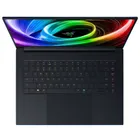
It's still one of the best-looking (and feeling) super-portable 16-inch gaming laptops you can buy
Asus has made a few tweaks to the keyboard, too. The deck has been reinforced to prevent flex, and the keycaps now have an anti-fingerprint coating, which feels rather grippy underneath my fingertips.
The hinge also uses two torsion springs to make it easier to lift, which is a nice touch. It's full of little bits of refinement, sprinkled on top of what was already an excellent design.

The 240 Hz OLED panel has also received some attention, as it now features a peak brightness rating of 1100 nits and VESA TrueBlack 1000 HDR certification. It's a sumptuous 1600p display, and a rival to the Blade 16's similarly-specced screen.
Overall, the G16 looks and feels near-identical to the old model when you pass it around in your hands. It's still got a large slash of tasteful LED lights on the lid, it's still one of the best-looking (and feeling) super-portable 16-inch gaming laptops you can buy, and this new version has received some tasty hardware upgrades. A strong start, I would say.
Asus ROG Zephyrus G16 performance

At 1080p, the new G16 puts on a good showing against the other RTX 5080-equipped, slim-as-you-like gaming machines in my charts—although the much chonkier Legion Pro 7i looms menacingly at the bottom.
Still, the fresh-faced Asus lappy is often significantly faster than the old model. This becomes obvious in our CPU-heavy Baldur's Gate 3 test, where the new Panther Lake chip beats the older Core Ultra 9 285 H quite handily.
1080p gaming performance
This chart shows average and 1% low frame rate results in various tested games at 1080p resolution
| Product | Value |
|---|---|
| Asus ROG Zephyrus G16 (2026) | RTX 5080 (135 W) | Core Ultra 9 386H | 52 Avg FPS, 39 1% Low FPS |
| Asus ROG Zephyrus G16 (2025) | RTX 5080 (120 W) | Core Ultra 9 285H | 50 Avg FPS, 44 1% Low FPS |
| MSI Stealth 16 AI+ | RTX 5080 (125 W) | Core Ultra 9 386H | 55 Avg FPS, 32 1% Low FPS |
| Razer Blade 16 (2026) | RTX 5090 (175 W) | Core Ultra 9 386H | 66 Avg FPS, 44 1% Low FPS |
| Lenovo Legion Pro 7i Gen 10 | RTX 5080 (175 W) | Core Ultra 9 275HX | 68 Avg FPS, 38 1% Low FPS |

It also scorches ahead in Black Myth Wukong, beating the new, similarly-specced MSI Stealth 16 AI+ by a massive 29 frames. In fact, it's only eight frames behind the new RTX 5090-equipped Razer Blade 16. Admittedly, the G16 still gets mopped up by the Razer in many of my other benches, but still. Small wins for the 135 W RTX 5080 mobile, and all that.
1600p gaming performance
This chart shows average and 1% low frame rate results in various tested games at 1600p resolution
| Product | Value |
|---|---|
| Asus ROG Zephyrus G16 (2026) | RTX 5080 (135 W) | Core Ultra 9 386H | 31 Avg FPS, 24 1% Low FPS |
| Asus ROG Zephyrus G16 (2025) | RTX 5080 (120 W) | Core Ultra 9 285H | 28 Avg FPS, 21 1% Low FPS |
| MSI Stealth 16 AI+ | RTX 5080 (125 W) | Core Ultra 9 386H | 34 Avg FPS, 22 1% Low FPS |
| Razer Blade 16 (2026) | RTX 5090 (175 W) | Core Ultra 9 386H | 39 Avg FPS, 30 1% Low FPS |
| Lenovo Legion Pro 7i Gen 10 | RTX 5080 (175 W) | Core Ultra 9 275HX | 40 Avg FPS, 28 1% Low FPS |
At 1600p, the 2025 G16 catches back up to its younger sibling in several of my tests. We're now out of CPU limited territory and into a zone where the GPUs can more freely compete, and as a result the mere 15 W difference between the two Asus machines means they track fairly closely. Apart from BG3, of course, which still takes all the CPU grunt you can throw at it.
The MSI Stealth, however, finds a sudden burst of speed in the Metro Exodus Enhanced Edition benchmark, jumping ahead of both G16s by a full six frames in the averages. It's still way off the pace in Black Myth, though, albeit slightly ahead in Cyberpunk 2077.
Small wins for the 135 W RTX 5080 mobile, and all that
And yes, it's time to talk about those two beasts lurking at the bottom. Our Razer Blade 16 sample might be an RTX 5090-equipped monster, but it's worth mentioning that it's available for the same cash as this particular spec at the time of writing. It's got the G16 firmly licked in three of my benchmarks, although pulls roughly level in the averages in BG3 and Black Myth.
And then there's the rocketship that is the Lenovo Legion Pro 7i Gen 10. It's not a slim model, and it's got pretty awful battery life, as we'll see in the charts later. But I've thrown it in as an example of what a much less portable, full-fat gaming laptop can do when pushed to the limit. Dare I point out it's significantly cheaper, too? Food for thought.
Real-world gaming performance
This chart shows average and 1% low frame rate results in various tested games at 1600p resolution with Quality upscaling enabled, and frame gen. where applicable
| Product | Value |
|---|---|
| Asus ROG Zephyrus G16 (2026) | RTX 5080 (135 W) | Core Ultra 9 386H | 95 Avg FPS, 79 1% Low FPS |
| Asus ROG Zephyrus G16 (2025) | RTX 5080 (120 W) | Core Ultra 9 285H | 85 Avg FPS, 48 1% Low FPS |
| MSI Stealth 16 AI+ | RTX 5080 (125 W) | Core Ultra 9 386H | 97 Avg FPS, 53 1% Low FPS |
| Razer Blade 16 (2026) | RTX 5090 (175 W) | Core Ultra 9 386H | 112 Avg FPS, 75 1% Low FPS |
| Lenovo Legion Pro 7i Gen 10 | RTX 5080 (175 W) | Core Ultra 9 275HX | 124 Avg FPS, 83 1% Low FPS |
Turn on the upscaling (and frame gen, in certain benches) and something rather interesting happens. The MSI Stealth 16 AI+, a lappy that's performed rather inconsistently across our gaming tests up until now, suddenly comes out on top versus the other lightweight RTX 5080 machines—at least when it comes to average frame rate.
It's not by a whole lot when compared to the new G16, and the MSI's 1% lows are often all over the place, but still. Not too shabby. And yes, the Blade 16 and the Lenovo rule the charts once more.
It's a lot of cash for these sorts of frame rates, even if the portability factor is off the charts
The Razer lappy stomps ahead by 15 frames on average in Cyberpunk, but the Lenovo goes another 12 frames further than that. It's a shame it's harder to shove one in your shoulder bag, isn't it?
Overall, it's a fairly impressive set of gaming results for the new G16. However, the price of this particular model keeps ringing in my ears. Yes, it's got 64 GB of RAM, and yes, the 32 GB version is $400 cheaper. But squaring these prices relative to the performance? It's a lot of cash for these sorts of frame rates, even if the portability factor is off the charts.
CPU performance
CPU performance figures taken from the Cinebench R24 single-core and multi-core benchmarks
Cinebench 2024
| Product | Value |
|---|---|
| Asus ROG Zephyrus G16 (2026) | RTX 5080 (135 W) | Core Ultra 9 386H | 1215 Multi-core index score, 124 Single-core index score |
| Asus ROG Zephyrus G16 (2025) | RTX 5080 (120 W) | Core Ultra 9 285H | 1171 Multi-core index score, 125 Single-core index score |
| MSI Stealth 16 AI+ | RTX 5080 (125 W) | Core Ultra 9 386H | 1221 Multi-core index score, 124 Single-core index score |
| Razer Blade 16 (2026) | RTX 5090 (175 W) | Core Ultra 9 386H | 1200 Multi-core index score, 124 Single-core index score |
| Lenovo Legion Pro 7i Gen 10 | RTX 5080 (175 W) | Core Ultra 9 275HX | 2039 Multi-core index score, 138 Single-core index score |
Hey, look at all those near-as-makes-no-difference Cinebench figures. All the Core Ultra 386H chips perform almost identically here, although the elder Core Ultra 9 285H in last year's G16 creeps ahead by a single point in the single-core scores, and drops slightly behind in the multi-core index figures.
Cinebench R24 can be a little twitchy, so I reckon if I ran all our Panther Lake machines through these benchmarks hundreds of times, you'd see them trade places by small amounts. One thing I would bet on, though, is that the 24-core Arrow Lake chip found in the Legion Pro 7i would beat them all no matter what.
Again, what we're seeing here is the difference between a chonky gaming laptop, and an ultra-portable machine. Larger chassis designs mean better airflow, and that means more thermal capacity for fire-breathing, ultra-fast components.
Asus ROG Zephyrus G16 thermals

One of my major issues with the 2025 version of the Asus G16 is the fan noise. That might sound slightly odd, as all gaming laptops can make a racket when pushed to their limits; however, the old G16 liked to spin up its fans at a moment's notice. Then spin them down again. Then back up. Then… you get the idea.
There was also a high-pitched, whiney note that sang out over the top of all the whooshing air, which proved rather irritating over a full working day. Thankfully, the 2026 G16 has no such issues, which makes it much more civilised to live with. It still sounds like a hairdryer in Turbo mode, but again, pretty much all gaming laptops do.
Real-world gaming temperatures
Gaming temperature results recorded during multiple Metro Exodus EE runs
Gaming temperatures
| Product | Value |
|---|---|
| Asus ROG Zephyrus G16 (2026) | RTX 5080 (135 W) | Core Ultra 9 386H | 72 Avg CPU (°C), 98 Max CPU (°C), 69 Avg GPU (°C), 77 Max GPU (°C) |
| Asus ROG Zephyrus G16 (2025) | RTX 5080 (120 W) | Core Ultra 9 285H | 74 Avg CPU (°C), 81 Max CPU (°C), 68 Avg GPU (°C), 72 Max GPU (°C) |
| MSI Stealth 16 AI+ | RTX 5080 (125 W) | Core Ultra 9 386H | 92 Avg CPU (°C), 100 Max CPU (°C), 81 Avg GPU (°C), 87 Max GPU (°C) |
| Razer Blade 16 (2026) | RTX 5090 (175 W) | Core Ultra 9 386H | 82 Avg CPU (°C), 98 Max CPU (°C), 62 Avg GPU (°C), 77 Max GPU (°C) |
| Lenovo Legion Pro 7i Gen 10 | RTX 5080 (175 W) | Core Ultra 9 275HX | 94 Avg CPU (°C), 105 Max CPU (°C), 74 Avg GPU (°C), 79 Max GPU (°C) |
Not only is the G16 much quieter during day-to-day usage, but it's pretty good at keeping its GPU cool during gaming. The Core Ultra 9 386H, however, likes to run fairly hot when given the opportunity, as you can see across all our Panther Lake-chipped laptops.
You can also start to see where the Lenovo Legion Pro 7i gets its extra performance from. Its CPU is beefier, and occasionally jumps well over the 100 degree mark—while its 175 W RTX 5080 also likes to suck down power and turn it into heat, as well as frames.
Asus ROG Zephyrus G16 battery life

The new G16 manages an impressive 117 minute gaming battery life figure, sending it to the top of my chart. It's only five minutes more than the older model, but I'd still say that's a pretty good win. It's also relatively light on the battery during a regular working day, which means I haven't felt the need to lug the charger around as often as I would with other gaming laptops.
Gaming battery life
Results recorded in the PCMark 10 gaming battery life test, with screen brightness set to 50% and Wi-Fi disabled
PCMark 10 gaming battery life test (minutes)
| Product | Value |
|---|---|
| Asus ROG Zephyrus G16 (2026) | RTX 5080 (135 W) | Core Ultra 9 386H | 117 |
| Asus ROG Zephyrus G16 (2025) | RTX 5080 (120 W) | Core Ultra 9 285H | 112 |
| MSI Stealth 16 AI+ | RTX 5080 (125 W) | Core Ultra 9 386H | 104 |
| Razer Blade 16 (2026) | RTX 5090 (175 W) | Core Ultra 9 386H | 102 |
| Lenovo Legion Pro 7i Gen 10 | RTX 5080 (175 W) | Core Ultra 9 275HX | 73 |
That 117 minute result equates to 13 minutes more than the MSI Stealth 16 AI+, 15 minutes more than the Razer, and a massive 44 minutes longer than the Lenovo.
Again I'm reminded of why you might want to sacrifice gaming performance for portability, beyond the convenience of shoving a slimmer machine in your bag. The Legion Pro 7i Gen 10 may be a lot quicker, but it's got a lot of disadvantages over the Asus G16, too.
Asus ROG Zephyrus G16 aesthetics

The aluminium G16 has always been one of my favourite laptop designs, and little has changed with the 2026 model. This version's silver-y frame (Eclipse Gray, if you ask Asus) is tastefully neutral to behold, looking more like an executive business laptop than a gaming machine.
Which means it'll look as good in the boardroom as it does on your desk. Many modern gaming laptops overplay their hand when it comes to the gamer aesthetic, which can leave you feeling like a bit of a plum when you want to answer some emails in an airport departure lounge.
No such worries here. The only hint that the G16 might be a gaming model comes in the form of the font on the keyboard, which still looks like it'd be better suited to a Star Citizen control panel than an all-business laptop design. I doubt anyone will really notice, though.

All this being said, if I had to pick the best looking laptop of the current crop (and the one with the better keyboard, thanks to its longer, more positive switch travel) it'd be the Razer Blade 16.
The Asus is a very pretty gaming laptop, but the Blade 16 is just plain purposeful. Moody, even. And as a tempestuous so-and-so myself, I like that. Plus, the Razer's trackpad is a little nicer to use, even if the G16's is also rather good.
The G16's 240 Hz ROG Nebula OLED panel, though, is a genuine competitor with the Blade's similarly-specced model. It's lush, vibrant, and delivers pretty much everything you could want out of a gaming laptop display. Sitting the two side by side, it's quite difficult to tell which has the better screen of the two.
Perhaps the Blade, if I was really pushed. Still, the G16 has nothing to be ashamed of in the display department.
Asus ROG Zephyrus G16 software

The Asus Armoury Crate software package isn't the most straightforward of affairs, I have to admit. Still, the switching options between power modes are easy to find, and a click on an image depicting the laptop itself (which isn't as obvious as it sounds) leads to plenty of extra options for customising the lighting, process handling, keybinds, and more.
The home page shows real time info for the CPU, GPU, and memory, along with readouts for the fan speeds. There's also a "Playground" menu in the sidebar that allows you to sync the lighting between various Asus products, adjust wallpapers, and all that sort of jazz.
If I had a major critique of the software (and Armoury Crate is far from alone in this regard), it's that it feels very… bitty. All the info and customisation options you can think of are in here. Somewhere. If you look hard enough.
A straightforward selection of menus, rather than a host of buttons, toggles, and sliders scattered all over the shop, would make the whole thing gel together a little more seamlessly.

There's also a greyed-out "Manual" power option, which is adjusted via a separate menu. Here you can tweak the CPU and GPU clock speeds, along with the option to boost the TGP of the latter all the way up to a 160 W top limit. The Asus reviewer's guide recommends you do this with the fan speeds pegged at 100%— which, as you might expect, is very loud.
Armoury Crate also provides you with a warning screen as you confirm the settings, absolving Asus from any responsibility if things go wrong. Which is enough to make you cross your fingers when you're testing the limits of a $4,800 gaming laptop, let me tell you.

We don't normally test overclocked gaming laptops beyond the Turbo or standard Maximum presets, but I put in my earplugs and ran the Cyberpunk 2077 benchmark regardless.
At top wattage settings (and at 1600p with DLSS Quality and 2x frame gen. enabled) this resulted in a 99 fps average, with 83 fps 1% lows. Essentially, a four fps gain in terms of average frames over the 135 W Turbo mode.
I also recorded an 84 degree peak from the GPU during the benchmark, which seems a little on the hot side to me. The marginal gains, plus the very loud fans and toastier peak GPU temps, don't endear me to the whole idea of messing with the GPU wattage in a machine this slim. It's a nice option to have, but I'd stick to the presets if I were you.
Asus ROG Zephyrus G16 value

And so we reach a crucial point. The concept of "value" and the term "gaming laptop" are two very difficult things to square in 2026, and the Asus ROG Zephyrus G16 2026 is a prime example of why. It's a lovely machine, and one I wish I didn't have to mark down over such trifling concerns as, y'know, money.
But the facts are simple. My review sample is $4,800, and that's far too much to pay for an RTX 5080 lappy. Even if it does come with 64 GB of RAM, for reasons that still elude me.
Luckily, the 32 GB version is a fair bit cheaper. I've found one for $4,400 at Best Buy, although it's still got a somewhat-miserly 1 TB SSD. For this sort of cash, I'd definitely be wanting more room for my games—and I'd want it included as part of the package, rather than having to make a pricey component upgrade for myself.

Here's another issue. The Razer Blade 16 2026, a laptop that, in my estimation, is even more desirable than the G16, is available in a RTX 5080 + 1 TB SSD config for $4,000. That's a $400 saving over the equivalent G16, and far from chump change. Plus it's got the same Intel chip, another excellent OLED panel, and a chassis, keyboard, and trackpad design that's got the G16 2026 beat. Even if it's just by a nose.
In previous years, both the Asus ROG Zephyrus G16 and the smaller, 14-inch G14 have been recurring entries on our gaming laptop deals page. I know, because I'm the one that updates it. Often, RTX 5070 and RTX 5080 variants have dropped down well below the $2,000 mark, and that's made them fantastic value for what you end up receiving.
If you can find one with a healthy discount? Go for it.
This time around, though, I've got a feeling it might be different. The memory crisis continues to rip its way through the gaming laptop market, and I don't think we're likely to see such heavy price reductions on these new 2026 models.
Unless they stop selling entirely, or you're prepared to wait for the Black Friday sales. It's a hard thing to judge, but I don't think I've got that small crumb of comfort to lean on—at least not in the same way I might have done previously.
All of which is to say, I think the G16 is a fantastic high-end gaming device, with a gorgeous OLED display and plenty to recommend it for. But it's hugely over-priced as things stand, and that's a fatal flaw hanging over the head of what is otherwise a highly-recommendable gaming laptop.
If you can find one with a healthy discount? Go for it. At full price, though? I'd urge you to check out the Razer lineup instead. Your money goes further, and the machine you'll end up with… well, it simply has the edge.
1. Best overall:
Razer Blade 16 (2025)
2. Best budget:
Lenovo LOQ 15 Gen 10
3. Best 14-inch:
Razer Blade 14 (2025)
4. Best mid-range:
MSI Vector 16 HX AI
5. Best high-performance:
Lenovo Legion Pro 7i Gen 10
6. Best 18-inch:
Alienware 18 Area-51
Oh, how I'd love to give the 2026 G16 a higher score. It really is a fantastic machine, and very difficult not to like. But at its current price, it simply doesn't make a whole lot of sense. When the already-price-inflated Razer Blade 16 is hundreds of dollars cheaper in virtually the same spec, the little Asus becomes difficult to argue for—although perhaps future discounts might bring it back into contention.