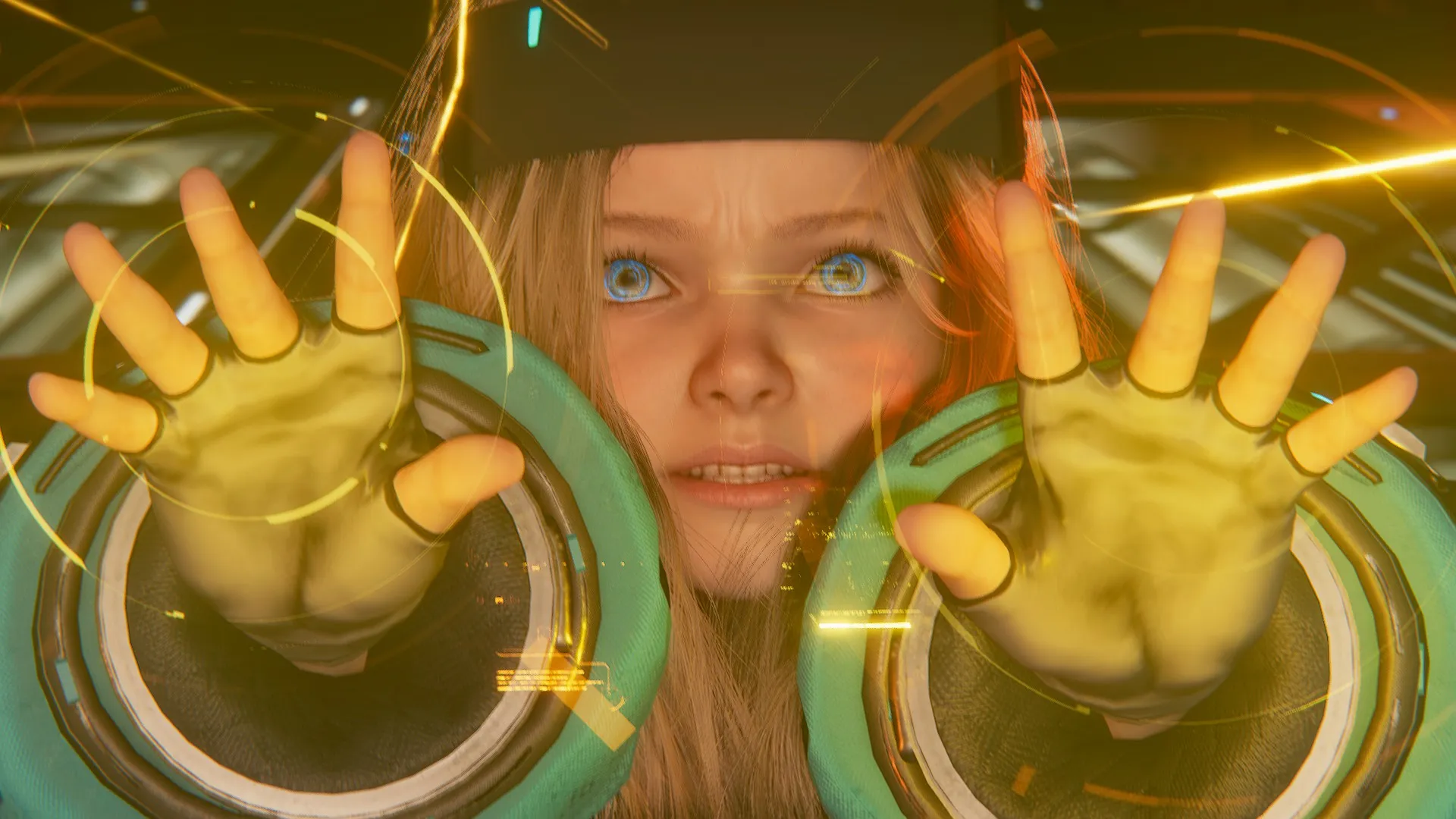
Like all of Capcom's modern action games, Pragmata is a highly polished experience befitting the legendary developer's reputation: There are hours of motion-captured performances to enjoy, detailed ray (even path) traced environments to admire, and enormous things to blow up in a variety of spectacular ways. There's also a generous selection of post-credits modes to play and extras to unlock—exactly the sort of thing anyone would hope to find in a shiny new game that clocks in around a dozen hours.
But there's a "secret" side to Capcom games that often goes underappreciated, one that I've been powerless to resist since the original Resident Evil: Speedrunning.
When I'm speedrunning a Capcom game I politely put all of that business about plot and lore-soaked emails to the side and treat a new release like one of their old arcade hits, something to replay and practice until I can tear through it at the speed of light. While there may not be a formal 'time attack' mode to select in Pragmata, this is more than some self-imposed entertainment for nerds. The games themselves quietly support this behaviour, so long as you know what to look out for.
The clear time listed on a completed save file.
The occasional "Would you like to skip the playable intro and get straight to the real game?" messages on later runs.
The freedom to skip those expensively made cutscenes entirely, ensuring I get back to the action as quickly as possible.

Everything that appears on my monitor is something I can learn from: Pragmata's deliberately artificial sci-fi setting makes it easy for a UI full of time-saving information to feel natural and welcome. Status effects are clearly labelled and displayed, scanned weak points are marked with targeting reticles, pixel-accurate AoE markers allow me to dodge and weave through a particle shower of deadly attacks. My entire arsenal is conveniently divided into clearly defined, colour-coded roles. The tools needed to lock into a flow state and blast through the game are all there—I just have to want to try.
But why bother when all of this self-inflicted stress doesn't actually "count" for anything, not even so much as an achievement?
The short answer is "Because it's fun." The longer answer is "Because playing in this way changes Pragmata so much it feels brand new again."
Although the end result is a faster finish time (if I'm lucky), speedrunning isn't about superficially skimming through a great game and choosing to miss all the best bits; when I'm speedrunning I'm engaging with the game so deeply I'm using dashes to cancel lengthy recovery animations, refusing to heal until I absolutely have to because (as in Monster Hunter) it's a slow, vulnerable act, and generally getting myself into lots of otherwise avoidable trouble that, again, is fun. It changes the entire tempo of the game, and introduces new challenges in what would otherwise be safe and straightforward places.

When I'm speedrunning I rush towards a robot the size of a house and try to dodge every close-range attack it throws at me instead of tactically picking it off from a safe distance. I allow a dangerous enemy to give chase as I boost towards my current objective, rather than carefully disabling it before moving on. A swarm of missiles approach my position and I calmly hack them while they're en route to my face, sending them back to whatever fired them for free additional damage instead of merely shooting them out of the air.
With practice, towering robots that used to stomp me into a fine paste are quickly prioritised and then left so confused they attack their allies, making it easy to walk up to them and unload exactly the right kind of weapon on weak points I no longer even have to think to look for.
This is a game I *want* to clear twice in a day
Much like Capcom's Devil May Cry, it's not the upgrades to my guns or the extensions to my health bar in Pragmata that make the biggest difference when I'm replaying an old level. It's how I'm using everything I've always had in more skilful ways, learning to anticipate enemy behaviour and how they interact with their environment. I'll move through the game faster if I remember which enemy groups I can completely ignore, which weapon I should hang on to for an upcoming fight, and the best way to tackle a room full of laser beams—and I can prove this is more than hollow theory by attempting to speedrun the unlockable "Lunatic" mode.
This difficulty makes enemies hit incredibly hard and also forces me to reacquire all upgrades from scratch, every run initially as fresh and weak as my first. The inescapable difficulty, coupled with a speedrunner's mindset, leave me with little choice but to play smart and try to find some life-saving synergy in the options available.

When's the best time to use a gun that increases the presence of helpful hacking nodes? How can I work a particular position-activated mod into my usual combat routine?
Do I want to knock enemies down, temporarily stun-lock them in place, or should I focus on triggering the overheat state instead, leaving robots on their knees and open for a powerful special attack?
I managed to shave a little over two hours off my initial 6 hour, 18 minute clear time on my second Standard difficulty run thanks to these questions and some practice, and after that I tried on Casual and got it down to about 2hr30m. That means I'm already dashing through Pragmata fast enough to comfortably clear it twice in one working day, long lunch breaks included.
That sounds like a terrible thing to say about a brand new release, doesn't it? But here's the thing: This is a game I want to clear twice in a day, even now, even though I already know how it plays from beginning to end to unlockable bonus stages. Repeat runs are more exciting, not less, because I'm constantly getting myself into scrapes I didn't before, and I'm thrilled when things go wrong because it's an explosion-filled chance to prove I have the skills to get myself out of this unplanned mess. There's always some new trick to learn, some way I can refine my run—and that means there's always plenty to look forward to, both in Pragmata and almost certainly in whatever under the radar speedrunning challenge Capcom decides to create next.