All Will Rise is the only deck-builder I know of that can run on vibes alone.
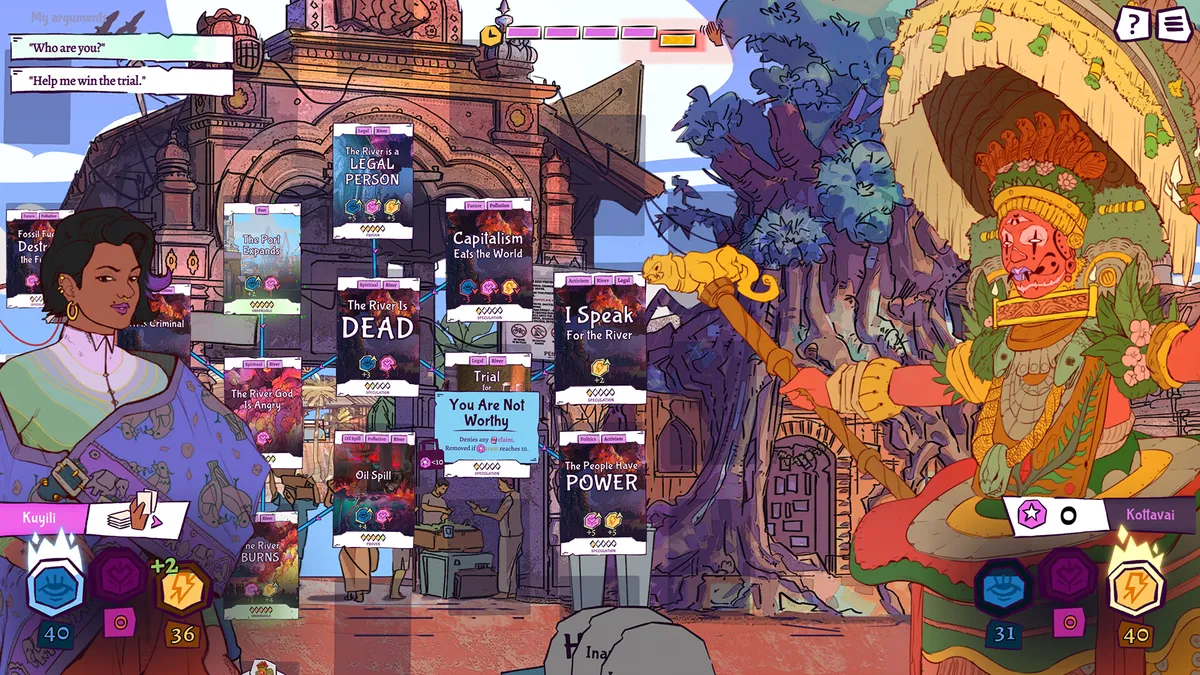
It has complex rules—so many that it can feel overwhelming—but during its three-hour demo I simply played whichever card felt right. I pointed out an Oil Spill then Spoke For The River, asserted my Right To Sue, argued that the Media Is Biased (naturally), cleared my Crystalline Mind to make my cards more powerful, and ended up dancing with a god on hot coals as a frenzied crowd swayed as one.
It's interactive fiction at heart. Half the game is card "battles" spiked with reactive dialogue, the other is choice-based conversations set to lavish illustrations. It's written by Meghna Jayanth, of 80 Days, Sable and Thirsty Suitors, whose direct, lyrical style—"Oil-slicked birds and pearl-spot fish swing amongst the horrified crows, mangrove trees wrench their roots up to escape the flames"—splatters every screen.
It flickers with rage. Your ultimate goal is to build a strong enough deck to put an exec on trial for murdering a river, but alongside ecocide it confronts corporate greed, inequality, poverty, and corruption, sometimes all at once. It reflects the views and the real-world anger of its creators at "powerful people behaving with absolute ugliness and impunity", says Jayanth, who is narrative director on the project.
"The rage is the fuel in a way," says design director Hugo Bille, of Fe, Ultros, and Stick it to the Man. "And it's inescapable, and we expect a lot of our audience to feel it already. The game is not there to boost that, but more to address it, or to play with it."
It's also deliberately silly. It pokes fun at itself, at the left, at the climate activists and lawyers it venerates.
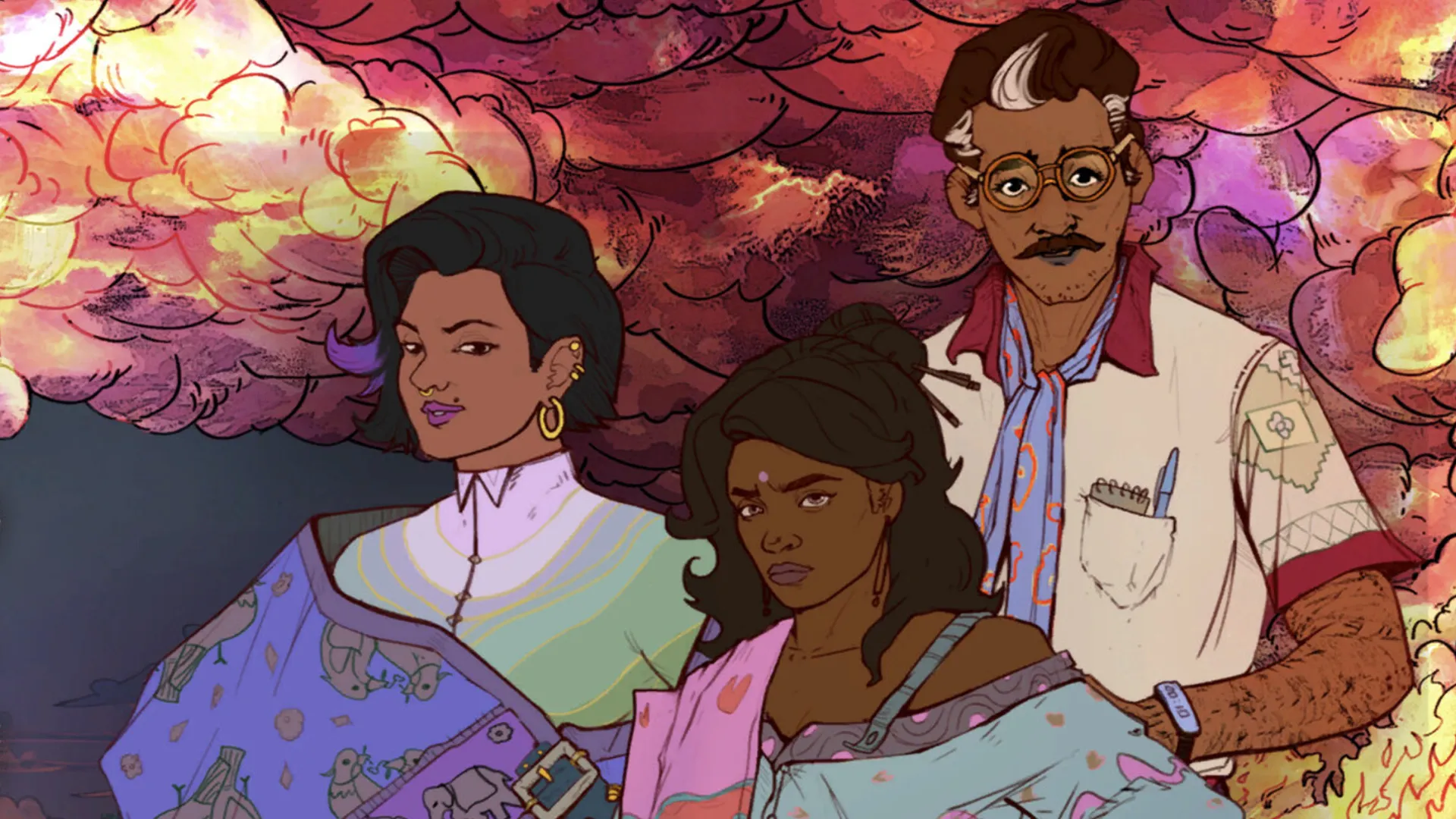
Between battles and missions that reward you with new cards, your group of three Indian volunteers banter and self-deprecate the absurdity of their "non-hierarchical workplace based on mutual co-operation and affinity". An NPC you meet tells you that "normal people don't find suing others very interesting", and one of the characters must periodically visit dad or face a guilt trip.
It's about finding joy and humour in the horror and corruption, Jayanth says. "Making something that is leftist, that is progressive in this way, you can just get put into the woke, liberal bucket. We really want to make sure that no, we're doing something a bit more interesting here."
And those battles are unlike anything else I've played before.
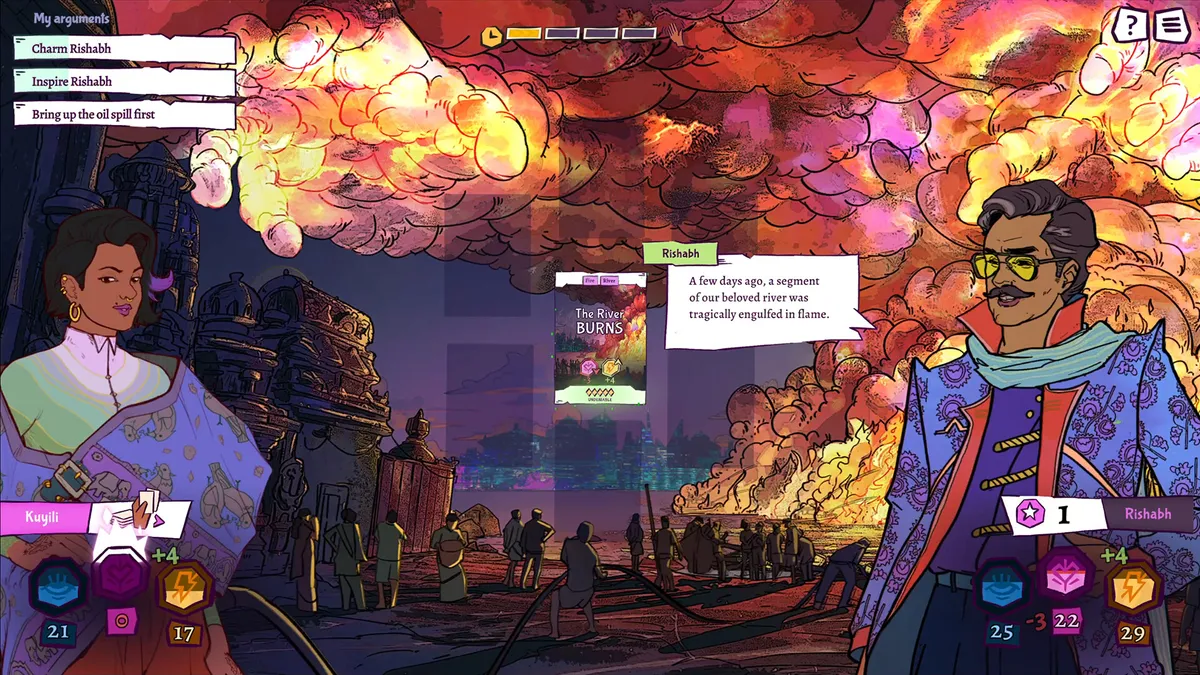
The full game is expected later this year, but the Steam demo starts you in court, convincing a judge that a river should be treated like a person. Soon that river is dying and on fire, and you plot your murder case.
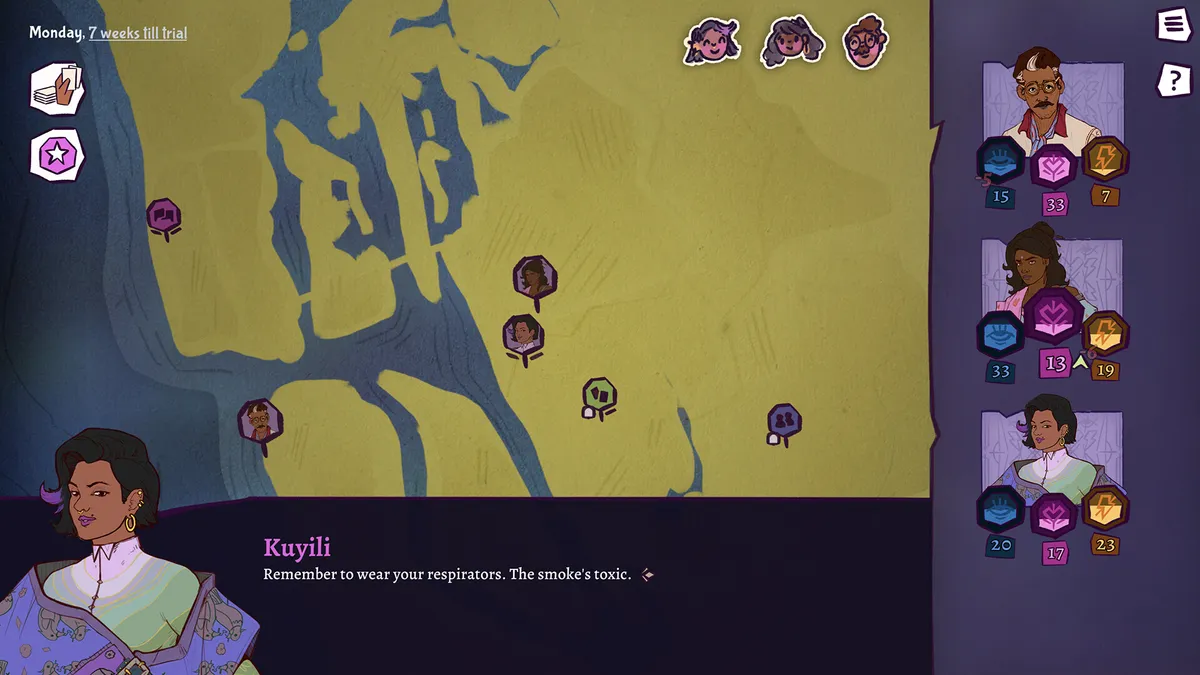
Each day you assign your volunteers to tasks throughout the Keralan city of Muziris, named after a real-world ancient port—you might cultivate a source in the local government, help locals clear up after an oil spill, or put on a play with local children. These tasks net you cards that Kuyili, a lawyer and the main character, can deploy during card battles.
And those battles are unlike anything else I've played before.
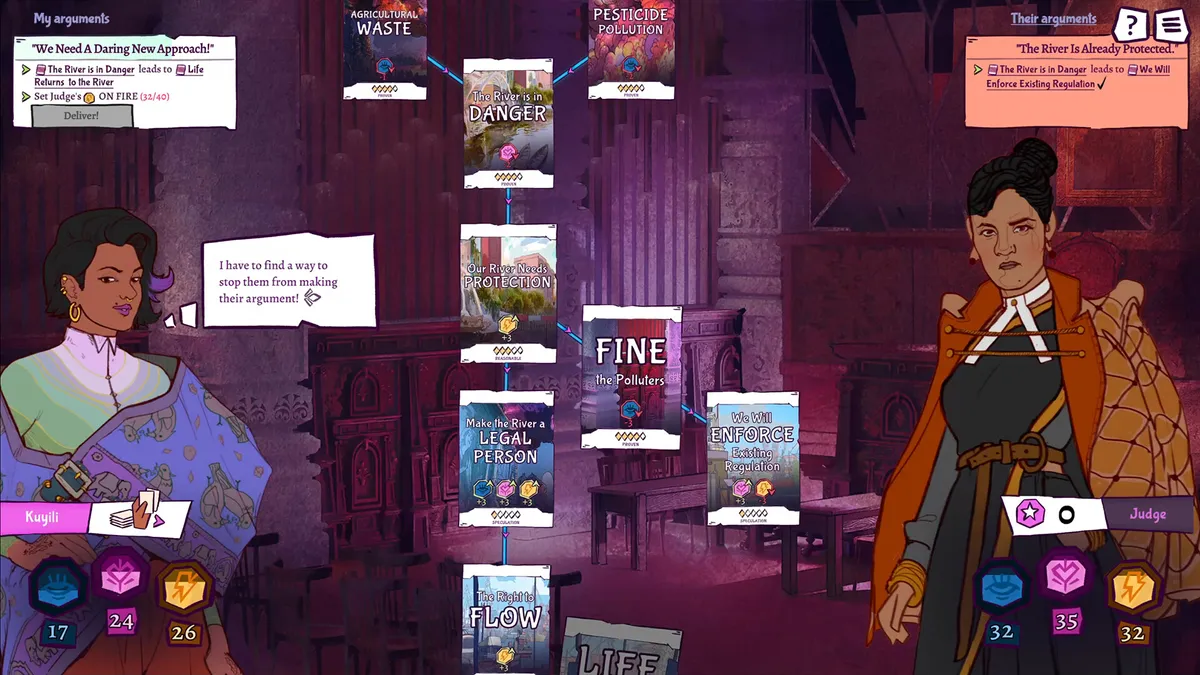
You share the board with your opponent—although that's a misnomer. Encounters can be combative, such as when you face the exec you intend to put on trial, but you're also playing with potential allies and friends. Together, you place cards to create a backwater of arguments, each claim flowing into the next.
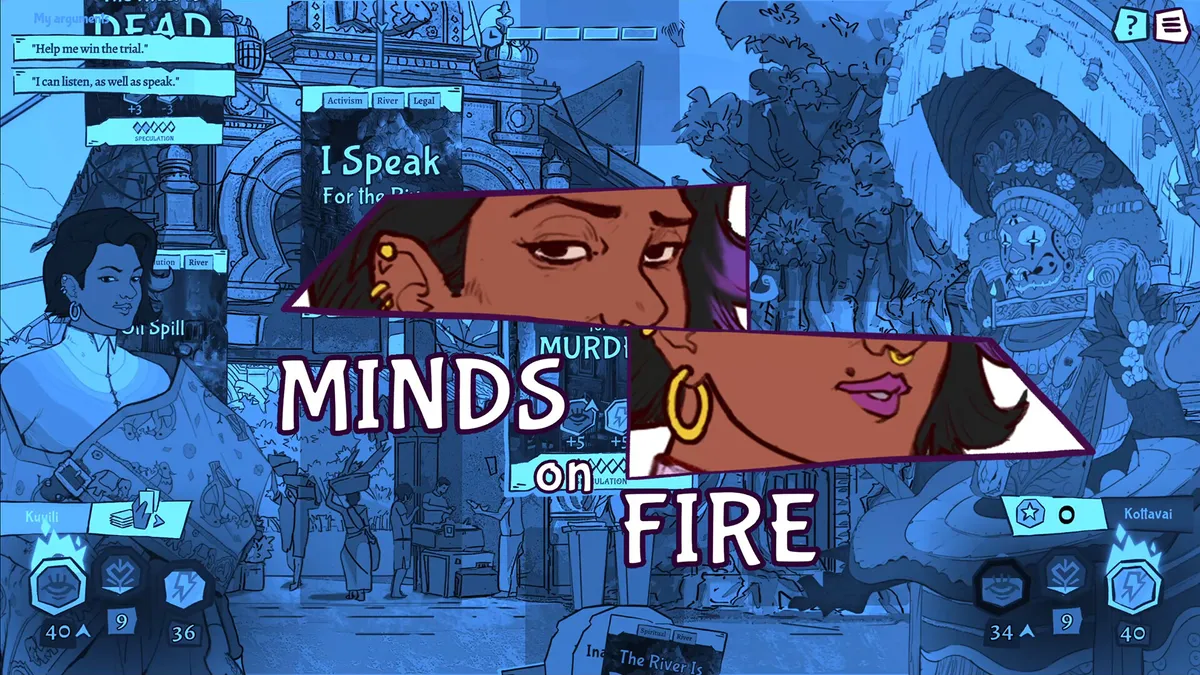
"We break a couple of taboos in card games," says Bille. "You can only play cards next to other cards that make sense narratively, and those links are not printed on the cards in any way. It's in large part an intuitive thing, which is in a way anathema to the sort of extreme transparency that the card genre expects. But since we're also doing a narrative game, I think it meshes a lot better."
We break a couple of taboos in card games.
Hugo Bille, design director
"The thing we really wanted to preserve," Jayanth says, "was that sense of back and forth conversation, and that you're building a shared narrative together."
My battle with Kottavai, a ritually-painted folk performer possessed by the river god, shows how loudly it can sing. Kottavai is mystical and unpredictable, dancing with abandon and unfocused eyes; we agree then argue, egging each other on before denying each other's key points. She laughs then ridicules me, declaring that strategic violence is the right path. I limp away having failed to gain her backing.
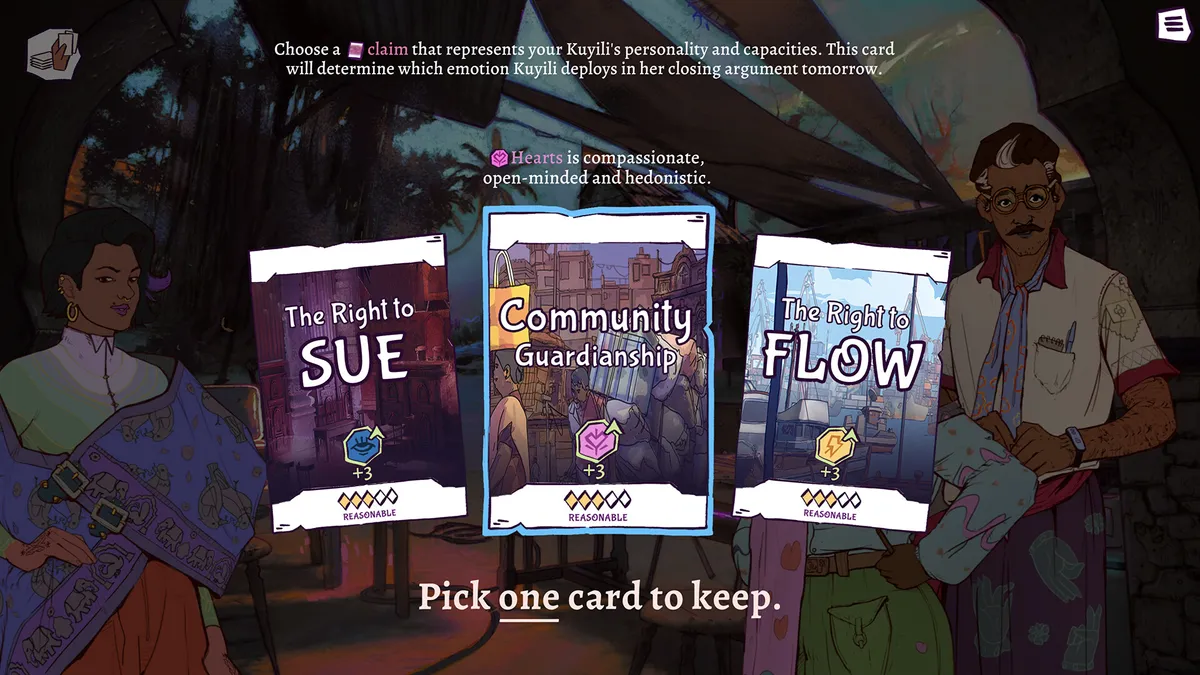
As well as forming narratives that might help your overarching goal, each card adds or subtracts from the three emotional energies of both you and your opponent: guts, hearts and minds. Drain one and you enter a "crisis", fill one and you go "on fire", and both states grant access to new cards. They can also change the story. For example, Jayanth says that if you can light the conspiracy-filled fisherman Shabeer's guts on fire he'll run for mayor, presumably with narrative implications.
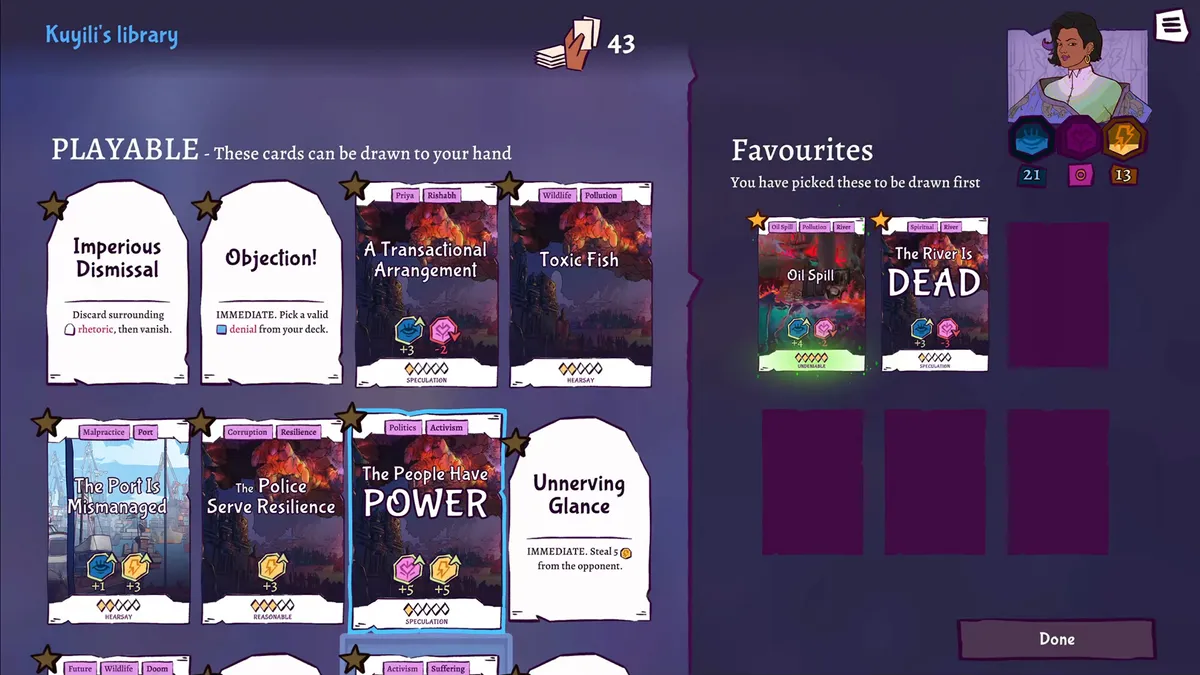
And the strength of your cards, or claims, can be upgraded as supporting evidence arises, taking them from mere speculation to proven fact.
It's already a lot to hold in your head before you consider that the success of your arguments, and even who will talk to you, depends on a trust mechanic. You can earn trust by completing missions and delivering specific arguments in battles—you can also boost trust with powerful and unique rhetoric cards that have a range of effects.
And if you need to, denial cards wipe an opponent's card off the board, reversing its effects.
When I tell Bille I felt a little overwhelmed playing it, he doesn't seem concerned. The final game will ease players in gentler, he says, but the complexity is necessary because of the constant overlapping of mechanics and narrative.
"It's kind of the bare minimum that we need to convey the story. It is complex and it definitely threatens to be daunting, especially to the more narrative-minded audience. So we're aiming for something kind of like Baldur's Gate 3, where there are a lot of complex systems, but you don't necessarily need to interact deeply with all of them," he says.
"If you play it on vibes, it's still kind of narratively interesting," Jayanth says. "You will accidentally make some arguments and move forward. But there's a lot of richness … the more strategic you are at the game, the more complex the game becomes and the more of the game you see. I think it works really well."
The systems start to click as I near the end of my demo and, sure enough, when it's over I immediately feel compelled to start another so that I can revisit Kottavai and win her over using tactics I've learned. The full game will last around eight hours, Bille says, but I can imagine its branching narrative and mechanical complexity will reward multiple runs.
I'm intrigued to learn where the story goes. Jayanth hints that you'll be able to charm, persuade, or suborn Rishabh, the exec on trial, or remain his nemesis throughout. From talking to the developers I can't foresee many clean, unambiguous endings: while the game's roots are firmly in climate activism—most of its development team have been activists in one form or another—it is not trying to prescribe a specific message, Bille says.
Instead its goal, he says, is to "instil a sense of, other futures are possible and there are pathways to them", and perhaps even convince players that they can make a difference in the real world.
"Climate is often thought of as a crisis of imagination: it's easier to imagine the end of the world than the end of capitalism," he says. "Games are so well positioned to address that and to help open up people's imaginations about other potential futures and worlds."
It feels like a lofty goal, but Jayanth agrees: "It can open people up to the idea that the world doesn't have to be as it is," she says. "And actually that's one of the early lines of the game: 'Reality is more malleable than you think.' Your actions can make an impact."
It can open people up to the idea that the world doesn't have to be as it is.
Meghna Jayanth, narrative director
She says that whenever she has dark days in the industry, she thinks about a player who told her that they were usually too shy to speak to strangers while on holiday, but that 80 Days inspired them to approach somebody in Istanbul and have a conversation.
"And that's a really small real-world change to take from the game. And it's not necessarily something that we prescribed for you, but it felt really beautiful," she says.
"It's the same here, we want to model a type of agency, or a way of looking at or being in the world more than anything else. The world is interesting and it's worth getting amongst it and trying to be in it."