Join The Club





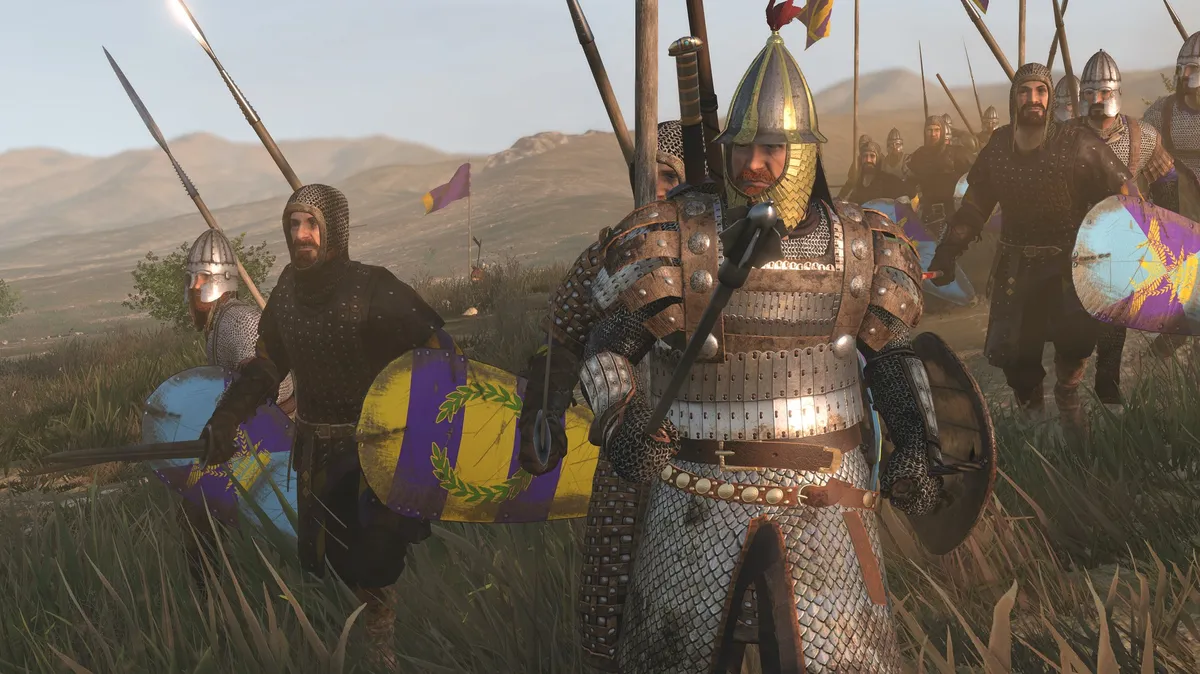
The Mount & Blade 2: Bannerlord team have revealed a physics-based combat system for the RPG that they say will take all the randomness out of cutting down your foes. While previous Mount and Blade games calculated damage using variables outside of the player's control, Bannerlord will physically simulate all of a weapon's characteristics—length, mass, weight distribution, swing speed and direction—and spit out a damage figure.
Players control these variables through the new crafting system. Weapons will be made up of component parts: a sword consists of a blade, a guard, a grip and a pommel, for example. Each element may grant special bonuses outside of the game's physics (such as a large guard increasing hand armour), but they will all have physical characteristics that will provide inputs for the game's combat simulation.
The mass of a weapon will affect its thrust attacks. Light weapons are faster but have less energy and therefore cause less damage, the team said. A heavy weapon will deal more damage but if it's too heavy it will "make contact with your opponent before it could reach its full speed, making it feeble and ineffective". So, it's a balancing act.


The calculations for weapon swings are even more complex. "Swing speed is affected not only by weight but also by the distribution of weight around the pivot point of the swing. Increasing the weight may increase the damage (within certain boundaries), but, it will also increase the inertia, meaning that more energy would be required to achieve sufficient speed on impact.
"Thus, these weapons will typically be slower and increasing the weight will only positively affect damage up to a certain point." Got that?
There's also a chance (although it's not stated explicitly) that player stance and direction of travel will feed into the mysterious combat equation. The game simulates a player's body as three 'motors' driving the weapon: one for legs and hips, one for the chest and shoulder, and one for the arm and wrist. Again, it's not made clear exactly how that impacts weapon damage, if at all.
Basically, it's shaping up to be a much more realistic combat simulation than previous Mount and Blade games. You can read about the plans in even more detail on this blog post.
The team doesn't actually say what the precise formula for damage is, which is presumably why the blog is only 'part one' of a discussion on weapons physics. I'll keep my eyes peeled for any follow ups.
Mount & Blade 2: Bannerlord's release date is yet to be revealed.