

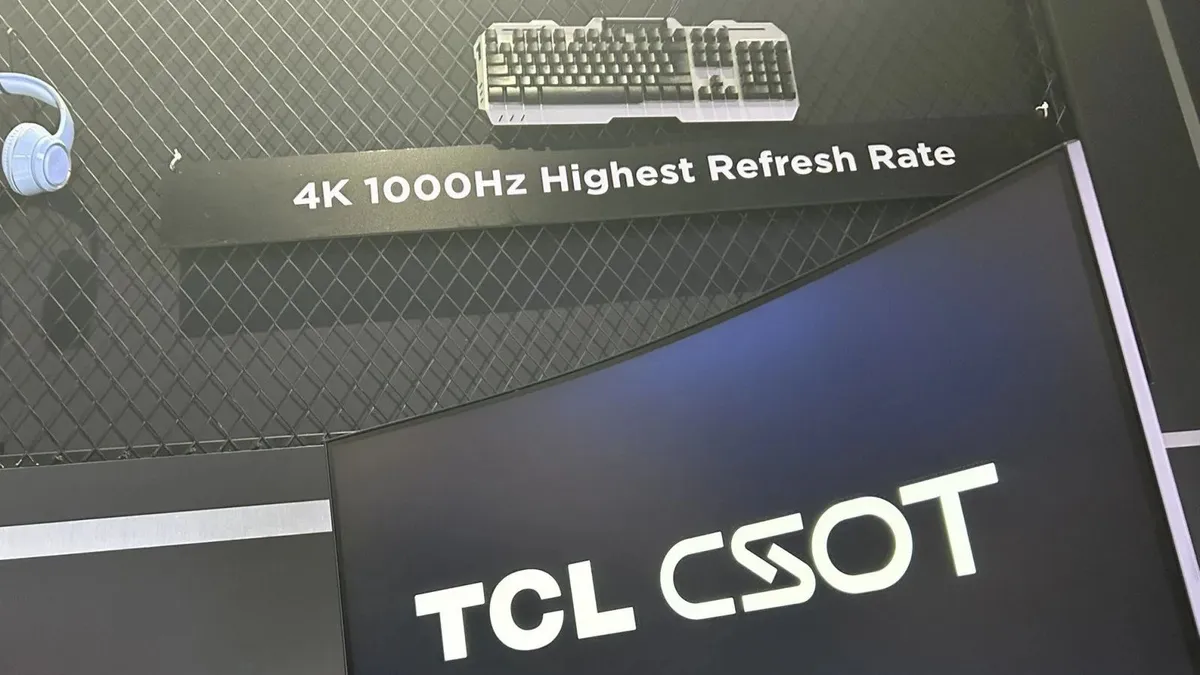
I've had my eye on TCL CSOT—CSOT being a TCL subsidiary responsible for OLED production—for a while now. It might just be the company that brings OLED monitor prices down thanks to its use of the inkjet-printing (IJP) process in manufacturing. TCL CSOT had already said it was moving in equipment for IJP manufacturing and expected production in the fourth quarter of 2027, but the company is now showing off some pretty impressive panels made using the process.
According to Display Specifications (via TechPowerUp), at the Display Tech-Ecosystem Conference 2026 (DTC2026), TCL CSOT showed off a 27-inch, 1440p, 500 Hz gaming monitor made using IJP tech. Apparently, the company describes this monitor as having the "world's first high-refresh-rate in-panel compensation system."
You already knew what that was, right? No, me either. According to Display Specification's understanding of the announcement, it's tech that "continuously adjusts image performance in the background without requiring periodic compensation cycles while the display is powered off."
OLED pixels can degrade at different rates, which is what causes pixel burn-in. The usual method for solving this is to run compensation cycles while the display is off, which takes a few minutes and boosts underperforming pixels up a bit back to where they should be.
It sounds like TCL's new tech will somehow allow this to happen without turning the monitor off, and will just happen as it's being used. Which might compensate for pixel burn-in without as much hassle. Just bear in mind that the word here is "compensation", not "prevention", as it's technically not stopping the burn-in, just, well, compensating for it.
The company also reportedly showed off an ultra-thin 14-inch notebook display prototype using an IJP OLED. I'm not sure how much IJP specifically contributes to the ultra-thinness.
IJP involves printing OLED materials directly onto a substrate rather than having evaporated materials go through a mask. The main benefit is that there's less material wastage, which should, in theory, mean cheaper production and hopefully cheaper costs for the OLED displays made using it. I certainly wouldn't turn my nose up at a 500 Hz OLED that's made much cheaper than it otherwise would be. Roll on 2027, I say.
1. Best overall:
MSI MPG 321URX QD-OLED
2. Best 1440p:
MSI MPG 271QRX
3. Best ultrawide:
Gigabyte MO34WQC2
4. Best budget ultrawide:
Alienware 34 QD-OLED AW3423DWF
5. Best WOLED:
LG UltraGear 32GS95UE
6. Best 27-inch:
Alienware 27 AW2725Q