

In a GDC interview with Freehold Games in 2025, I asked the developers of magnificently mutated, indulgently arcane science-fantasy roguelike Caves of Qud the same thing anyone would in my situation: What's the ideal number of limbs for a being to aspire to? Their answer was none, because "a perfect sphere is the ideal form" and "we started in perfection and only moved farther from God."
As you can imagine, I was eager to speak with co-creators Brian Bucklew and Jason Grinblat earlier this month about Diaspora, the roguelike's upcoming first expansion. Diaspora aims to add an "influx of riotous life" to Qud, expanding its body plan-agnostic mutation system with playable animal and plant characters. With Qud's mutagenic possibility space about to erupt even further, I posed its developers another pressing question: Is it a greater moral tragedy for a sin to be committed by a man who mutated into a tree, or by a tree who mutated into a man?
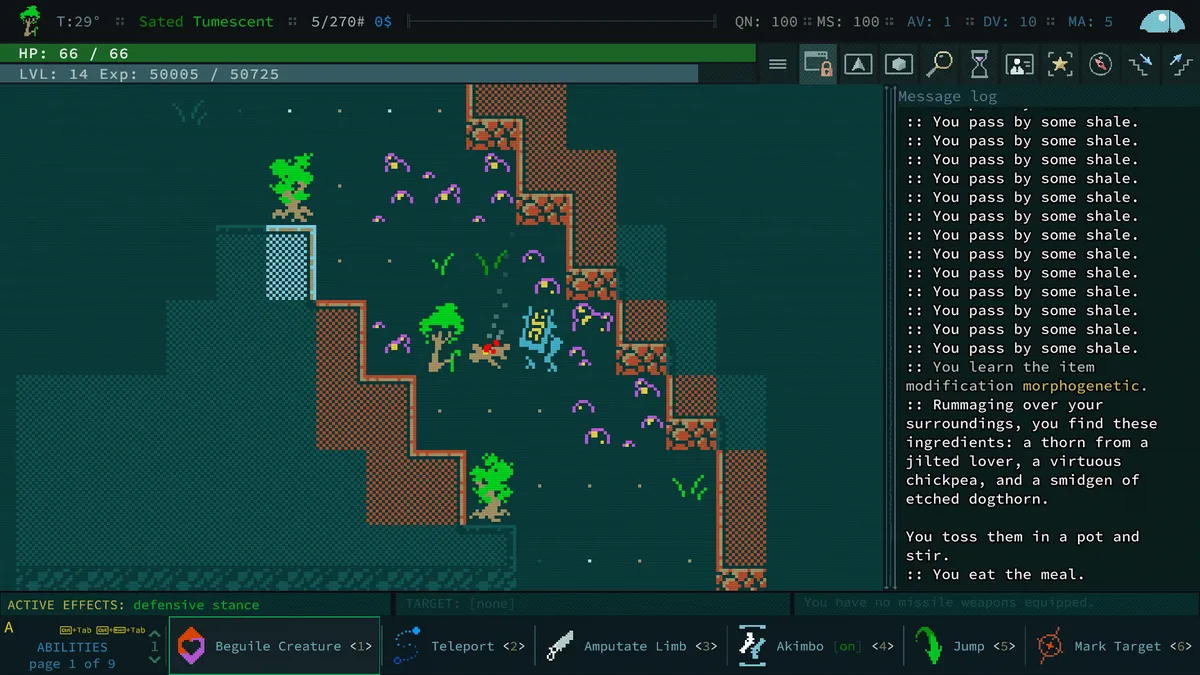
"We have text on this in-game," Grinblat said, citing Aphorisms About Birds—an in-game book which notes that our fairy tales pay plenty of attention to the man who's turned into a bird, but little to the cruelty fate's inflicted on the bird who's turned into a man. "I think that's probably even more true if you're a tree. There's one tree mayor in the game. He's pretty happy. He's been around for a while. If he were a guy just walking around out there, getting acid gas shot at him, I think he'd be pretty upset."
"It hits too close to home, right? We're having trouble in our world dealing with things transforming into the facsimile of man," Bucklew said. "It's hard for me to think about turning into the facsimile of man without becoming sad about the way the world is and how real that question's going to be in our lives for the next 20 years."
Conversely, Grinblat noted, "becoming a tree sounds really nice." To that, Bucklew agreed, wondering whether "there's some way we can get into that business," possibly through marketing "some random peptide."
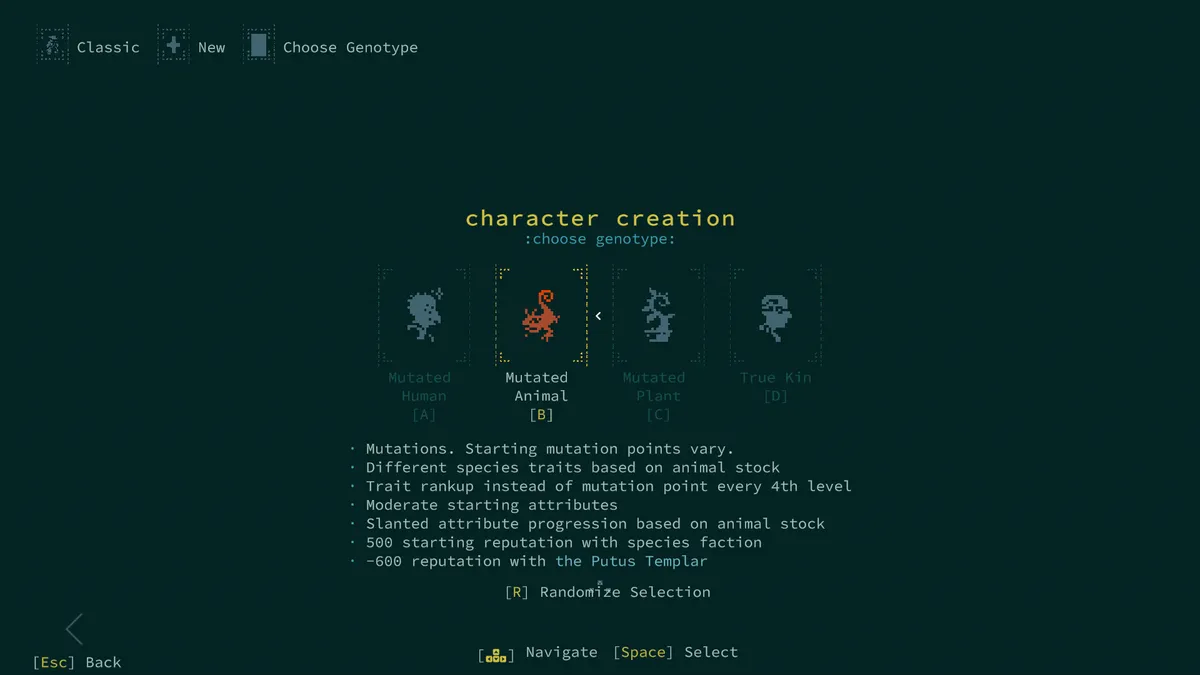
With an air of existential horror comfortably established, we moved into a more mechanical discussion of Diaspora's new plant and animal playstyles. In Caves of Qud, it's already possible for a player character to end up with all sorts of bodies: A mutant character could end up sprouting a bouquet of new limbs and body parts, each capable of equipping items and using abilities. And a number of the game's existing mutations allow a character to acquire some very animalian or plantlike characteristics, whether it's antlers, ape fur, or photosynthetic skin.
With Diaspora's plant and animal gene-stocks, however, the developers are aiming to lean even harder into exploring what more specialized body types provide—and what they don't.
"They have different body plans. That's one that jumps out immediately," Grinblat said. "I'm a crab: I have six legs, I might have a claw. I'm a bear: I'm a quadruped that doesn't have hands in a traditional sense. That's already a space to play with."
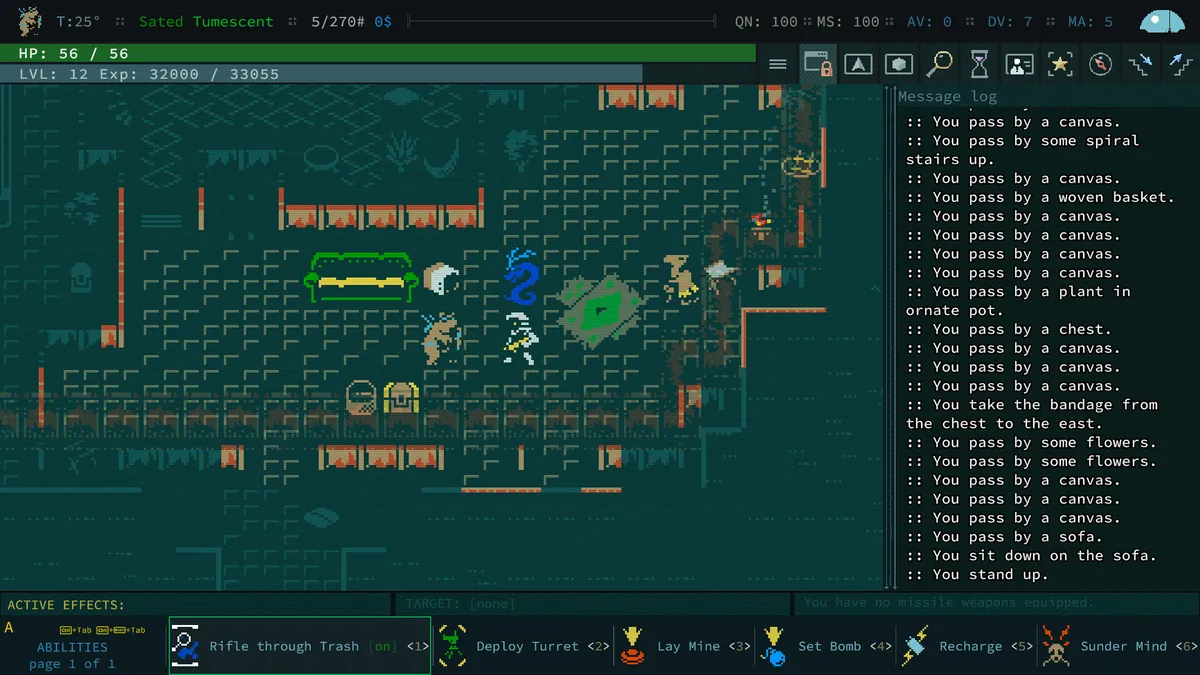
That's elaborated on further with species traits, a new feature exclusive to Diaspora character types. Species traits are a kind of stock-specific mutation bonus, representing the inherent features of an animal's—or plant's—anatomy. While a human character can mutate wings, a mutant bird's inherent wing mutation will advance faster and allow access to new, bird-specific flight advancements. Same with tails: Mutant animal characters that possess a tail as a species trait will be able to mutate the appendage to be prehensile more quickly than mutant characters that don't.
"We want every animal to have something weird and unique about them that you can't just get if you were a human and you advance that mutation a bunch," Grinblat said.
Species traits will introduce a breadth of new opportunities for Qud's already-rich buildcrafting, but creating a new plant or animal character will mean opting out of some things that are standard to the human experience. For example: If I make a mutant dog, can I hold a gun without mutating new hands or opposable thumbs?
"This is a big thing. No," Grinblat said. "Right now, no."
"Yeah. You're a dog," Bucklew said.
"You're a dog," Grinblat confirmed.
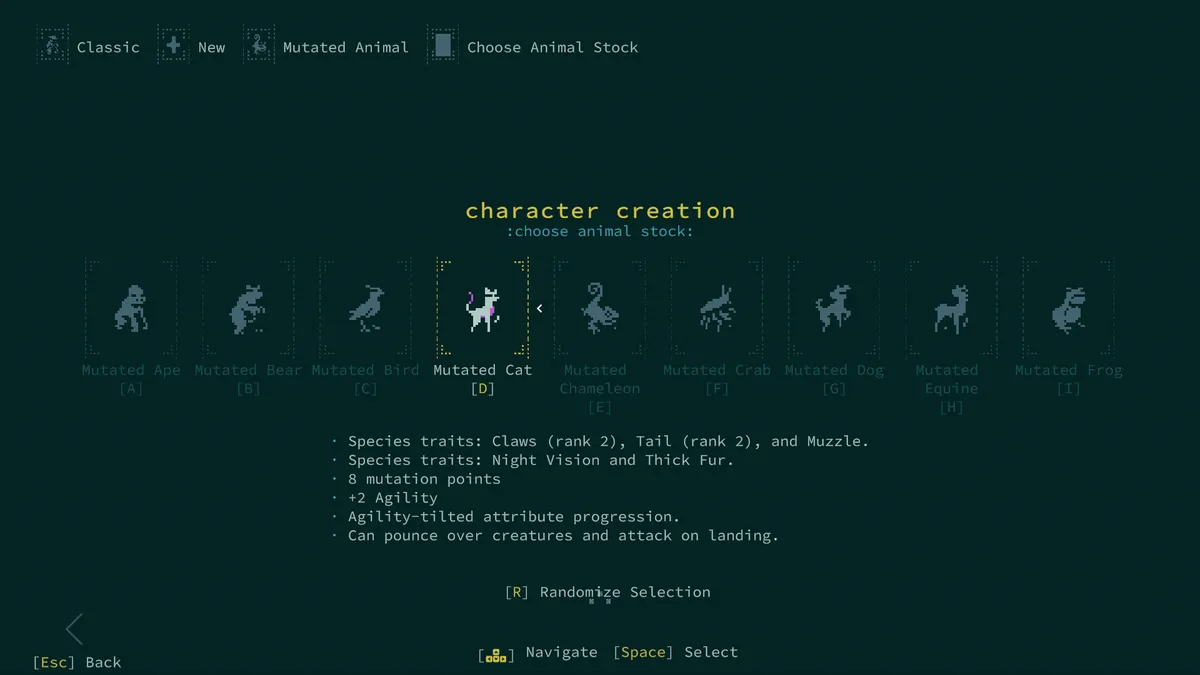
There are, of course, ways for my mutant dog to achieve its dreams of weapon-wielding. I might seek out the helping hands artifact already present in-game, which provides the wearer with two extra arms and hands—or I could pick up that aforementioned prehensile tail mutation and grant my tail the gift of gunslinging. But while Grinblat acknowledged that "hands are very powerful," he said implementing those kinds of natural animal limitations are an intentional design decision, made in the hopes that players will explore new ways of surviving Qud's countless dangers.
"You might end up with a dog with a gun, but you might be doing a lot of dog stuff—running with a pack of dogs who each do their own thing," Grinblat said. "What an actual dog looks like in Qud is up for grabs, but we want to encourage different playstyles that animals can lean into without just feeling like, 'oh, I'm always going to get hands and use guns.'"
Unfortunately for Freehold, introducing a yet wider gradient of body types into the absurd complexity of Qud's systems and simulations has produced exciting new problems to solve—and philosophical riddles to ponder.
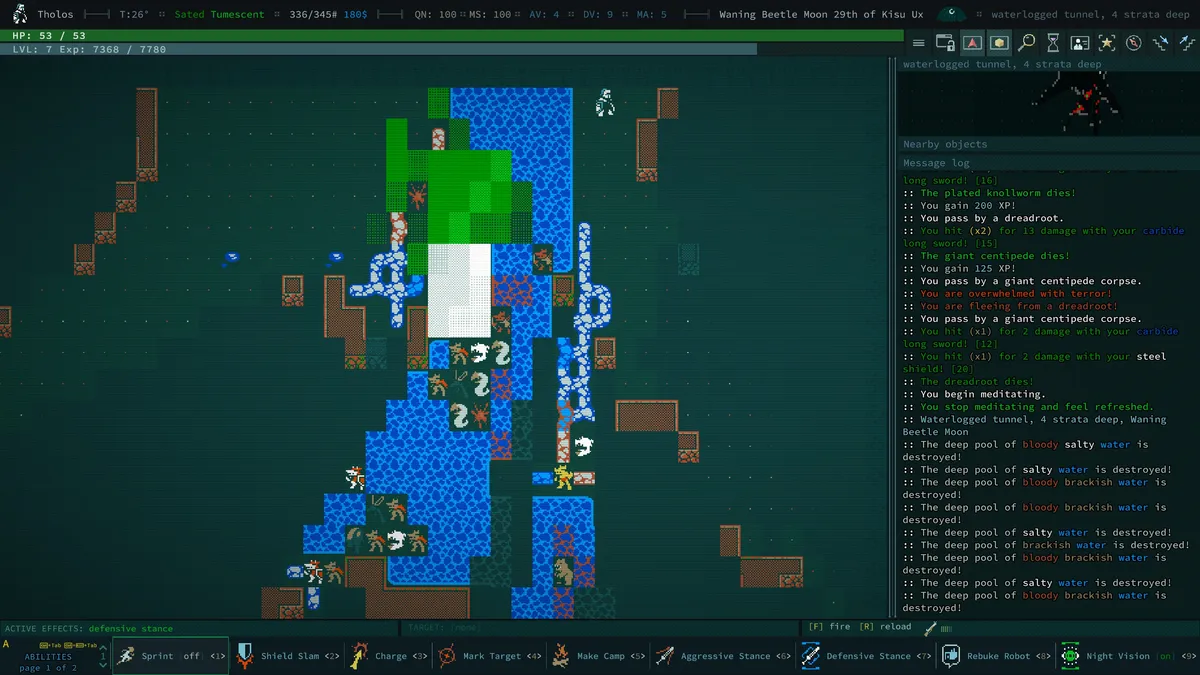
"We've spent so much time figuring out the ontology of tails," Bucklew said. "Are tails arms? Can they wear bracelets? How different is a prehensile tail from a regular tail? Is a tail different from a head in terms of what it can wear? A necklace? A bracelet? A lot of hours in meetings about tail ontology."
Freehold's "last three months," the Qud creators said, have been dominated by "people having strong opinions about limbs." Many of the emergent issues are related to Qud's core questline, which is requiring the devs to reevaluate all sorts of interactions that were designed under the assumption that the player would be roughly human-shaped.
"The limbs have taken the bulk of it, but there are other issues," Grinblat said. "Like, oh, I can't tattoo myself because I'm a crab, so I can't tattoo the Mark of Death on me. Or, oh, I can't eat because I'm a plant. I can't eat the Eater's Flesh that lets me advance past that part of the quest. There's all sorts of problems."

Crabs, in particular, seem to be a source of constant headache as Qud is reconfigured to accommodate animal playstyles.
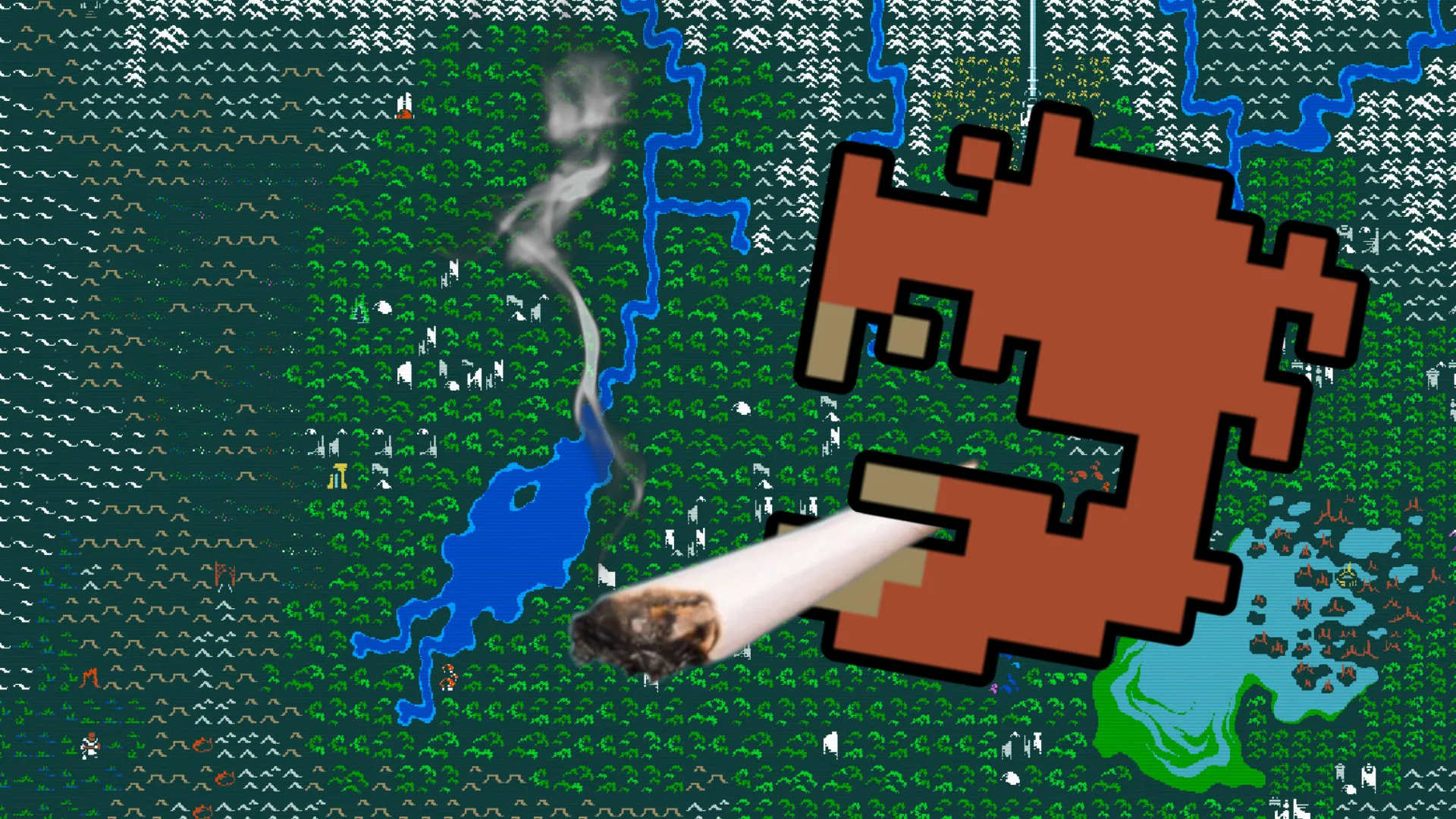
"How does a crab get high? Like, it's an integral part of a Caves of Qud quest, and a crab is not very good at it," Bucklew said. "Do we need a tattooing booth? If you don't have hands, how are you going to tattoo yourself? We're going to need a tattoo grenade or something. But you can't throw stuff either. Oh man, I have no answer."
"God," Grinblat said, "It's so much to do."
By the end of our conversation, the developers remembered that crabs can probably hold a tattoo gun in their claws. Deciding how plants will tattoo themselves, they said, was a problem for another day.
Caves of Qud: Diaspora launches in early access on Steam on December 9.