

Nvidia is the talk of the world right now. The company's co-founder Jensen Huang has been ousted from the company, following claims of multiple affairs: one said to be with a suspected Chinese intelligence asset, and another an alleged with an executive at Nvidia.
These events and more had put pressure on the company's board to consider ousting the co-founder and CEO, who has now been replaced by CFO Colette Kress acting as interim CEO; at least until a suitable replacement can be found.
To better understand these events, the wider context of what's at stake, and why chip smuggling and export controls are also a part of the conversation, check out our timeline below.
October 29
New York Times report on Jensen Huang's unclear relationship with an alleged Chinese spy, Alice Huang.
Alice Huang was the managing director of Megaspeed, a datacentre company in Singapore that imported billions of dollars worth of Nvidia GPUs. Her husband, Kang Wei, is a private equity investor.
Megaspeed had been subject to an investigation for chip smuggling, but Nvidia and the company say it was cleared of suspicion.
Megaspeed statement from December, 25: "We want to be absolutely clear: over the past six months, our company has undergone multiple on-site inspections and reviews by key institutions, including the Bureau of Industry and Security of the US Commerce Department, the Ministry of Investment, Trade and Industry of Malaysia, and Nvidia. These thorough investigations have confirmed that there has been no evidence of any violations concerning the illicit transfer of chips or any illegal activities."
Nvidia spokesperson, John Rizzo, said at the time accusations of chip smuggling made against Megaspeed were "thoroughly investigated and debunked last year."
However, during that investigation, Alice Huang is said to have come under suspicion by US authorities, who determined that Alice Huang was working as an intelligence asset for China.
China denies the claims.
Authorities also noted Jensen Huang was close to Alice Huang, though their exact relationship was not specified.
Rizzo said: “Jensen’s interactions with Ms. Huang are not unusual or unexpected. Meetings with customers are part of a CEO’s job; Jensen talks with thousands of customer executives every year.”
It is said at this time that neither Jensen nor Nvidia had been briefed on foreign intelligence threats by the US government, despite prior memos in the government and US authorities deeming her a threat.
November 5
Jensen is called to a meeting with the various national security and foreign affairs committee leaders in US Congress on November 18.
On the meeting for this agenda is Alice Huang: Jensen's relationship with her and whether she could have collected sensitive information about US technology. It's also about Nvidia's security protocols.
This presumably puts some pressure on Huang and Nvidia to be seen to take action.
November 8
Jensen Huang and Nvidia's board put out statements at the same time on Nvidia's newsroom.
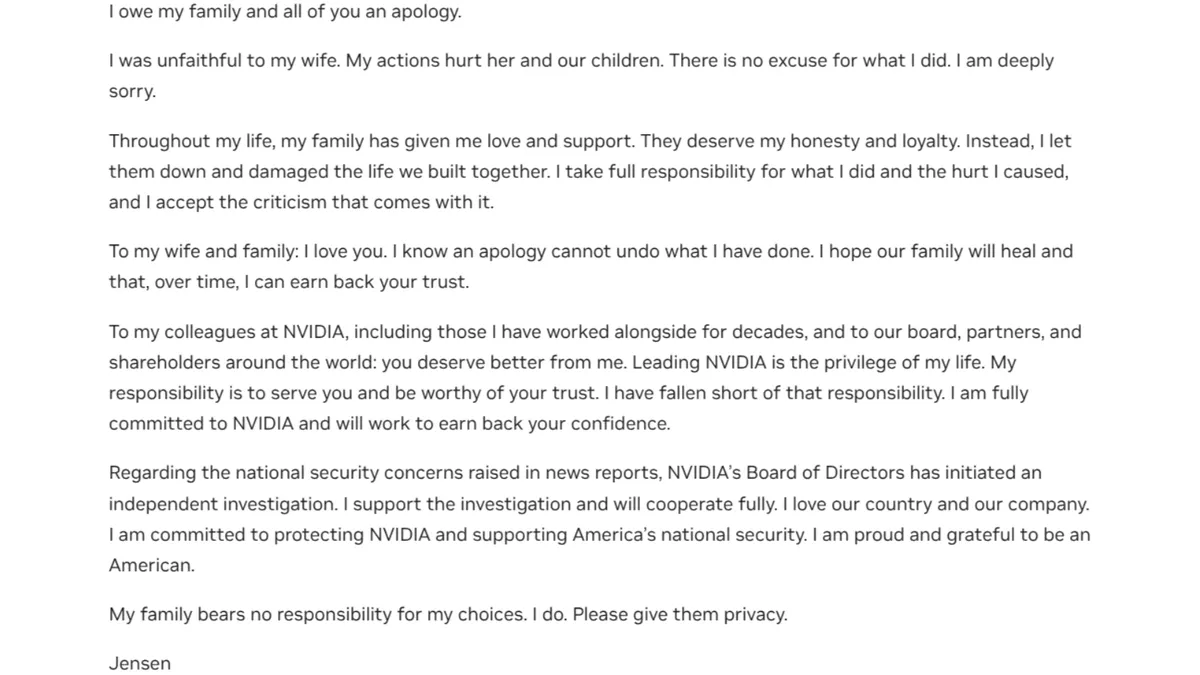
Jensen's statement admits he was having an affair with an unnamed person. He apologises to wife and family, his staff, and says he has fallen short of his responsibility to them.
In the same statement, he notes national security concerns arising from news reports:
"Nvidia’s Board of Directors has initiated an independent investigation. I support the investigation and will cooperate fully. I love our country and our company. I am committed to protecting Nvidia and supporting America’s national security. I am proud and grateful to be an American."
The board of Nvidia focuses on the reports of a "foreign intelligence effort" against the company's CEO and launches an independent investigation to check.
"While the Board has no reason to believe that either national security or Nvidia secrets were compromised, the Board's inquiry will examine all available information. Jensen fully supports the review and has committed to cooperating with it."
That same day and immediate days thereafter
The share price for Nvidia drops: around 21% since October 28, the day prior to the initial New York Times report.
This also happens to be around a similar time of a wider tech selloff due to AI fears, midterm elections, and opposition to datacentres.
Nvidia loses a couple hundred billion dollars in value, give or take. It's share price is not quite the lowest it's been this year—that was on March 30. That was driven by fears of AI spending slowing, CapEx, and China export rules. So it's not apocalyptic for the company.
November 9
Donald Trump speaks to press about his pal, Jensen Huang. He's generally very positive and seems to back the Nvidia CEO.
Trump asked if Jensen Huang had any idea Alice Huang was a spy. Jensen Huang said no.

Trump was reportedly informed of Alice Huang much earlier, but suggested he did not regret not acting on that advice sooner: "No, I don't think so. I think he's an honourable guy. I think he probably has an excuse for it."
"He's an amazing guy. I just hope there's no problem. If there is a problem, we'll let you know about it."
Trump also casually mentions the FBI are investigating.
November 10
Law firms start flooding in with requests for Nvidia investors to sign up to class-action lawsuits or "investigations" into the company. I saw around five press releases for law firms offering their services to investors hoping to claim back some money, but there are reportedly even more.
The Rosen Law Firm's complaint (PDF) outlines ways that Nvidia may have made misleading or false statements on Jensen Huang, his relationship with Alice Huang, and didn't express the risks to the company and share price adequately.
Nvidia hires law firm Wachtell Lipton to lead Jensen Huang affair probe.

Report by The Information suggests Alice Huang facilitated some 240k AI GPUs, largely at-the-time banned H100 and H200 chips, roughly costing around $7.5B
It is speculated that Alice Huang was introduced to Jensen Huang by her investor husband, who had interest in gaming companies. It is also speculated whether she was picked up by Chinese intelligence after starting a relationship with Huang, rather than the other way around.
Axios reports that Commerce Secretary Howard Lutnick was sent a classified memo warning over the relationship between Jensun and Alice Huang. Lutnick is the one charged with safeguarding US technology and keeping it away from its perceived rivals.
The report also notes that Marco Rubio warned Trump about Huang being potentially spied upon on Airforce 1 directly before they picked up Jen-Hsun for the China trip.
Huang returns to a "sad" Nvidia office but seems to act business as usual.
November 11
US senator says he has to go.
"… If the worst thing he did in real life is infidelity with this woman who may or may not be a Chinese spy—but she might be—that's enough, because whatever else there is, we don't know. And to me, that's a security risk."
November 11
Jensen Huang claimed to have yet another affair, this time it is alleged with someone at Nvidia: vice president Kimberly Powell. The Nvidia board meets in claimed preparation to oust Huang.
The New York Times cites five unnamed sources, claiming they were made aware of the affair. It was also claimed the pair were seen "being affectionate" at an Nvidia conference earlier this year, and a bystander recorded a video of the incident before being made an offer by security to sign an NDA.
The Wall Street Journal reports that the Nvidia board, currently setting up an investigation into their CEO, is meeting to discuss Jensen Huang's future. The report states the board is "preparing to oust CEO Jensen Huang."
Nvidia's share price plummets in after-hours trading to its lowest value since June, 2025.
November 12
Jensen Huang has resigned from his position as CEO of Nvidia, effective immediately.
A statement on the Nvidia newsroom confirms Huang's departure. He has also vacated his seat on the board and role as president.
He will be replaced by interim CEO, Colette Kress, who had previously worked as the company's CFO for a long stretch.
"Nvidia Board of Directors announced today that Jensen Huang has resigned as President, Chief Executive Officer, and a member of the Board, effective immediately," a statement on Nvidia's newsroom says.
Coming up:
- November 17: Nvidia set to report its Q3 2027 financials (strange dating due to Nvidia's weird internal calendar)
- November 18: Jensen Huang's meeting with House committee leaders
Timeline: US/China GPU export controls
Export rules between the US and China go back to Biden and that administration's trade war. The US had previously blocked China from accessing the latest in lithographic chipmaking machines, but started to go further into exports of high-end chips.
In 2022, the US decided to halt exports of the very best datacentre chips to China, followed by limitations to the export of other certain GPUs from October, 2023. This bans the RTX 4090 and other capable cards based on performance density and total processing power.
Nvidia and AMD circumvent the ban with chips with limits to slide in under the new regulations, ie. the H20 and MI308. The secretary of commerce at the time, Gina Raimondo, didn't like that much.
Jensen Huang and AMD CEO Dr. Lisa Su say Chinese business is pretty much dried up during this period; Huang says company is "100% out of China."
Once Donald Trump is back in the White House, he proclaims a new policy that will "identify and eliminate loopholes in existing export controls." Later that same year, the president allows sale of some GPUs to China in return for 15% of AMD and Nvidia's China revenue.
By December, 2025, Trump says they can sell even the big chips, like the Hopper H200, but falls short of new Blackwell chips. US Commerce Department gets a 25% slice of the pie in return.
Chinese companies, like Alibaba and Bytedance, may be limited to 75,000 chips each. Nevertheless, Nvidia says it has lots of customers hoping for chips in China.
By February, 2026, sale of Nvidia's top chips are seemingly stalled by a national security review. US politicians are split on whether they should sell chips to China.

This seems to clear up, though, as recent NYT report suggests the US is approving sales of Nvidia AI chips to companies in China. Only problem is those companies are alleged to have dubious backgrounds and funding, thus further stoking some politicians' concerns that the US shouldn't be selling the chips to China whatsoever.
Turns out, China doesn't even want 'em. The CCP takes a while to agree to import the chips, then finally approves their import, then sorta backtracks, and reports suggest they're still stuck in Hong Kong to this day.
China wants homegrown tech. It wants to make its own chips, own chipmaking machines, and lessen dependence on the US—which makes sense, as for the past half-decade, it couldn't reliably get hold of advanced US chips; longer still, advanced lithographic machines.
So, for the better part of five years, and the AI boom, Chinese companies can't officially get their hands on many top AI chips.
A brief history of chip smuggling
Some chose to bypass export controls put in place by successive US administrations. This has led to counts and convictions for chip smuggling over the years.
GPU shipments in south east Asia have come under particular scrutiny, due to suspicions countries there have been used to indirectly ship chips to China.
There have been multiple high-value cases in Malaysia, Singapore, and Taiwan, using techniques such as dummy servers, swapping stickers with hairdryers, and diverting shipments. One case involving billions of dollars of hardware involves the co-founder of Supermicro, a datacentre server company.
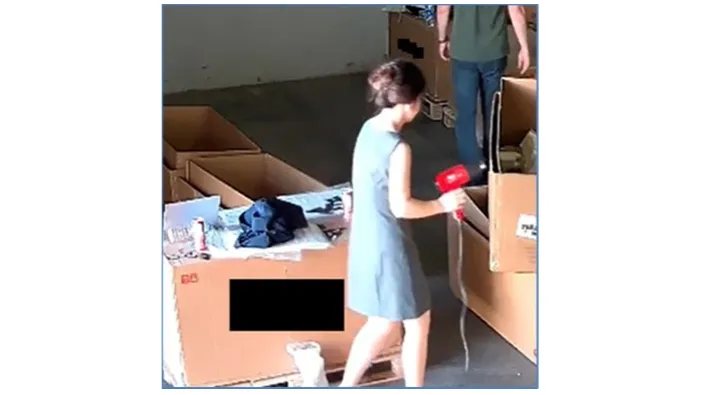
The issue got so bad, the US government asked Malaysia to keep a close eye on any shipment containing Nvidia GPUs back in March, 2025.
Megaspeed was also subject to investigation going back to 2024. The NYT reports that the Commerce department's investigation into the company was later handed over to the Justice department, who is said to still be conducting a criminal inquiry into the company.
Officials cited in the story suggest Nvidia's involvement in the case to be strange. Nvidia spokesperson John Rizzo said the company works "to help government and our partners halt any would-be smugglers while serving the critical market of lawful customers that help America win worldwide."
By December, 2025, Megaspeed published a statement on its website denying any claims of chip smuggling, citing inspections by multiple authorities and Nvidia. Nvidia also backs the company's legitimacy.
NEW: We are short Nvidia $NVDA. We believe Nvidia has a significant China problem. Please see our full report and disclosures now available on our website, link in bio. https://t.co/oTaJyL7S2RMay 13, 2026
A later report by Culper Research alleges Megaspeed is financed in part by Chinese giant Alibaba through a shell company. Megaspeed's balance sheet is said to have exploded from $33 million at the end of 2023 to $3 billion by the end of 2024, and its subsidiary, Speedmatrix, imported billions of dollars' worth of products from an Nvidia server company.
There are further claims made of companies, shell companies, subsidiaries, being set up and moving shipments around the region. Though a great deal of speculation remains as to where any chips actually ended up.
That said, the US government holds that DeepSeek has been trained on Blackwell GPUs, which technically it shouldn't have been able to access—a claim that Nvidia later suggested it could not substantiate.
"We haven’t seen any substantiation or received tips of ‘phantom data centers’ constructed to deceive us and our partners, then deconstructed, smuggled and reconstructed somewhere else,” an Nvidia spokesperson said at the time.
"While such smuggling seems far-fetched, we pursue any tip we receive."