While AMD didn't have much in the way of brand-new PC gaming hardware for Computex 2026—just a cut-down GPU, plus a last-gen X3D CPU and a last-last-gen one—it has at least reminded us of something important for many rig builders. Its current desktop processor socket will still be supported by new chip releases for at least another four years, but that doesn't mean AMD is just leaving things as is.
At the yearly megatech event in Taiwan, AMD reiterated something that it promised back in 2024, in that the AM5 processor socket will be around for a good while yet. Back then, it committed to "2027 and beyond", but that latter part now has a bit more meat to it, with Team Red crossing it out and replacing it with 2029.

With Zen 6 chips expected to make an appearance at some point later this year or early in 2027, this suggests that you'll be able to install Zen 7 CPUs in the same socket. Whether a current X870 or B850 motherboard will happily take such a processor is another question, but those that sport extra-large BIOS chips probably will.
In terms of Ryzen nomenclature, it looks like AM5 will run from the 7000-series all the way through to the 11000 or even 12000-series, assuming AMD keeps to that code scheme (something that the company doesn't exactly have a great track record of).
As a quick note, you might think that AMD names its sockets after what DRAM it supports, e.g. AM5 uses DDR5, AM4 uses DDR4, and AM2 is DDR2. However, it's more of a coincidence than anything else, because AM3 is fine with DDR2 or DDR3, and AM1 (which appeared between AM2 and AM3) is DDR3 only.
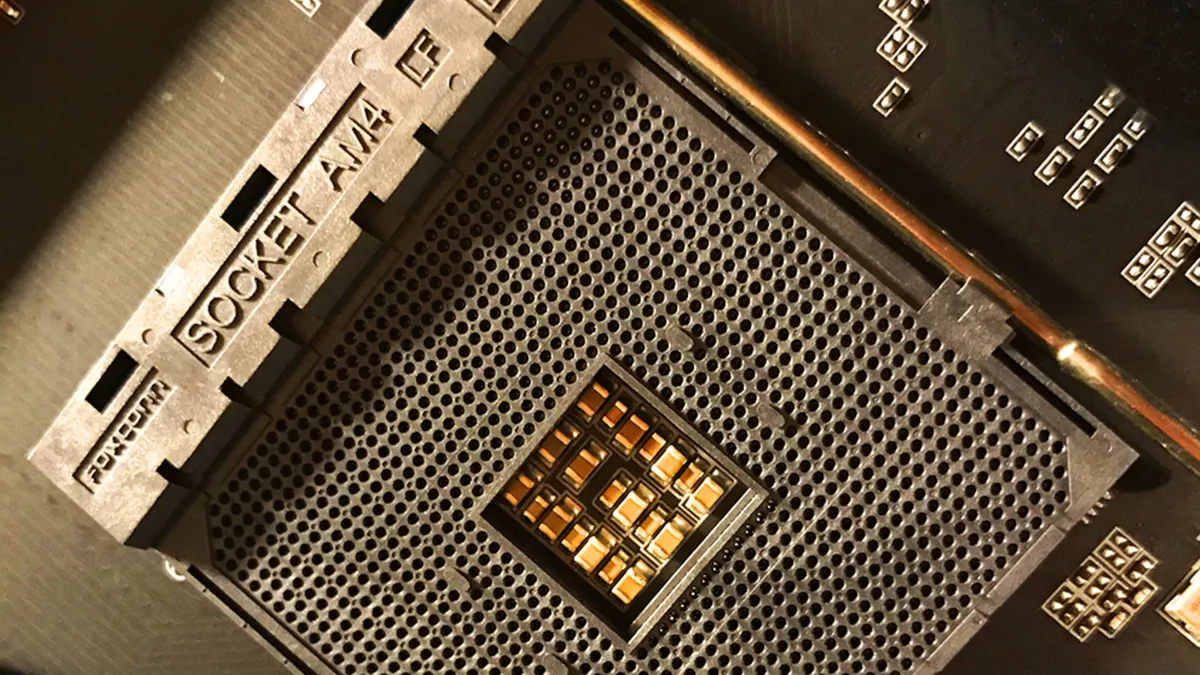
With this confirmed support, it does make me wonder if AM5 will outlast the 'legendary' AM4 socket, because that's still enjoying new chips appearing even now, albeit just those being spat out again from Team Red.
Anyway, for some PC builders, all of this is going to be great news, because the idea that you can have a PC with a Ryzen 5 9600X that you could drop a Ryzen 9 11950X3D into is really appealing. I'm in the alternate crowd, in that I keep the same processor and motherboard for four or five years and then change the whole lot, but I fully appreciate why lots of PC enthusiasts prefer AMD over Intel because of the socket longevity.
It's also worth noting that just because AM5 is going to be around for a good while longer, AMD isn't just leaving it alone. In fact, quite the opposite, as the chip giant also announced an upcoming tweak to its EXPO memory overclocking system at Computex. I know that's not the same thing as upgrading a processor socket, but having faster memory does require that the socket's electrical properties are up to supporting the tweak.


Called EXPO Ultra Low Latency, or EXPO ULL for short, AMD is promising up to 4% more performance in games, compared to AM5 PC's using the standard EXPO profile. What resolutions and graphics settings are required for this performance gain isn't clear at all, but you typically need high-end hardware and 1080p to make DRAM the limiting factor in the frame rate.
So EXPO ULL is likely going to be of use to the esports crowd only, and even then, you'll need to have an updated motherboard BIOS to support it, and buy a new set of DDR5 memory that has the updated EXPO profile. You know, the stuff that's just so cheap and readily available at the moment.
1. Best overall:
AMD Ryzen 7 9800X3D
2. Best budget:
AMD Ryzen 5 5500
3. Best mid-range:
Intel Core Ultra 5 250K Plus
4. Best high-end:
AMD Ryzen 9 9950X3D
5. Best AM4 upgrade:
AMD Ryzen 7 5700X3D
6. Best CPU graphics:
AMD Ryzen 7 8700G