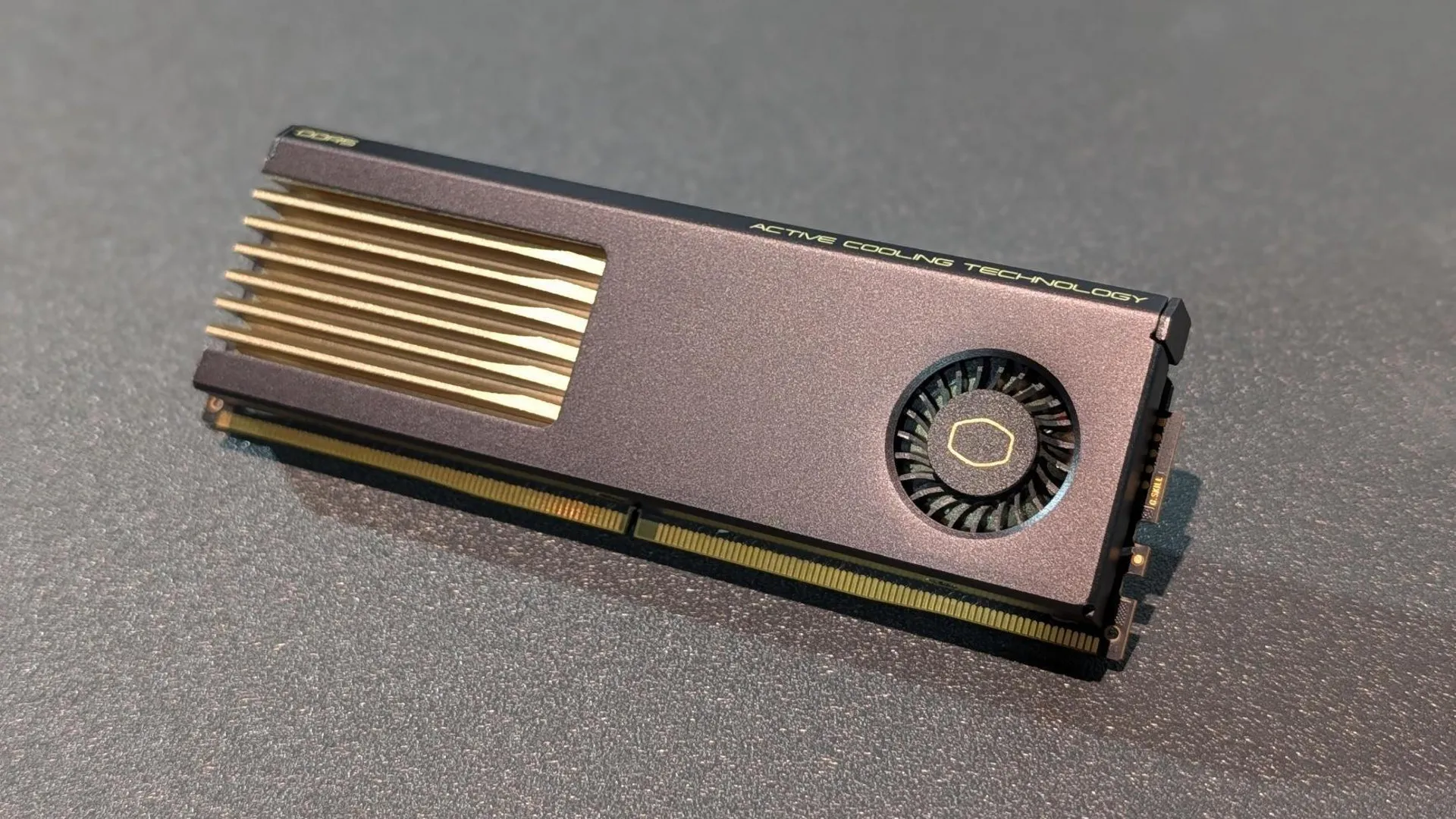
Prise open any random gaming PC, and you'll be greeted with the common sight of a big cooler on the CPU and GPU, replete with multiple fans and maybe even a coolant loop. But when it comes to the DRAM sticks, you'll just mostly see a few pieces of metal for a heatsink. Enter stage left, Cooler Master and G.Skill, with their new actively cooled MasterDimm DDR5 kits, perfectly pitched at today's economy.
It’s official. Cooler Master and G.SKILL are teaming up to bring active cooling to DDR5 memory with the new MasterDimm. Built for next-generation systems that run faster, push harder, and demand stability under heavy workloads. Because cooling should not stop at your CPU or… pic.twitter.com/w3g7kbJ383May 29, 2026
With announcements from both firms posted on X, you can see for yourself what the new memory sticks will look like. I have to say that I like the look of them, though I do wonder just how effective that fan is, given that it's small and shallow, and in a dual-channel setup, one of them is going to have far less airflow to work with than the other.
Ultra-fast DDR5 can run pretty toasty. For example, when I tested Corsair's 48 GB DDR5-8400 CUDIMM kit last year, I recorded a noticeably higher temperature in my stress test, compared to a 'standard' DDR5 set. That said, it wasn't exceptionally high and well within tolerances, so I'm not entirely convinced that we really need active cooling for memory sticks.
Of course, the collaboration could only be for really fast stuff, such as DDR5-9600, but even then, G.Skill just uses its standard heatsinks for its absolute fastest memory kit.
As you've possibly already gathered from the headline to this article, none of this is what's bothering me about this announcement. It's that the whole thing just seems like the two companies are being completely oblivious to the current state of the DRAM market. Even the most enthusiastic of PC enthusiasts is unlikely to be asking for actively cooled memory; they, and everyone else, just want DDR5 that's sensibly priced.
Over at Amazon, the cheapest 32 GB G.Skill dual-channel kit is a whopping $429, and it's even more expensive at Newegg. Go back in time by eight months or so, and you only had to pay around $90 for the same memory, roughly 79% cheaper than it is now (or, if you prefer the figures the other way around, the price has risen by 376%).
That's right! We've teamed up with @CoolerMaster to bring active memory cooling to DDR5 memory with the new Cooler Master MasterDimm.Featuring high-performance DDR5 memory with kits offered in either Intel XMP 3.0 or AMD EXPO profiles and integrated active cooling, MasterDimm… pic.twitter.com/rvYQOl3jEKMay 29, 2026
I have no doubts that some people out there will snap up a set of MasterDimms, the moment they become available, either for bragging rights or because they plan on overclocking the twangers off the kit the moment it's jammed into their PCs. But that's surely going to be a very small number of people, and certainly a demand lost in the cacophony of pleas for affordable DRAM.
I greatly fear that this is going to be a common theme at this year's Computex event, where instead of seeing all kinds of innovative ways of beating back the RAMpocalypse, we'll just get a flood of tone-deaf launches, all pretending that everything is just fine and dandy. With luck, the MasterDimm announcement will just be an isolated case, but if not…Well, let's not go there.
1. Best gaming laptop: Razer Blade 16
2. Best gaming PC: HP Omen 35L
3. Best handheld gaming PC: Lenovo Legion Go S SteamOS ed.
4. Best mini PC: Minisforum AtomMan G7 PT
5. Best VR headset: Meta Quest 3