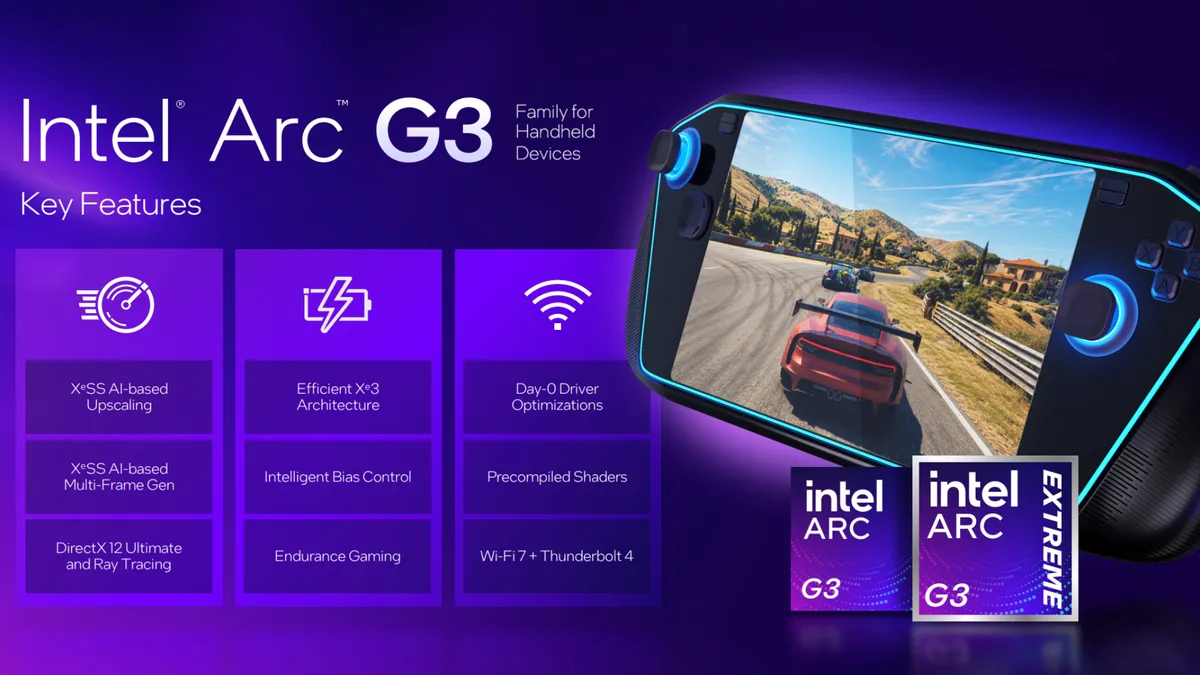
So, Intel has announced its new chips for handheld gaming PCs, the Intel Arc G-Series. And you know what? They're probably going to be pretty good given they're basically versions of the well-received Panther Lake processor. In fact, they could well be the fastest handheld chips on the market. Well, at least at launch. There are good reasons to doubt how committed Intel will be to Arc G in the longer term.
But here's the thing. The only reason why the top-of-the-range Intel Arc G3 Extreme could be the fastest gaming handheld chip at launch is because AMD has been dragging its feet horribly when it comes to APU technology.
AMD's Strix Point APU came out about two years ago. Strix Point was a decent advance on its predecessor, Phoenix, but it used the same TSMC N4 silicon, limiting the upgrade potential.
AMD has since launched the Gorgon Point APU, the follow up to Strix Point. But it's just a warmed over Strix Point APU in truth and, again, is still on N4 silicon.
Since Phoenix came out in 2023, AMD APUs have been stuck on the same silicon node for several years. But what you might call AMD's true next-gen APU, codenamed Medusa Point, isn't out until next year.
Now it's not entirely clear what node Medusa Point will be on. AMD has said that Zen 6, which Medusa Point will use for its CPU cores, is already in production on TSMC's new N2 node. But that's Zen 6 for Epyc server CPUs. It doesn't automatically follow that every Zen 6-based chip will be on N2.
Still, you'd expect Medusa Point to make the move to at least TSMC N3 silicon, which would represent the first node shrink for an AMD APU since 2023. And even N3 should allow AMD to squeeze in a much more powerful iGPU.
Oddly, however, the rumours suggest that Medusa Point will both stick with RDNA 3.5 graphics technology and actually regress from 16 graphics compute units (CUs) to just eight. If this is true, I'm not sure what to make of it all.
There are a couple of possibilities here. AMD could do a cut-down version of its Medusa Halo APU, which is rumoured to be getting up to 48 CUs, which fits into a handheld power budget. And that could represent a big step forward.
It's also possible that something suitable for handhelds could come out of the broader collab' on Xbox chips with Microsoft. Maybe there's a more performant mobile Xbox APU that could be used broadly in gaming handhelds.
Of course, whatever AMD has coming, it's just that—coming rather than here. Which is why the door has been left open for Intel. But, personally, I think that's a real pity.
However good Intel Arc G-series turns out to be, it's based on an essentially dead GPU architecture. Intel hasn't made an official announcement. But it didn't bother releasing its new big Battlemage GPU for gaming and all the indications are that the Arc experiment is over, with Intel set to replace Arc iGPUs in its chips with Nvidia graphics tech in a generation or two.
I don't know about you, but I wouldn't be super confident about paying what, in current market conditions thanks to the AI boom, will inevitably be a lot of cash for an Intel Arc G handheld. How much effort and money will Intel be putting into Arc drivers now that it has already decided to throw the towel in and let Nvidia do the gaming graphics?
Intel is promising "Day-0" driver optimisations for Arc G. But, frankly, I'll believe when I see it. And that will be doubly true a couple of years from now.

1. Best overall:
Lenovo Legion Go S SteamOS
2. Best budget:
Steam Deck
3. Best Windows:
Asus ROG Xbox Ally X
4. Best big screen:
Lenovo Legion Go
5. Best compact:
Ayaneo Flip DS