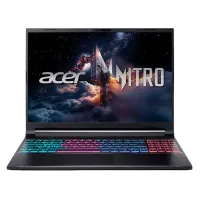
I'm going to be honest, I did not expect to hit upon what might end up being the best Prime Day gaming laptop deal a day before Prime Day actually starts in earnest. Officially Prime Day doesn't start until tomorrow, June 23, but all the other retailers have stolen a march on big Jeff's big shop and have already launched their own sales.
And the pick of the bunch, for me, is this Acer Nitro V 16S with its RTX 5070 GPU for just $1,000. Actually, it's a penny under $1,000 which makes it the first time, probably since Black Friday last year, that we've seen an RTX 5070 system coming in below that figure.
Otherwise it's all pretty standard sales fare out there at the moment—there are some bad RTX 5060 laptop deals, some good RTX 5050 ones, but precious few really, really outstanding deals. With maybe the exception of the best performing machine in our best gaming laptop guide, the Lenovo Legion Pro 7i with its RTX 5080 GPU at $2,549. That's expensive, but it's still nearly $1,000 cheaper than you'll find it direct from Lenovo itself.
The first thing to say, however, is that because this is the slim version (hence the 'S') the chassis and cooling of the Acer Nitro V 16S means that the RTX 5070 inside is limited to 85 W. That's important because it will mean you're not quite getting the full performance that silicon is capable of in a chonkier machine. But it'll still deliver a decent frame rate on the native 2880 x 1620 screen so long as you're comfortable with DLSS and Frame Generation.
The AMD Ryzen 260 is a rebadged version of the Ryzen 7 8845H Hawk Point chip, a Zen 4 CPU with eight cores and 16 threads of processing power. So in productivity terms it's certainly no slouch, though obviously that 16 GB of DDR5 memory is going to be holding it back in seriously memory-intensive tasks.
You are also only getting a 512 GB SSD. That is sadly now the sort of storage capacity you can expect at the more affordable end of the gaming laptop market, now that the memory crisis has taken hold of RAM and SSDs, spiking their prices to unparalleled levels. It sucks, and will fill up quickly, but it is the world we now live in. Alongside the AI that is hoovering up all the memory.
I'm very much a penny-pinching sort, and I could swallow that low storage capacity, and that power limited RTX 5070, for the price Best Buy is charging here. I've not found an RTX 5060 gaming laptop that can match it for price, which makes this more powerful machine even more tempting. I reckon it'll be one of the best deals of Prime Day... if it stays in stock at this price anyways.
👉️Check out the Best Buy Prime Day gaming laptop deals👈️
1. Best overall:
Razer Blade 16 (2025)
2. Best budget:
Lenovo LOQ 15 Gen 10
3. Best 14-inch:
Razer Blade 14 (2025)
4. Best mid-range:
MSI Vector 16 HX AI
5. Best high-performance:
Lenovo Legion Pro 7i Gen 10
6. Best 18-inch:
Alienware 18 Area-51