





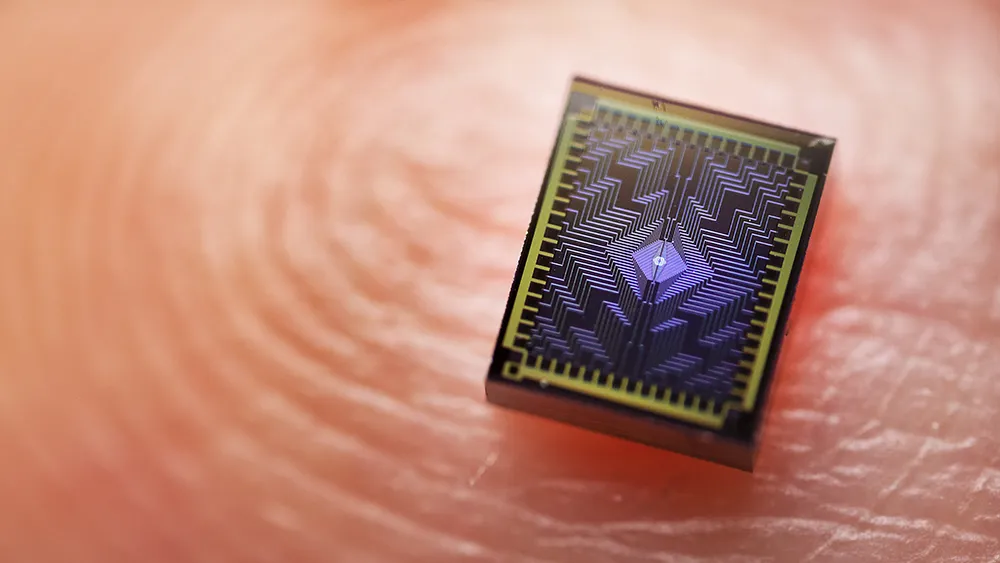
Intel announced it has begun producing its latest silicon based quantum processors. The Tunnel Falls chip is a 12-qubit chip built to aid researchers and academics working in the quantum computing field. It's hoped the chip will accelerate the development of practical quantum computers in the years ahead.
It's a big deal because it uses current complementary metal oxide semiconductor (CMOS) manufacturing technology, and is available in volume. Don't expect to add one to your Newegg cart any time soon though. These chips are very much development tools and are being given away to researchers.
Much cutting edge quantum computing research has required the expensive and time consuming development of an application specific custom device. In other cases, developers have to adapt their software to run processes on a cloud service or within the constraints of the hardware that is available. That means limited flexibility.
According to Dr. Dwight Luhman, distinguished member of Technical Staff at Sandia National Laboratories, "Sandia National Laboratories is excited to be a recipient of the Tunnel Falls chip. The device is a flexible platform enabling quantum researchers at Sandia to directly compare different qubit encodings and develop new qubit operation modes, which was not possible for us previously.
"This level of sophistication allows us to innovate novel quantum operations and algorithms in the multi-qubit regime and accelerate our learning rate in silicon-based quantum systems."
Intel plans to use the information it learns from Tunnel Falls to assist in development of future quantum computing technologies. Its next-generation quantum chip based on Tunnel Falls is expected to be released in 2024.
What does all of this mean for consumers? Not much right now. As gamers, we don't need to start planning upgrades to quantum computers any time soon.

The initial applications are very much scientific and academic. Think things like materials science or molecular analysis. Among other things, quantum computers are expected to assist with the development of things like improved drugs, battery technology and climate analysis and forecasting. Traffic management is another highly practical task I've heard mentioned.
But there's another, more nefarious quantum computing application. They are set to become vital tools in the area of digital warfare and espionage. That's because a quantum computer is uniquely capable of making many widely used encryption standards obsolete. Much of the work on quantum computers is taking place in secret by the governments of the world. It’s something of an arms race.
Best CPU for gaming: The top chips from Intel and AMD
Best gaming motherboard: The right boards
Best graphics card: Your perfect pixel-pusher awaits
Best SSD for gaming: Get into the game ahead of the rest
A quantum computer could theoretically crack Satoshi’s private keys and access those long dormant Bitcoins. All that sounds dramatic, but the millions of qubits required to do something like that are many years away, and a lot of the world's security can be upgraded with quantum secure encryption. Your money in the bank should be safe. Famous last words?
Intel's efforts in the quantum computing race are welcome. I look forward to seeing just how this revolutionary and genuinely world changing tech develops. As long as it's used to benefit the world, rather than hinder it.
By 2030 we might get real time fully ray traced games, or maybe Cyberpunk at 4K, 120 fps, without DLSS. That's the real goal of the Tunnel Falls chip, I'm sure.

