


What's better than giving the hardware you already own a fresh lease on life? Dedicating your older tech to resurrecting even older supercomputers.
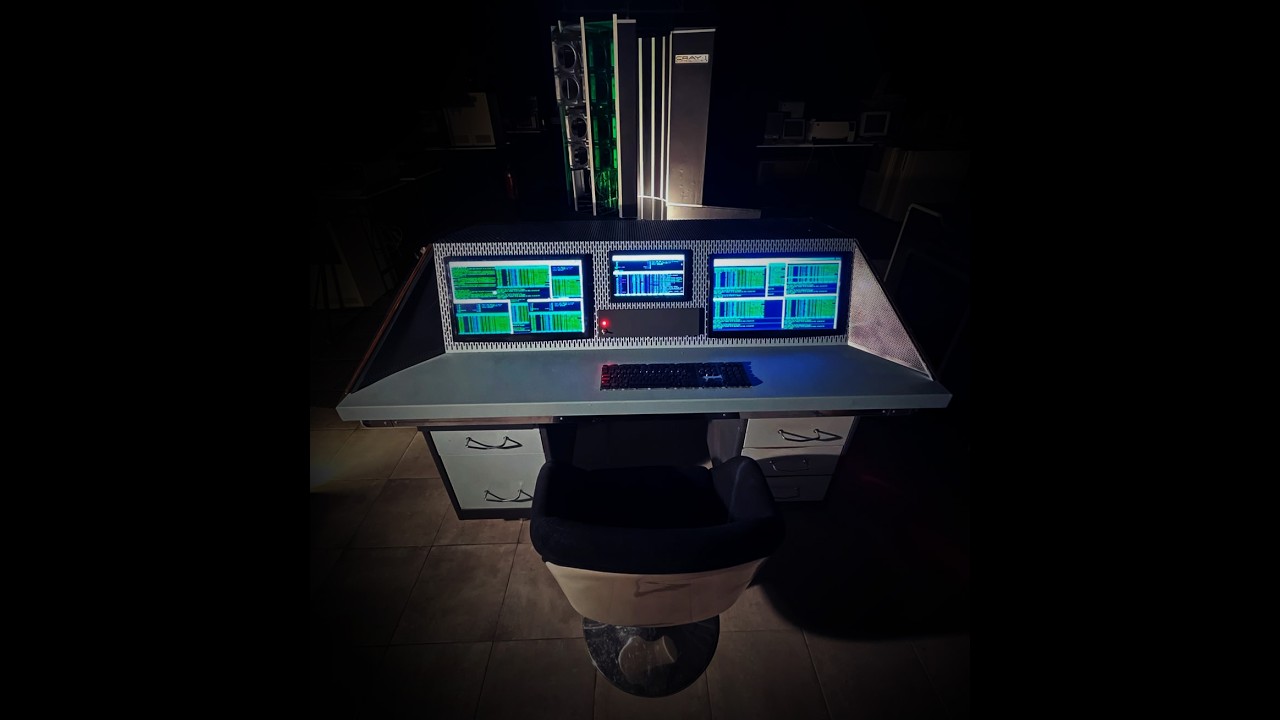
At least, that's if you ask the Museo de Historia de la Computación in Spain. The hardware history museum recently used 30 Mac Minis dating between 2012 and 2014 to resurrect the Cray-1 supercomputer (via Ars Technica).
Debuting in the bygone year of 1976, the Cray-1 is noted for its striking C-shaped cabinet. However, what's arguably most impactful about the new display is that its composite parts make it technically more powerful than the original machine.
The museum's exhibit features five quad-core i7s, and 25 dual-core i5s, resulting in a total of 70 cores to play with. The 30 Mac Minis run on Mojave, leveraging MacOS' Message Passing Interface to pass off computing tasks between them. When all of these cores were online during testing, the exhibit achieved 1.5 teraflops.
The original Cray-1 had a 64-bit, 80 MHz processor and 8.39 MB of memory (PDF warning), with a theoretical peak performance of about 160 megaflops. It's a fitting tribute to both Apple and the Cray-1's 50th birthday this year.

So yes, this exhibit isn't just for show, as striking as it is. But let's talk about that 'tower': The 30 Mac Minis sit within a "natural convection ventilation system (without mechanical fans)" that manages temps while also keeping cooling noise low within the museum space. Basically, all the heat rises and comes out the top of the tower, while keeping cooling component chatter to a minimum.
Apparently the biggest source of noise is the exhibit's two gigabit Ethernet switches, chatting away at about 30 or so decibels (the museum team is looking to replace these with silent alternatives).
Everything is controlled from a very vintage-looking terminal. The screens here are more recent Samsung displays rather than classic CRT monitors for ease of connectivity. Otherwise, this terminal comprises "a Raspberry Pi running classic environment emulators and managing a Raspberry Pi cluster, and two authentic 2006 Cray CX1 units running CentOS." There's also a Mac Mini inside this terminal conducting all of the others on distributed computing tasks.
This old-meets-new, look-how-far-we've-come exhibit is on permanent display at the Museo de Historia de la Computación—but it's not yet finished. In addition to the already installed 30 Mac Minis, the team is looking to crowd fund about 80 more M4 Mac Minis. Why? In the hopes of building an honest to goodness, modern day supercomputer that can rank on the Top500 list.
Well, that's definitely one way to make the most of old hardware.
1. Best gaming laptop: Razer Blade 16
2. Best gaming PC: HP Omen 35L
3. Best handheld gaming PC: Asus ROG Xbox Ally X
4. Best mini PC: Minisforum AtomMan G7 PT
5. Best VR headset: Meta Quest 3