The market is full of excellent gaming handhelds—and also full of price increases, as the memory crisis hits the sector hard. However, we spend all year long testing oodles of portable gaming machines, all the while monitoring their prices against the competition. As a result, we're happy to call the options below the best handheld gaming PCs you can buy in 2026.
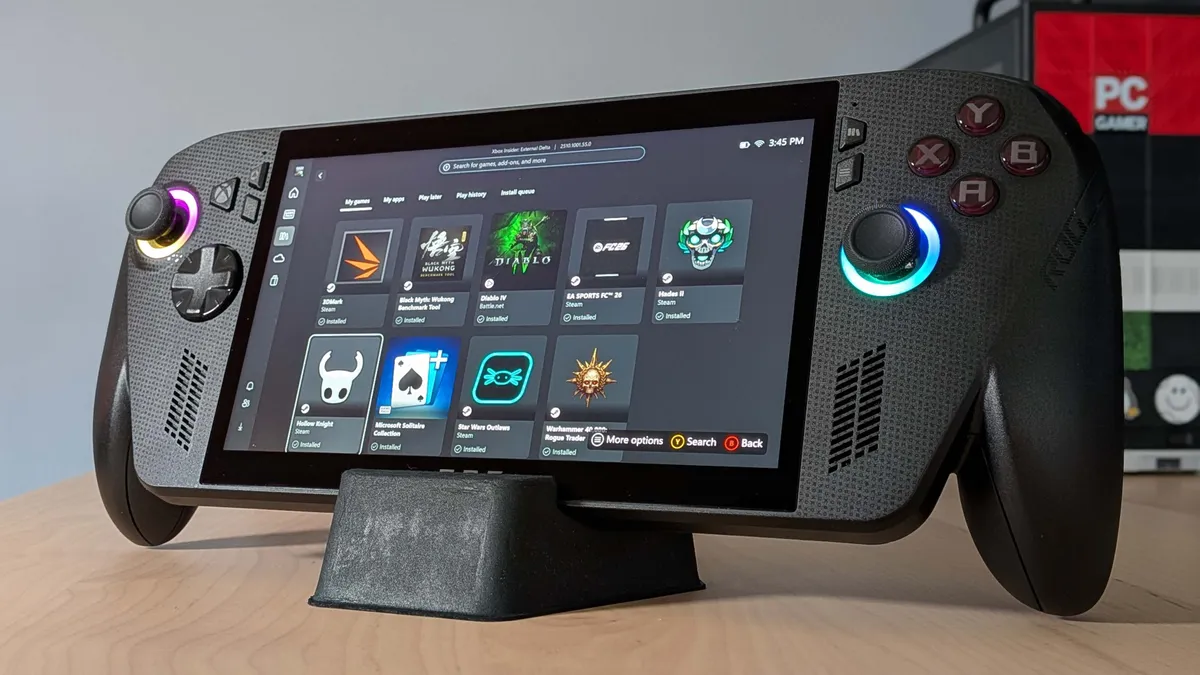
To start with, the best handheld gaming PC is the Asus ROG Xbox Ally X, thanks to its impressive performance, comfortable shape, and surprising value. This powerful machine has somehow held on to its MSRP while its rivals have soared off into the stratosphere, and its absolutely the best all-rounder you'll find today.
If you're looking to spend considerably more cash on the best high-performance gaming handheld, though, the MSI Claw 8 EX AI+ is where you'll want to be. If you've got the money, this is the one that'll give you the best frame rates overall in demanding games.
The best budget handheld gaming PC is the regular, non-X Asus ROG Xbox Ally. We used to have the formidable Steam Deck in this position, but price increases have ruled it out of contention for now. The non-X Asus machine can be found for significantly less, and offers slightly better performance wrapped up in a comfortable chassis design.

Gaming handhelds haven't been around for long, which means Jacob has had a chance to experience many of them first-hand. From Alienware's short-lived Project UFO and pre-Steam Deck Intel-powered handhelds, which left a lot to be desired, to the wave of modern and extremely adept handhelds we're seeing today—Jacob has tried the lot.
August 21, 2026: I've added in a more straightforward listing table at the top along with our review search box, which allows you to search through all our handheld PC reviews if you don't see a particular product recommended on this page to read what we think of it.
July 26, 2026: I've re-worked this guide to reflect the state of handheld gaming PC pricing in 2026. That means the Asus ROG Xbox Ally X is now the best overall, the Asus ROG Xbox Ally (no "X") is the best budget, and the MSI Claw 8 EX AI+ is our new best high-performance pick. Simple, ey?
April 24, 2026: We've made the information in the guide just that little bit more concise and made it easier to get out to reviews of the specific handhelds. I've also added a note about the new Panther Lake handhelds we're hoping will be arriving soon, and maybe even some Arm-y ones, too.
The best handheld gaming PC


1080p gaming performance
| Product | Value |
|---|---|
| Asus ROG Xbox Ally X | 26 Avg FPS, 19 1% Low FPS |
| Lenovo Legion Go S SteamOS | 20 Avg FPS, 17 1% Low FPS |
| MSI Claw 8 EX AI+ CG3EM | 33 Avg FPS, 16 1% Low FPS |

✅ You want great performance: Thanks to the AMD Z2 Extreme chip at its heart, the Xbox/Asus handheld is one of the quickest we've tested to date in terms of real-world gaming figures.
✅ You want comfort: We baulked a little when we first saw the handles mounted to either side in the product photos, but using them in person reveals a brilliant ergonomic design.
❌ You're on a budget: It's $1,000. I don't need to say much more than that, do I?
❌You want a fabulous screen: The 7-inch IPS panel is fine, but it'd be nice to see an OLED included for this sort of cash.
This is an Xbox, Microsoft proudly declares. Well, you could have fooled us. Other than the addition of some handles and and an Xbox-style overlay, it sure feels like an Asus product. And that's a good thing, as Asus knows a thing or two about making a fantastic gaming handheld—so much so that this machine is our pick for the best Windows handheld gaming PC overall.
Yes, it's still Windows 11 hiding underneath the Xbox full screen experience, which can still be found if you switch it to Windows Desktop Mode. You likely won't need to if pure gaming is your thing, however, as the UI overlay is actually very good, mimicking the Xbox Series X/S interface and providing an easy way to switch between your games and adjust the odd setting.
You do get superb performance for your cash, though, as the Ryzen Z2 Extreme chip at its heart delivers some excellent frame rates—although it's beaten by the massively fast (and very expensive) MSI Claw 8 EX AI+ below.
The Asus/Xbox machine isn't a huge leap ahead of most of the competition when it comes to performance, but when we're talking the difference between, say a 41 fps average in Cyberpunk 2077 at 1080p Medium settings, versus the 32 fps average you'd get from a regular ROG Ally X, it soon starts to stack up.
Handhelds can still struggle with smooth frame rates in demanding games, but this one gives a comfortable performance advantage over many, and that really will make a difference to your gaming experience.
It boots quickly, enter and exits sleep modes with the minimum of fuss, and is generally pretty well implemented. Oh yes, the ROG Xbox Ally X is also... $1,000. That's a lot amount of money to drop on any piece of gaming hardware, but given the handheld market is full of over-inflated price tags right now, this one actually looks like surprisingly good value. Shocking, I know. But that's the way handheld pricing goes in 2026.

Click through to read our full Asus ROG Xbox Ally X review.
The best budget handheld gaming PC


✅ The ROG Xbox Ally X is too expensive: While its much more powerful sibling sits at the $1,000 mark, (and many handhelds are now much more expensive than that) the non-X machine makes a lot of sense for the cash.
✅ You want a Steam Deck alternative for less: We love Valve's portable gaming machine, but since the recent price rises, the ROG Xbox Ally is the better proposition.
❌ You want ultimate gaming performance: The Ryzen Z2 A chip at its heart will be perfect for indie gaming, but the demanding stuff will likely require a lot of dropped settings and upscaling help for smooth frames.
❌ You want a gorgeous screen: Nope, no OLED for you. While the ROG Xbox Ally's display is a perfectly decent IPS model, it's a touch dull compared to some of the higher-end efforts.
The venerable Steam Deck used to sit in this spot, but after substantial price rises in 2026, it no longer represents the value proposition it once did. However, the non-X variant of the Asus ROG Xbox Ally can still be found for reasonably money, and it's got some advantages over the Deck that make it a shoo-in for this spot.
Hardware wise, the ROG Xbox Ally makes use of AMD's Ryzen Z2 A chip, which at first glance looks a lot like the APU you'll find in a Steam Deck. It's got the same four cores and eight threads, but also come with slightly higher base and boost clock speeds, along with double the L3 cache.
Small differences, I'll grant you. But while this won't add up to a massive performance difference, the Asus/Xbox machine still represents a small upgrade over the Deck's internals for significantly less cash.
And no, it doesn't have an OLED screen like the Steam Deck OLED. But its 7-inch, 1080p IPS panel is the same as you'll find in its more expensive (and more powerful) bigger brother, and it's a perfectly decent display, if a touch dull. You're also getting the same chassis design, which we've found to be remarkably comfortable to hold for long periods, with well-appointed buttons, bumpers, and triggers.
It's also got a slightly larger battery than the Steam Deck, and given our experience with the X model, should run cool and quiet in your hands. You'll also be able to take advantage of the Xbox Full Screen Experience to manage your games. It's not as feature-packed as SteamOS, but it makes a decent fist of getting out of the way and letting you manage your library in peace.
This is a Windows 11 machine underneath, which opens up some possibilities for tinkering, too. So, while the Steam Deck has fallen victim to the memory crisis, the significantly cheaper Asus ROG Xbox Ally has become the best budget handheld gaming PC I can think of. It's worthy of some serious consideration for those who want in on some handheld PC gaming hijinks—without spending $1,000+ for the privilege.
The best high-performance handheld gaming PC


1080p gaming performance
| Product | Value |
|---|---|
| MSI Claw 8 EX AI+ CG3EM | 33 Avg FPS, 16 1% Low FPS |
| Asus ROG Xbox Ally X | 26 Avg FPS, 19 1% Low FPS |
| Lenovo Legion Go S SteamOS | 20 Avg FPS, 17 1% Low FPS |
✅ You want the best handheld silicon: The MSI Claw 8 etc. is the current pinnacle of handheld gaming PC technology and if that's what you need in your life, it's right here for you.
❌ A handheld needs to be an affordable second-device: At $1,800 the Claw 8 etc. costs the same as a full Radeon RX 9070 XT gaming PC, making it very much a luxury purchase and an impulse buy only for the mega-loaded.
The MSI Claw 8 EX AI+ CG3EM is the most powerful handheld gaming PC I've ever used. It is also the most expensive. And these two things do kinda go hand-in-hand, but are also at odds with each other. A handheld gaming PC is very rarely going to be anyone's sole PC or gaming device, and when it costs the same amount as a genuinely powerful gaming laptop or desktop that makes it a tough recommendation from any value perspective.
But if your perspective is purely based on what it's like to use or how powerful it is, then the MSI Claw 8 EX AI+ is a far easier thing to recommend, because it is genuinely excellent. If you can get past the price (welcome to the party, Mx. Moneybags) then this is the experience I always wanted out of a gaming handheld.
The performance of the Intel Arc G3 Extreme silicon brings the B390 integrated graphics to bear on mobile gaming, and it slams through games with barely a problem. Throw in some upscaling, and maybe a little Intel frame generation, and it flies. To the point where, for most of us, performance anxiety will be a solved issue. Okay, you're not going to be gaming at the highest ray traced settings, but standard 1080p medium settings will be buttery smooth.
Range anxiety, too, is almost sorted by the Intel architecture and MSI's choice of a 77.8 Whr battery. The battery life at full power is already excellent, but stick it into Endurance mode (around 20 W) and you'll find yourself barely bothering to look at the tell-tale percentage numbers around the battery symbol.
But sadly, because of the Intel Panther Lake architecture's desire, no, need for lots of high-performance memory, the price of the MSI Claw 8 EX AI+ is unlikely to come down any time soon.
Battery life testing
Battery life
PCMark 10 | Gaming battery test
| Product | Value |
|---|---|
| MSI Claw 8 EX AI+ CG3EM (Endurance mode) | 308 |
| MSI Claw 8 EX AI+ CG3EM (Full power) | 153 |
| Lenovo Legion Go S | 126 |
| Asus ROG Xbox Ally X | 125 |
| Lenovo Legion Go | 89 |
| OneXPlayer OneXFly F1 Pro | 82 |
| Ayaneo 3 | 69 |
How we test handheld gaming PCs
When we test handheld gaming PCs, we live with them in the same way you would at home, using them to play the latest big-budget games and any indie titles that take our fancy.
This will highlight any failings in battery life, how the screen looks long-term, and how the thumbsticks feel after hours of play. Each device is calibrated to play as it should, and compatible games are tested at multiple different settings.
Fast-paced shooters are perfect for testing the response of the screen, and the neon-dripping world of Cyberpunk 2077 makes for an excellent HDR tester. We try to cover a good range of gaming use cases.
We also go through a series of experiential tests to highlight any performance problems, as well as assess heating over the long term and how upgradable things like the internal storage are. It can be easy to get lost in a sea of numbers, so, as well as doing specific tests, we make sure we get lots of time in every day, as we would with a traditional gaming rig.
Given they are handheld gaming PCs, the feel is incredibly important, so we make sure to test lots of different types of games to find each device's strong and weak points.
Best handheld gaming PC FAQ
What is the most powerful handheld gaming PC?
As of right now, the MSI Claw 8 EX AI+ is the fastest handheld we've tested to date in terms of real world gaming performance. However, the Asus ROG Xbox Ally X is also a very speedy machine, and much cheaper, too.
How much RAM do you need in a handheld gaming PC?
16 GB of memory should be the minimum amount of RAM you look for in a handheld gaming PC. This is because handheld memory counts for both system memory and the GPU's VRAM—two portions of memory which are usually separate in desktops and gaming laptops. A few GB will ideally be used as VRAM, so if you have 24 GB of memory, that'll still leave 16+ GB for your system to use, with up to 8 GB used as VRAM for the GPU. 16 GB is fine, though, especially if the handheld's only using, say, 4 GB of that for the GPU.
How much storage should you get in a handheld gaming PC?
Though bigger is better, and this is especially true when you can often upgrade storage, the sweet spot for commercial handheld gaming PCs right now tends to be at around 1 TB. This gives plenty of room for both big-budget titles and smaller indie games.