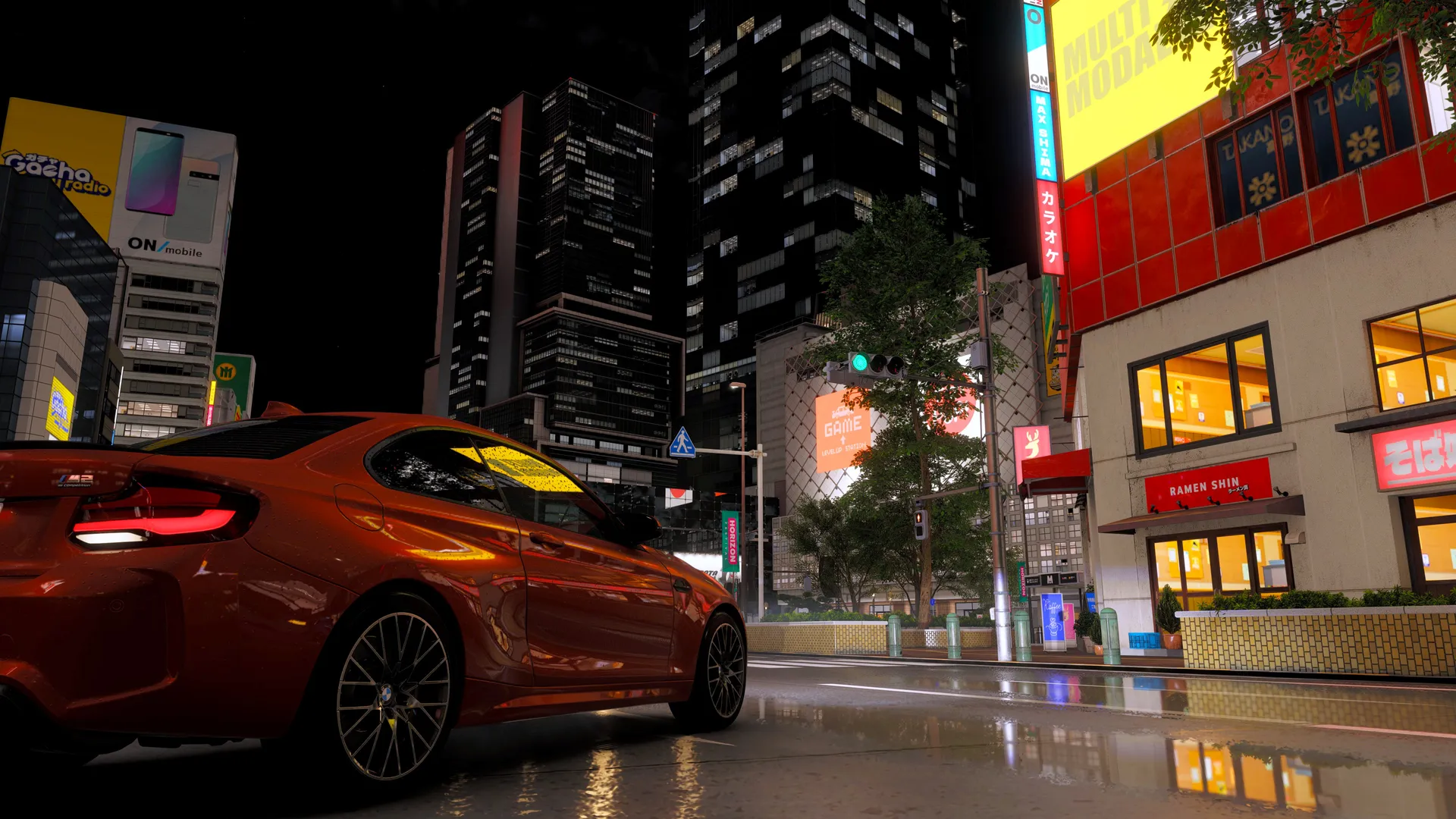
These past few days, I've been testing Forza Horizon 6 across various gaming PCs, monitor resolutions, settings, and whatnot. Overall, everything is peachy—the game looks and runs very well, even on older hardware, and you don't have to lean on upscaling or frame generation to get a decent frame rate. But there's one setting that has left me somewhat disappointed, even though it's an option I tend to enable wherever possible.
As you've already picked up from the headline above, it's the game's ray tracing options. There are two specifically: one for reflections and the other for global illumination. They both work as intended, producing pixel-perfect lighting and images in shiny surfaces.




Use the image comparison thingy above to see what I mean. On the left, FH6 is using the Extreme preset, which sets every option bar one (reflection quality) to its maximum value. On the right, it's the same preset but with ray tracing being used.
My issue with both is that neither lifts the game's visuals to a level worth using them. Ray-traced reflections are definitely better-looking than screen-space ones, which typically pop in and look a bit odd.
The thing is, most of the time, you're hammering past the scenery at such a rate of knots that you barely have a moment's notice to take it all in, and the flaws of screen space reflections are gone from view before your brain really registers that something is amiss.
That's not the case for ray-traced global illumination (RTGI), which should matter everywhere, but the option in Forza Horizon 6 just feels very... meh. I suspect that this is in part due to the nature of the game world. It's 'open world' in the genre sense, but it's also 'open' in the sense that having buildings, objects, and the environment in general being all correctly lit doesn't really stand out, because you can't really get near to them
However, this doesn't explain why Forza Horizon 6's RTGI implementation scrubs out details on surfaces in some cases. Just check out the doorway area to see what I mean.
Normally, I'm the kind of PC gamer who will twizzle every graphics knob to the maximum setting, and then experiment with upscaling and frame generation to get the performance I want. With an RTX 5090, at 4K with DLSS Quality, the difference between the Extreme and Extreme+RT presets is roughly 36%, in terms of frame rate loss.
This video compares Forza Horizon 6 with maximum graphics settings but no ray tracing (left) against the same configuration but with ray tracing (right)
That's not a trivial hit, but it's not a massive one either, and easily recoupable with a touch more upscaling, and it disappears altogether with frame generation. But I'm not happy with how RTGI looks in Forza Horizon 6, and the screen space reflections don't bother me, so all my post-testing driving in the game has been without ray tracing enabled, despite having the hardware to cope with it all.
Still, it makes a change from having a setting that gives you prettier graphics but then swallows up half of your performance, forcing you to lean on frame generation to get something approaching a modern PC gaming frame rate. You might find it all very nice to use, and if that's the case, you'll be pleased to know that at lower settings/resolutions, the ray tracing options are very accessible.
Now, if you'll excuse me, I've got a dinky minivan to hoon around Tokyo. I want to see if I get two wheels off the ground mid-corner. Wish me luck.
1. Best overall: AMD Radeon RX 9070
2. Best value: AMD Radeon RX 9060 XT 16 GB
3. Best budget: Nvidia RTX 5050
4. Best mid-range: Nvidia GeForce RTX 5070 Ti
5. Best high-end: Nvidia GeForce RTX 5090