Our Verdict
Asus's latest 4K OLED gaming monitor doesn't just pack LG's latest Tandem WOLED tech. It adds an RGB-stripe twist. The results are very, very good. But OLED perfect still hasn't quite been achieved.
For
- Latest LG Tandem WOLED tech
- RGB-stripe subpixels
- Glossy panel coating
Against
- Very expensive
- Some brightness limitations
- OLED tech is changing fast
PC Gamer's got your back Our experienced team dedicates many hours to every review, to really get to the heart of what matters most to you. Find out more about how we evaluate games and hardware.
Every time a new OLED gaming monitor comes out of late, it seemingly poses pretty much the same question. Is this the one, is this the model that effectively "completes" the task of gaming monitors, that represents 2D panel technology perfected? Give it up, therefore, for the latest candidate, the Asus ROG Swift PG32UCWM, a 32-inch 4K model.
There's a lot to keep up with when it comes to OLED panel technology developments, but big news here is the inclusion of a new LG Tandem WOLED panel with RGB-stripe subpixel structure. We've already seen LG's Tandem WOLED tech in 32-inch 4K trim recently in another Asus monitor, the Asus ROG Strix XG32UQWMS. But that didn't get the RGB-stripe version of the new panel type, instead retaining the additional white subpixel LG has long used to boost brightness in an "RGWB" configuration.
In theory, then, this new panel has it all. You get the very latest LG Tandem WOLED panel generation with all the benefits that brings, but applied to a pure RGB-stripe subpixel structure. That's it then, job done, the perfect OLED gaming monitor?
Screen size |
32-inch |
Resolution |
3,840 x 2,160 |
Brightness |
250 nits full screen, 1,000 nits peak HDR |
Response time |
0.03 ms |
Refresh rate |
280 Hz (480 Hz in 1080p dual mode) |
HDR |
DisplayHDR True Black 400 |
Features |
LG RGB-stripe Tandem OLED panel, G-Sync, 2x HDMI 2.1, DisplayPort 12.1, USB-C with 90 W PD |
Price |
$1,299 | £1,099 |
Buy if...
✅ You want the most precise RGB-stripe experience: Asus has gone for the RGB-stripe version of LG's new Tandem WOLED tech and it's super precise in just about every way.
Don't buy if...
❌ You want the absolute brightest OLED monitor: That RGB-stripe panel tech comes at a slight cost in terms of brightness.
Not quite. It's not all pros with this RGB-stripe panel. There are some cons, too, at least on paper. The RGB-stripe subpixel structure—or red, green and blue subpixels arranged vertically in that order—should mean more precise rendering, especially for elements like fonts that rely on addressing the panel at subpixel level to achieve maximum crispness. It also promises more accurate colours and a wider overall colour volume, too.
However, LG has been using the white subpixel on all of its previous OLED panel generations for PC monitors for a reason. And the consequence of removing it is that this RGB-stripe 32-inch Tandem WOLED panel has lower full-screen and peak HDR brightness ratings than its RGWB cousin.

So, where the Asus Strix model was rated at 330 nits full screen and 1,500 nits peak HDR in a 2% window, this RGB-stripe Asus Swift clocks in at 250 nits and 1,000 nits respectively. It also makes do with DisplayHDR True Black 400 certification instead of True Black 500.
Just to confuse things, this new RGB-stripe panel tech is also being used in the new Alienware AW3926QW 39-inch 5K2K monitor, a review of which we also have coming. That has exactly the same pixel density, but somehow Alienware has managed to squeeze 300 nits, 1,300 nits and HDR True Black 500 from that panel. Odd.
Anyway, it should also be noted peak brightness specs aren't the whole story, in any case. As I've explained before in reference to monitors using Samsung's competing QD-OLED panels, which have never used white subpixels at all, peak brightness ratings are for pure white.
But panels with lower brightness ratings thanks to using pure-RGB subpixel structure can actually offer superior colour brightness. Put another way, if you want to show pure and accurate red, for instance, the white subpixel isn't much help in boosting brightness.


Speaking of QD-OLED monitors, it's notable that the likes of the MSI MPG 322UR X24 uses a Samsung panel with no white subpixel to achieve 300 nits full screen and True Black 500 certification. What's more, Samsung has also announced an even better 32-inch 4K QD-OLED panel with 360 Hz refresh and True Black 600 certification. Samsung hasn't quoted panel brightness, but the True Black 600 tier requires 350 nits full-screen at minimum. Like I said, it's a lot to keep up with.
One last note on the panel tech. LG's branding for all this stuff is getting really confusing. The "W" in Tandem WOLED doesn't refer to the white subpixel, hence its use here. It refers to the fact that each subpixel emits white light that is then passed through a colour filter. And the "Tandem" equally doesn't actually mean two full OLED panels stacked atop one another, but instead refers to additional emissive layers, again within the subpixels.
My actual final note on the panel is that it's glossy, not matte, which isn't always a given with LG-based OLED monitors. Anywho, aside from the panel specs, this is an Asus "Swift" model, which makes it more premium than the Strix version I reviewed recently and that has implications for the feature set. First up, that includes a 480 Hz 1080p "Dual" mode to complement the 240 Hz native 4K refresh rate.
The panel is glossy, not matte, which isn't always a given with LG-based OLED monitors.
Connectivity wise, you get full 80 Gbps DisplayPort 2.1, two HDMI 2.1 ports, plus USB-C with 90 W of power delivery. There's also full KVM switch support. Further gaming-friendly features include ELMB motion blur reduction and VRR anti-flicker. Oh, and there's not only HDR10 support, but Dolby Vision, too, albeit Dolby Vision is more relevant to HDR video than HDR gaming.
It's all wrapped up in a premium chassis that includes height, swivel and tilt adjustment, RGB lighting, including a down projector, and some nifty design elements. Most unusual is the partly transparent rear chassis cover.
It's a lot like the see-through rear cover on devices like Nothing's smartphones and headphones. It's pretty neat, albeit you're obviously not going to see it day-to-day on a monitor sitting up close to a wall.


Without further ado, then, how good, exactly is this new RGB-stripe Tandem WOLED panel? Pretty darn good, but not quite perfect, is the short answer. There's some subjectivity in this, but I have never personally much liked LG OLED panels with the added white subpixel. They lack colour vibrancy and suffer from slightly green-tinted white tones.
That's all fixed with the RGB-stripe panel. To sum up the experience, it's a lot closer to a Samsung QD-OLED panel in terms of how pleasing and punchy the colours are. But you don't have to worry about the purple tint that even the latest QD-OPLED panels suffer from in bright ambient light.
This RGB-stripe WOLED also has a more accurate and neutral colour balance compared to the slightly warm colour temperature of QD-OLED panels. Add in the precision of the RGB-stripe subpixel structure, especially as applied here to a super-sharp 4K panel, and all the usual OLED upsides, including ridiculously fast 0.03 ms pixel response, perfect lighting control and very wide viewing angles and, well, you have one heck of an experience.


For the record, the banding or "dirty screen effect" that some other lower resolution Tandem WOLEDs suffer from is more or less invisible here. So, that's good. And if you are wondering, yes this monitor does have something akin to MSI's EOTF boost mode that essentially enables maximum available brightness in both brighter and darker HDR scenes.
Asus calls it "Adjustable HDR" on this model, but it does basically the same job and works well enough, albeit with some limitations, which we'll come to in a moment.
Now, I know I go on about this routinely when it comes to OLED monitors. But the night time HDR scenes in CyberPunk 2077 really do look spectacular on this panel. Let me give you an example to get across the experience. You know those neon lights and signs that populate many of Cyberpunk's moody urban scenes? They don't look like images of neon lights and signs. They look like actual light sources.
That's actually the point of HDR done right. To recreate the true dynamic range of reality and that means light sources that look like actual light sources.
That's actually the point of HDR done right. To recreate the true dynamic range of reality and that means light sources that look like actual light sources.
The reality is that most supposedly HDR-capable screens can't really do HDR. Well, this one can, and it looks epic at its best. But what about at its worst? Brighter gaming scenes inevitably show up the limited full-screen punch.
Again, we're into subjective territory here. Do you really want the screen to light up at 500 nits and beyond across the whole screen? That wouldn't actually be comfortable for extended use. But it cannot be denied that 250 nits full-screen is not hugely punchy and there are moments when this monitor can look a bit, well, dull.


Overall, I'd definitely take this RGB panel over the RGWB alternative. Where the choice becomes more tricky is versus a QD-OLED. I think the latest QD-OLEDs are still a touch punchier in brighter scenes and on the Windows desktop.
If you disable uniform brightness in order to max out the visual pop in SDR mode, there's more apparent dimming according to how much bright content you are showing with this LG RGB-stripe panel than a Samsung QD-OLED.
That dimming, as more and more of the screen is lit up, is also apparent in HDR mode when the Adjustable HDR setting is maxed out. And that dimming is more significant than you'll see on the latest QD-OLED panels, including that MSI MPG 322UR X24, which is something to think about.
On the other hand, there's no purple tint to contend with and, like I said, the colour temperature is more natural. In the end, it's now a very close run thing between this LG panel and the QD-OLED alternative. That's a major step forward given I'd have taken QD-OLED easily, before.


Really twist my arm and I'd probably pick this panel. There, I've said it. Wait, can I take that back? I've just remembered this LG RGB-stripe dims a tiny bit more than I like. Argh. Ultimately, it's probably too close to call. Both of the current LG and Samsung options have their own slight shortcomings, but both are also great panels.
More to the point, however, 32-inch 4K OLEDs of any stripe—pun fully intended— make fantastic all rounders. They're big enough to be really immersive, in-game, but also have sufficient pixel density to look crisp and sharp for daily computing.
So, really the main problem for the Asus ROG Swift PG32UCWM is how the value proposition stacks up. At $1,299 or £1,099 this is a very expensive display. You can typically get a first-gen 32-inch 4K QD-OLED for somewhere in the $600 to $700 range, currently. Yes, this new RGB-stripe Tandem OLED is better by several metrics. But not that much better.


The choice is yours, but I'd want a look at that Alienware before pulling the trigger, that's for sure.
Then there's the comparison with that Alienware AW3926QW. That isn't quite on sale yet, but it's expected to come in at $1,100. Okay, it doesn't have USB-C connectivity. But it's not only brighter, but larger at 39 inches and offers that ultrawide 5K2K upgrade.
Of course, you're going to need one heck of a GPU to drive this display at its full 240 Hz refresh at 4K and that challenge is only going to be stiffer with a 5K2K panel. But perhaps that's a separate issue to the reality that you're paying more for less with this Asus compared to that upcoming Alienware. The choice is yours, but I'd want a look at that Alienware before pulling the trigger, that's for sure.
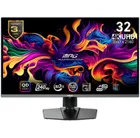
1. Best overall / 4K:
MSI MPG 322UR X24
2. Best budget 4K:
Asus ROG Strix XG27UCG
3. Best budget OLED
Alienware AW2726DM
4. Best 1440p:
MSI MPG 271QRX
5. Best budget 1440p:
KTC H27T22C-3
6. Best 1080p:
AOC Gaming C27G4ZXE
7. Best Ultrawide:
Gigabyte MO34WQC2
8. Best budget ultrawide:
Koorui 34E6UC
9. Best competitive
KTC 25M1
Asus's latest 4K OLED gaming monitor doesn't just pack LG's latest Tandem WOLED tech. It adds an RGB-stripe twist. The results are very, very good. But OLED perfect still hasn't quite been achieved.