
This month I've been: Marvelling at a slew of cool Computex builds, including this skyscraper-shaped custom PC. I've also been building (and burning) my own bridges in Paralives.
A photo-real art style rarely sells me on a game. That said, over the last few months, a tech delivering low-cost, photorealistic graphics has become something of a singular obsession of mine: Gaussian splatting.
Previously, I lost myself in this very basic FPS laying its scene inside a Gaussian splat of a real-world abandoned space. I caught up with the browser-based demo's artist, Christoph Schindelar, for an introduction into what Gaussian Splatting is and how it works. But today, I'd like to take a deeper dive into how it's done and what it can be used for—so I pestered Christoph Schindelar for his insight once again.
Schindelar is a scan artist who has previously worked for Quixel, an Epic-owned company with a world-renowned library of 3D scanned assets. He has been Gaussian splatting (or GS) since at least 2024. By way of a brief recap, Schindelar describes Gaussian Splatting as "a modern capture-and-rendering method that turns photos or video into a real-time 3D representation." It's very similar to photogrammetry but is arguably much less resource-intensive.
"A simple way to imagine it is like a very advanced point-cloud or particle/sprite-based rendering system," Schindelar says, "The scene is not built from polygons, but from millions of small semitransparent 3D Gaussians, often called 'splats.' Each splat has a 3D position, size, orientation and opacity, [plus] view-dependent behaviour called 'spherical harmonics.' When rendered, the approach projects to an elliptical footprint on screen."
In the past, I broke down this technical explanation of what GS is by likening each 'splat' to dandelion seeds. One little puffball doesn't look like much, but you collect a whole fistful of them and a soft shape begins to form. Well, imagine the vindication I felt when Schindelar showed me the below close-up of a cephalopodic statue splat—just look at all those little 3D Gaussians blowing in the wind.

Gaussian splatting is exciting in part because it's far less resource-intensive than other rendering techniques used to create photorealistic graphics. Rather than streaming, say, high-quality textures, Schindelar explains, "the GPU mostly has only to project and blend these splats, [so] playback can be very fast."
Even better, it can be an accessible route to photorealistic presentation for smaller projects. When I ask Schindelar what's one thing he'd like more people to know about Gaussian splatting, he answers that the tech is "implemented in nearly every major engine (standalone or via plugin)."
"The GPU mostly has only to project and blend these splats, [so] playback can be very fast."
"What is especially exciting to me at this point in time is that GS opens doors for independent creators," He goes on to say, "While the big budget game industry seems pretty slow with implementing new technologies, small studios are not! The most interesting practical experiments are currently happening with indie developers and independent creators. We are the ones pushing forward right now."
So, how is the splat sausage made? First comes the scan. For "high-end work, [where] color fidelity, dynamic range and overall image quality are crucial," Schindelar spends several hours snapping images using either a DSLR camera or a camera-RIG solution.
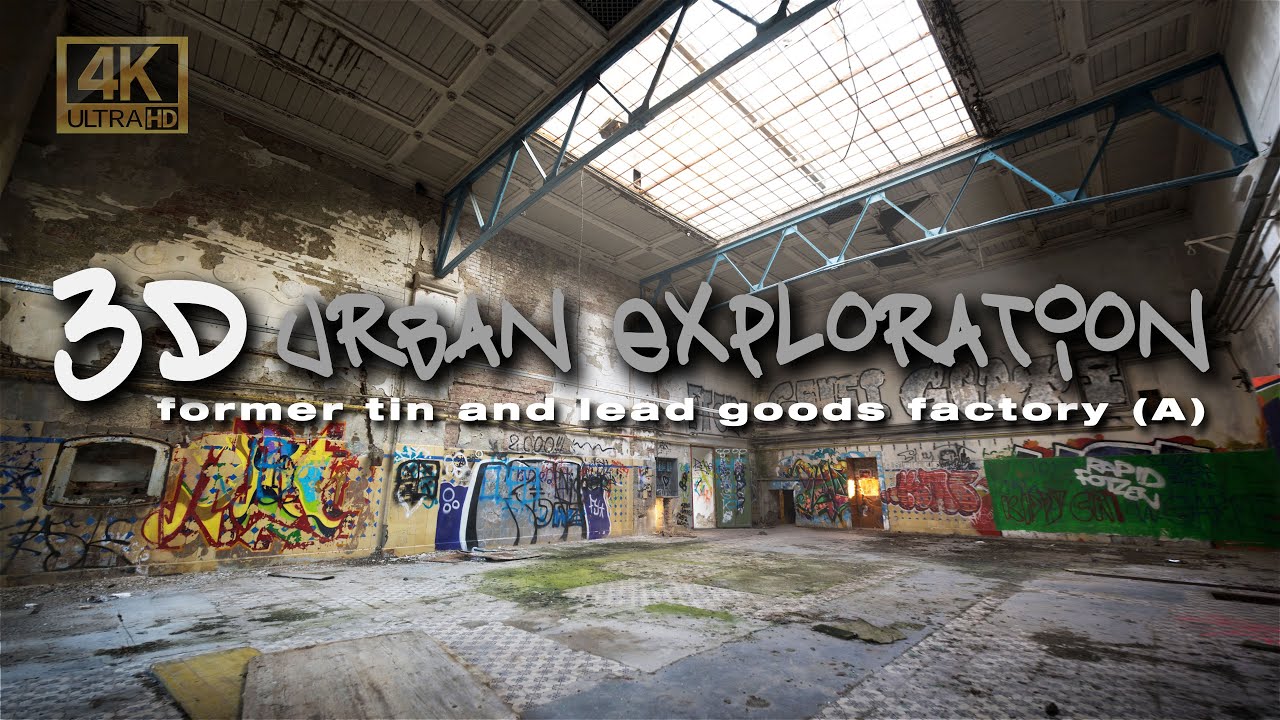
Schindelar elaborates, "For example, I scanned and processed this abandoned former lead and goods factory, including [the entire] interior and exterior within two weeks [using] a single Sony A7R4."
As for the required resolution of these images, this can vary depending on "the size of the environment, the capture distance, the field of view, the desired level of detail and the use case." While working with a lower resolution camera will generally require snapping more pictures to capture all the details, Schindelar also says it's not always a case of "more megapixels is always better."
"It's about having enough visual information from the right viewpoints," he says.

In other words, you could probably get away with a lower resolution data set for the squiddy statue above, or a narrow physical space, so long as you take close-up coverage to capture the details. Larger scenes, on the other hand, will usually require more high-res coverage.
Schindelar explains, "For example, in a forest environment, I would usually work with high-resolution cameras, because I don’t want the visuals to break at the first line of trees—otherwise I need to walk all the way to get every tree with close-up captures."

As such, data sets resulting from these capture sessions can vary massively in size. "In some high-end projects, I have reached raw capture datasets close to 1.5 TB. But that is definitely not what most indie developers should expect in everyday production. In many practical cases, the raw data is more in the double-digit gigabyte range," Schindelar says.
Post-processing can then take between one and three days. "The really interesting part that shines here is the reconstruction pipeline," Schindelar begins. "Starting from captured reference images, usually with pre-aligned camera positions and a sparse point cloud estimated through [structure from motion, i.e. photogrammetry], the Gaussian Splatting optimization process adjusts splats until the rendered views match the original photos as closely as possible. This is what we call 'splat training.'"

He later adds, "At the start of the training, you see a chaotic cloud of splats, scattered across the scene and not yet properly aligned. During optimization, this cloud gradually converges into a coherent representation, until the rendered result closely matches the original source images. That’s then our FINAL result."
"GPU power matters, of course, but in production I would say VRAM is the thing you always want more."
When it comes to hardware, apparently Nvidia GPUs are preferred for this part of the process. Schindelar uses an RTX 5090 for splat training on most projects, but also stresses that a monster workstation is far from necessary, having seen some splat artists achieve good results with relatively lightweight laptops.
"The most important hardware factor is VRAM since all the data must be cached on the card," he explains, "GPU power matters, of course, but in production I would say VRAM is the thing you always want more."
That said, there are cloud-based options for processing too. "Varjo Teleport, for example, is positioned as a cloud platform for real-world 3D and explicitly mentions elastic GPU clusters for scaling Gaussian Splatting workflows," Schindelar tells me, "KIRI Engine also offers app/cloud-style Gaussian Splatting processing and also XGRIDS have their own cloud-based processing service."

Schindelar explains that "after reconstruction, training and export," most GS scenes are a much smaller file size than the data set used to create them. He says, "For many of my environments, the exported data may end up in the range of a few gigabytes—often around 2 to 4 GB—and this is still not the optimized/compressed version. My largest current continuous scene is around 130 million splats with about 16 GB uncompressed, and it’s not even [a large space], but complex and highly detailed."
"We pushed a church scene from about 1 GB down to only 55 MB without significant visible losses."
The largest splat in question is Schindelar's Urbex: Greenhouse demo, in which I was surprised to find myself spending so much time marvelling over upended plant pots. Shifting from the biggest to the smallest, Shindelar highlights a PlayCanvas demo using 'Self-Organizing Gaussians' compression; "We pushed a church scene from about 1 GB down to only 55 MB without significant visible losses," he says.
The interior of the Kefermarkt Church is a thing to behold from your desk. 'Standing' between the pews, the 15th century carved wood altarpiece will take your breath away…though moving in close betrays the many Gaussians that make up this representation. Schindelar notes that seeing splats up close can look odd as people simply aren't as used to seeing them as, say, the pixels that dominate our screens.
"But honestly, is this a real issue? Idk," he ponders.
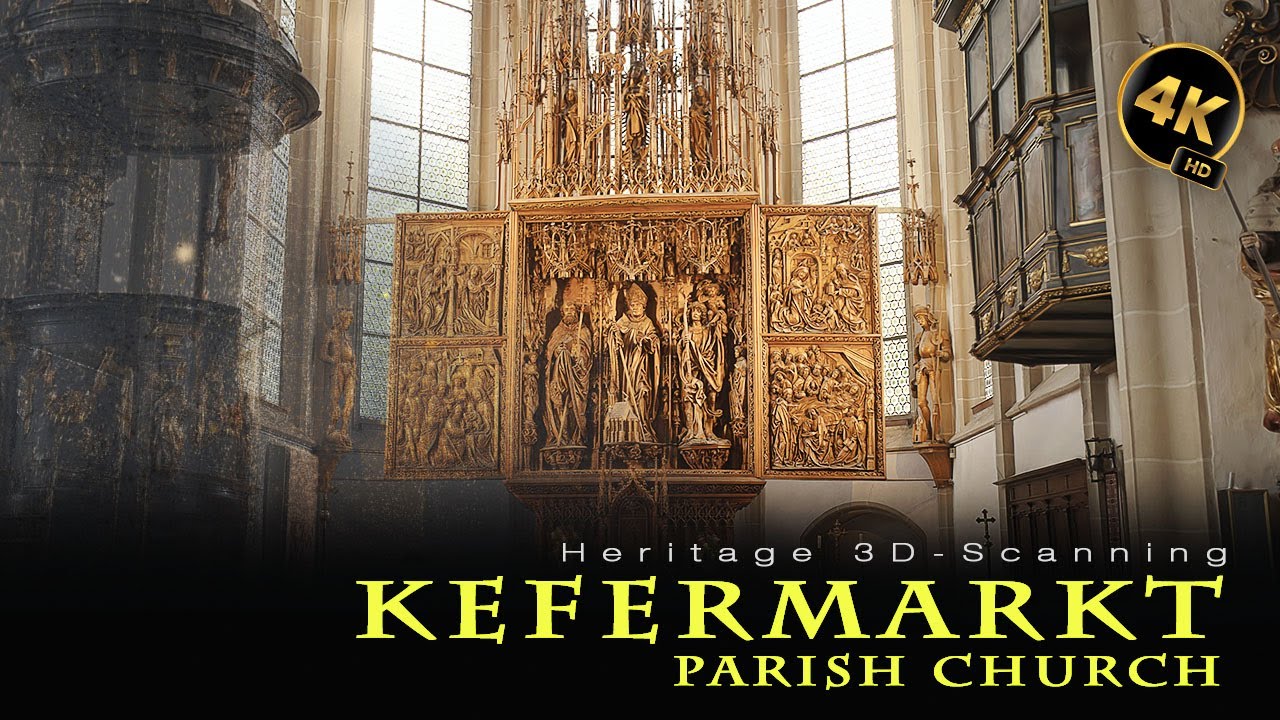
The 'Pfarrkirche Kefermarkt' scene won 'Splat of the Year' at the 2025 Polys Immersive Awards. Schindelar reflects, "There was very little comparable Gaussian Splatting content out there [at the time], and I think the result opened many people’s eyes to what this technology could do, not only for cultural heritage, but also for gamified real-world environments and interactive experiences."
Besides this tech's accessibility, or the fact that—if you play your compression cards right—large real-world scenes could be fully explorable on a mobile or handheld device, Gaussian splatting has a number of other strengths.

The tech is especially well suited to "thin structures like hair, wires and foliage that can hardly be reconstructed via traditional mesh-based solutions when scanned." I know Faye's hair looks incredible in that God of War: Laufey reveal, but I break out in a cold sweat thinking about what the technical art department had to do with potentially mesh-based techniques to get those luscious locks looking so realistic.
Schindelar continues, saying that "through [Gaussian splatting's] spherical harmonics, it can even capture and render reflections, translucency, semi-transparency and other visual effects." But before we start cracking 'DLSS 5, who?' jokes, it's important to remember that Gaussian splatting has its fair share of limitations. For instance, because splat scenes are based on still images, lighting is often baked in and not dynamic.

Schindelar argues these lighting limitations can be addressed with "practical production layers" such as using "a hidden mesh for dynamic light sources" or a shadow catcher "for collisions and interactive elements." He adds, "Decals and stuff like bullet holes can also increasingly be handled with solutions like parametric splat generation and splat painter."
The scan artist has experimented with dynamic lighting in a Gaussian splat scene, using Octane by Otoy. "I think combining technologies is great. Still, I wouldn't necessarily use GS for dynamic objects [such as animated props or assets that need to be editable inside a traditional pipeline], but it already works pretty well with static environments."

Though he admits Gaussian splatting still requires a lot of work before it can truly become just another tool in the game developer's toolkit, Schindelar remains excited about the tech's potential.
"When I'm testing some of my splat-based game experiments on my Steam Deck, this puts a huge smile on my face, and I can clearly see the potential," He tells me. "This level of visual quality on the small device is absolutely stunning. We are not quite there performance-wise, but really, really close—some more optimizations down the line and this is a game changer!!"

1. Best overall:
HP Omen 35L
2. Best budget:
Lenovo Legion Tower 5i
3. Best high-end:
Corsair Vengeance A7500
4. Best compact:
Velocity Micro Raptor ES40
5. Alienware:
Alienware Area-51
6. Best mini PC:
Minisforum AtomMan G7 PT