Join The Club





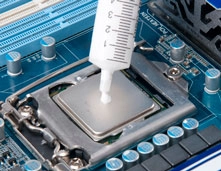
Does thermal paste really matter? We applied, reapplied, reapplied some more, and turned up the heat on our testing CPU to find out.
Ask ten geeks about their preferred thermal interface material (TIM) and you’ll get six different answers. Five will go with Arctic Silver 5 and the others will have five totally different favorites. Ask a non-geek about their favorite thermal paste and you might get slapped.
A Note on Methodology
Our test bed consists of an Intel Core-i7-975 CPU, overclocked to 3.9GHz. This gives an idle clock speed of 2.1GHz. Our motherboard is an Asus P6X58D Premium with 6GB of RAM and a Thermaltake Frio OCK cooler with its fans set to their highest setting, to maximize airflow. Our test bed is built into a High-Speed PC Top Deck Tech Station (large), and our PSU is an Antec TruePower 850W.
Article continues belowWe tested each thermal paste after an hour of idling, then after three hours running Intel’s Nehalem thermal stress-testing utility at 85 percent thermal load. How’d we get that number? We applied our standard thermal testing compound—Arctic Silver Lumiére—and cranked up the utility until the CPU was consistently just under 90C, then used those settings for every future test. CPU temperatures are an average of the four CPU core temperatures as measured by HWMonitor, and we used TMonitor to make sure the processors were running under 100 percent load at their full 3.96GHz during testing.
For this test, we focused on thermal pastes that are nondestructive—none of this liquid metal stuff—and readily available in the United States.
After a few weeks of testing day in and day out, we’re ready to report our results. Here are your contenders!
The Contenders (in order of testing)
Arctic Silver Lumiére OEM Thermal Testing Compound, Price N/A (OEM only)

Arctic Silver’s OEM testing compound is a ceramic-based TIM which we’ve been using in the lab for years because of its consistent performance and lack of burn-in time. It’s not available to the general public, but we included it to see how our baseline TIM really stacks up to the competition.
Not well, it turns out. We’ve been using Lumiére since God was a kid, and it’s not bad at low temperatures, but in our stress test it pulled down temps on par with the worst performers of the bunch—89C, almost hot enough to trigger our CPU’s automatic throttling.
Geek Approved?: No
Noctua NT-H1, $10 / 1.4ml tube


NT-H1 is good stuff. At full burn our processor only averaged 81.25C, and at our processor’s idle temps (still far higher than most processors’ burn temps) were just 41C.
Geek Approved?: Yes
Arctic Cooling MX-4, $13 / 4g tube


Geek Approved? Yes
Tuniq TX-4, $12 / 1ml tube


Geek Approved?: Yes
ZeroTherm ZT-100, $10 / 4g tube


Geek Approved?: Yes
Prolimatech PK-1, $13 / 5g tube


Geek Approved?: Yes
Rosewill RCX-TC090 Pro, $6 / 20g bottle

Rosewill’s thermal grease is cheap and easy to apply, thanks to its glorified nail-polish bottle and brush applicator, but its performance is strictly middle-of-the-road, with a burn average of 85.5C. Most of its 20g weight is the glass bottle.
Geek Approved?: No
Xigmatek PTI-G3606, $8 / 3g tube

Xigmatek’s memorably named PTI-G3606 is a silicon-based electrically non-conductive thermal grease. It’s very easy to apply a thin layer to the CPU with the included plastic spreader. In our tests it performed slightly better than the Rosewill RCX-TC090PRO, with burn temps of 84.5C.
Geek Approved?: No
Tuniq TX-2, $8 / 3.5g tube


Geek Approved?: Yes