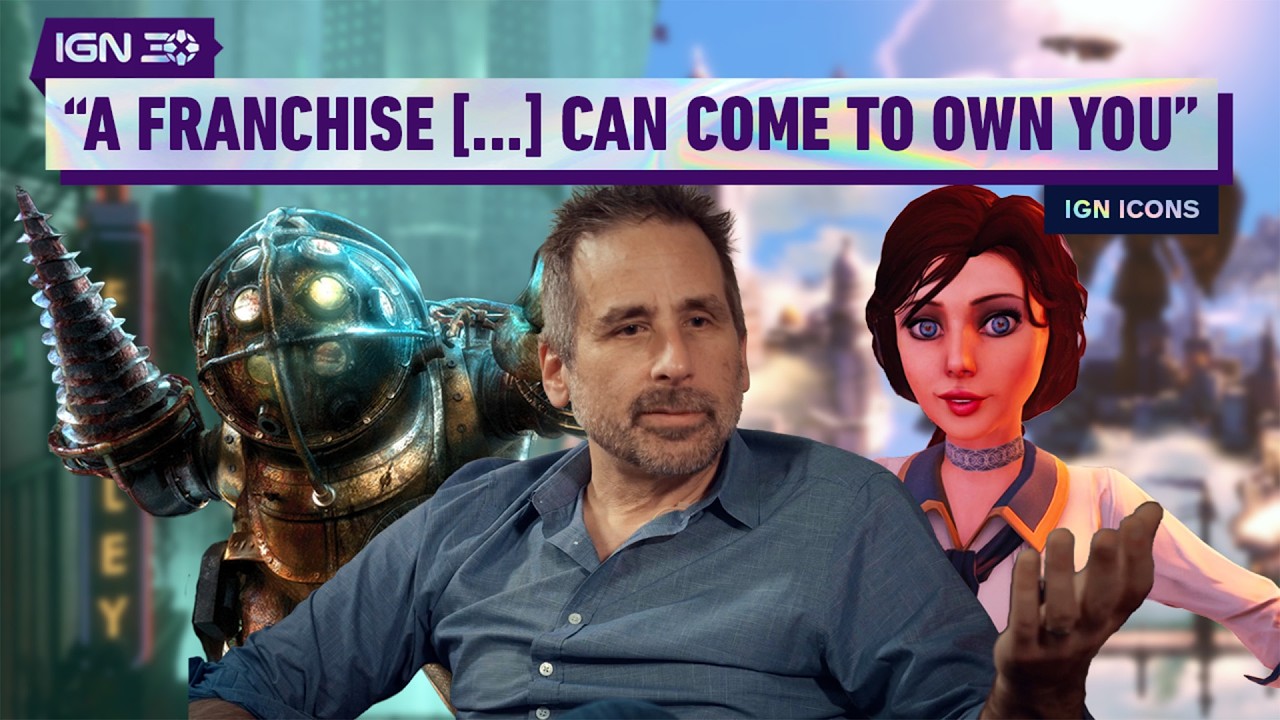
Ken Levine recently sat down with IGN to have a retrospective chat about his career, and naturally one of the big touchstones was the series he's best-known for: Levine co-directed Bioshock and was the sole director on Bioshock Infinite. At one point Levine is asked if it was tough to leave Bioshock behind after the closure of Irrational Games, and particularly now that Bioshock 4 in the hands of others.
"I was very incredibly fortunate to have a franchise that people cared about," says Levine. "It's very important to me. Like I've got a giant Big Daddy in my living room, I've got toys and stuff around. It's very important to me, but I didn't have a lot else to say in that world.
"So a franchise is an interesting thing because it can come to own you if you're not careful, right? Like it can define you. It was scary and risky and kind of crazy to walk away from a very successful franchise. I didn't do it because I didn't love the franchise. I did it because I didn't want to just make a new thing and call it [Bioshock] because that would be safer. I wanted to step away and challenge myself in a different way and challenge the team in a different way."
Levine's parting gift to the series was to elegantly create a framework that could contain a multitude of stories. As the ending of Infinite puts it: "There's always a lighthouse. There's always a man. There's always a city." If you've got those three elements, you've got a Bioshock story. But Levine says defining Bioshock was a lot thornier than that. While being a first-person shooter is part of its essence, as is some degree of alternate history setting, he says "even if you ask me to define what a Bioshock game is, I couldn't really even tell you exactly."
"Things can own you if you hold them too tightly rather than the other way around," Levine says. "Certainly, there's a lot of DNA in Judas of our legacy. But people are also going to be surprised how different it is. I did worry that this would just be the rest of my life. And I may look back and be like, that was the dumbest thing I ever did … But I'm fortunate that I've made enough, you know, I've had enough success where money is not the most important thing.
"Challenging myself and coming to work and working with brilliant people on hard problems is really what gets me going in the morning and so I wanted a new hard problem and we got one."
Levine is currently working on Judas, and has previously said it might look a bit like Bioshock but is "radically different." It really does resemble it though: as PC Gamer's Jody MacGregor said of the game's first trailer, "Judas couldn't look more like BioShock 4 if it had a lighthouse, a man, and a city."

1. Best CPU: AMD Ryzen 7 9800X3D
2. Best motherboard: MSI MAG X870 Tomahawk WiFi
3. Best RAM: G.Skill Trident Z5 RGB 32 GB DDR5-7200
4. Best SSD: WD_Black SN7100
5. Best graphics card: AMD Radeon RX 9070