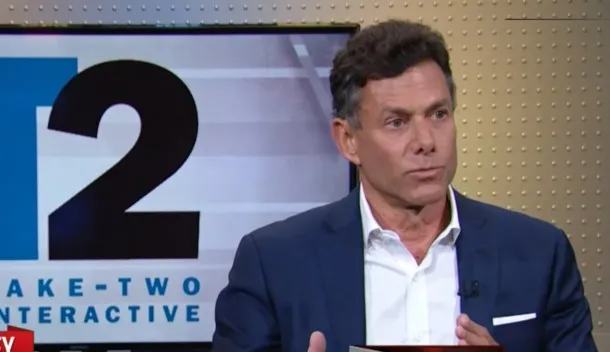
Take-Two CEO Strauss Zelnick has held a few contrarian opinions over the years. In 2019 he declared that Fortnite "never affected the [videogame] industry," and a year later he said he was "highly skeptical" that subscription services like Xbox Game Pass would become a primary distribution method for games. He was even more forceful in his thoughts on the future of VR, saying that he was thankful Take-Two "didn't waste any money on it."
On the non-fungible front, though, he's definitely rolling with the crowd. Following closely behind Ubisoft and Electronic Arts, Zelnick told GamesIndustry that he's a "big believer" in NFTs—although not necessarily as they exist right now.
"If you believe in collectible physical goods, I don't know why you wouldn't believe in collectible digital goods," Zelnick said. "And blockchain authorization, which is what an NFT really is, is one way—not the only way—to authenticate the fact something is singular, is rare.


"So I'm a big believer, but what I don't believe is that just because something is digital or an NFT that it suddenly has value and/or has value that will be increased in the future. And I think that's the problem. NFTs, because they're related to the blockchain as currently contemplated and because some have gone for a lot of money, are seen by some as just another opportunity to invest in a speculation that some think will only go up. And speculations don't just go up; they come down too."
He's not wrong, but he is perhaps understating the matter a little bit. Multiple recent NFT scams have cost backers millions of dollars: The creator of the Evolved Apes NFTs made off with $2.7 million in October, and earlier this week an unofficial Squid Game crypto-scam netted more than $3.3 million. Take-Two is obviously less likely to do a rug pull than Evil Ape, but it's still early days of a complex and risky technology—and that's without considering the challenges of convincing people that an image on the internet is unique and worth $600.
"For an NFT to be valuable and durable, it has to be found at the intersection of rarity and quality, of rarity and value," Zelnick said. "And there's rarity for sure in all NFTs, but I'm not sure there's value."
NFTs and cryptocurrency are also a point of contention across the industry as a whole. Steam recently imposed a blanket ban on games with NFTs or cryptocurrency on Steam, after which Tim Sweeney said the Epic Games Store "will welcome games that make use of blockchain tech." Interestingly, that position directly contradicted a statement he'd made less than a month earlier, when he disavowed NFTs because "the whole field is currently tangled up with an intractable mix of scams, interesting decentralized tech foundations, and scams."
The environmental impact of the blockchain technology that underpins NFTs and cryptocurrency is also a major concern: An MSNBC report from earlier this year said bluntly that "Bitcoin, NFTs and other crypto fads are destroying our planet" because of their extreme energy usage. A United Nations story from June took a more positive view, though, saying that the technology could become a net positive for the global community if "low-energy solutions" can be found. Zelnick expressed similar long-term confidence in blockchain tech, saying that "it hasn't found that many uses yet outside of cryptocurrency, but it will."