Nvidia is far and away still the biggest AI hardware company, and a large reason for that is thanks to CUDA. AMD, however, thinks that CUDA might have already had its day in the sun and is a "non-event" for some companies.
At an Advancing AI pre-briefing, AMD's corporate VP and GM of its data centre GPU business group Andrew Dieckman explained:
"I used to talk to our customers about CUDA a fair bit. I have almost zero conversations with our customers about CUDA at this point in time. It's a non-event, certainly for our major... Like, everyone's programming at higher levels of abstraction. They're using different serving frameworks.
"And the other thing that's really accelerated [CUDA] not really being the 'moat' that some people still think it is, is the efficacy of the AI agents, the models themselves, to assist our customers optimising to the AMD platform. That's a 2026 phenomenon."
Obviously, AMD isn't an unbiased source on this topic, but if there's truth to what the company says, Nvidia's dominance in the AI hardware space could be threatened. Because the reason Nvidia is the sole AI-related company making significant profit (AMD is making a much smaller margin) is largely CUDA.
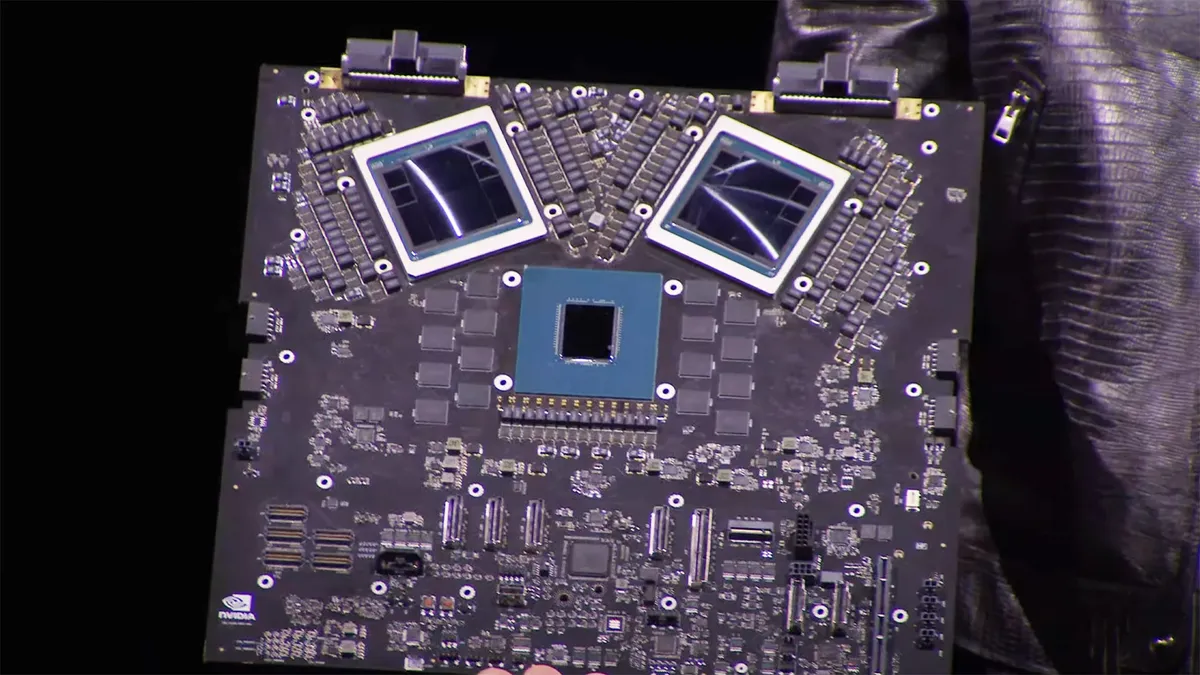
Nvidia has been cementing CUDA as the link between hardware and certain kinds of compute like matrix operations—which undergird AI—for years. So part of why so many AI companies use Nvidia hardware is because a lot of the tools, software libraries, and so on, have been built on top of CUDA, and it makes little sense to spend time and energy reinventing the wheel with something else.
That, plus Nvidia's capitalisation on it by leaning into full-scale solutions with CUDA at the centre, is largely why Nvidia has dominated the market.
The conventional view is that CUDA therefore protects Nvidia from competition. However, here AMD is saying it's not such an economic "moat", protecting the company and maintaining its advantage, as people may think.
According to Dieckman, AMD is seeing companies programming at "higher levels of abstraction" where CUDA isn't really needed. At these higher levels of abstraction, you're not interacting with the underlying framework(s) like CUDA at all, so you can take your pick and let whatever tools you're using deal with that translation to lower-level operations. And he also seems to imply that AI agents themselves can help optimise the platform without CUDA.

If CUDA does become irrelevant for these reasons, and if other companies, such as AMD, can offer cheaper alternatives, AI companies might start to branch away from Nvidia and towards AMD's ROCm, for instance. That would mean there'd be less need to buy into Nvidia hardware for AI.
That first 'if' is a big one, though. Because even if CUDA does become a "non-event" for some, others may prefer to play it safe with the infrastructure that's been working well so far. Especially given we're not playing with small sums of money when we're talking about AI data centres.
1. Best overall: AMD Radeon RX 9070
2. Best value: AMD Radeon RX 9060 XT 16 GB
3. Best budget: Nvidia RTX 5050
4. Best mid-range: AMD Radeon RX 9070 XT
5. Best high-end: Nvidia GeForce RTX 5090