Join The Club





Update: IO Interactive has now significantly changed the 007 First Light system requirements, saying it found some "inconsistencies" in the original specs. The recommended RAM, for instance, is now 16GB instead of 32GB, and the VRAM requirements for both the minimum and recommended specs have been lowered as well. PC Gamer hardware writer Nick Evanson still has concerns that there's no indication as to what quality settings are supposed to be used with the minimum and recommended setups, and whether or not upscaling needs to be used, but at least the numbers make a little more sense now.
Here's the new rundown:

But that is the way of PC gaming, isn't it? Always has been, always will be: I used to run Quake 2 at the most hideously low-spec settings possible, so I could squeeze a few more frames-per-second out of it and thus an edge over my online competitors. And I liked it!
Article continues belowYou won't be dueling with your fellow gamers in 007 First Light, no, but you may have to strike some sort of balance between pretty and performance. Luckily, it looks like there's a good bit of wiggle room in that regard. Here's what you'll need:
Minimum (1080p/30fps)
- Processor: Intel Core i5 9500K / AMD Ryzen 5 3500
- Graphics Card: Nvidia GTX 1660 / AMD RX 5700 / Intel discrete GPU equivalent
- RAM: 16 GB
- Video RAM: 8 GB
- Storage: 80 GB minimum
- OS: Windows 10/11, 64-bit
Recommended (1080p/60 fps)
- Processor: Intel Core i5 13500 / AMD Ryzen 5 7600
- Graphics Card: Nvidia RTX 3060 Ti / AMD RX 6700 XT / Intel discrete GPU equivalent
- RAM: 32 GB
- Video RAM: 12 GB
- Storage: 80 GB minimum
- OS: Windows 10/11, 64-bit
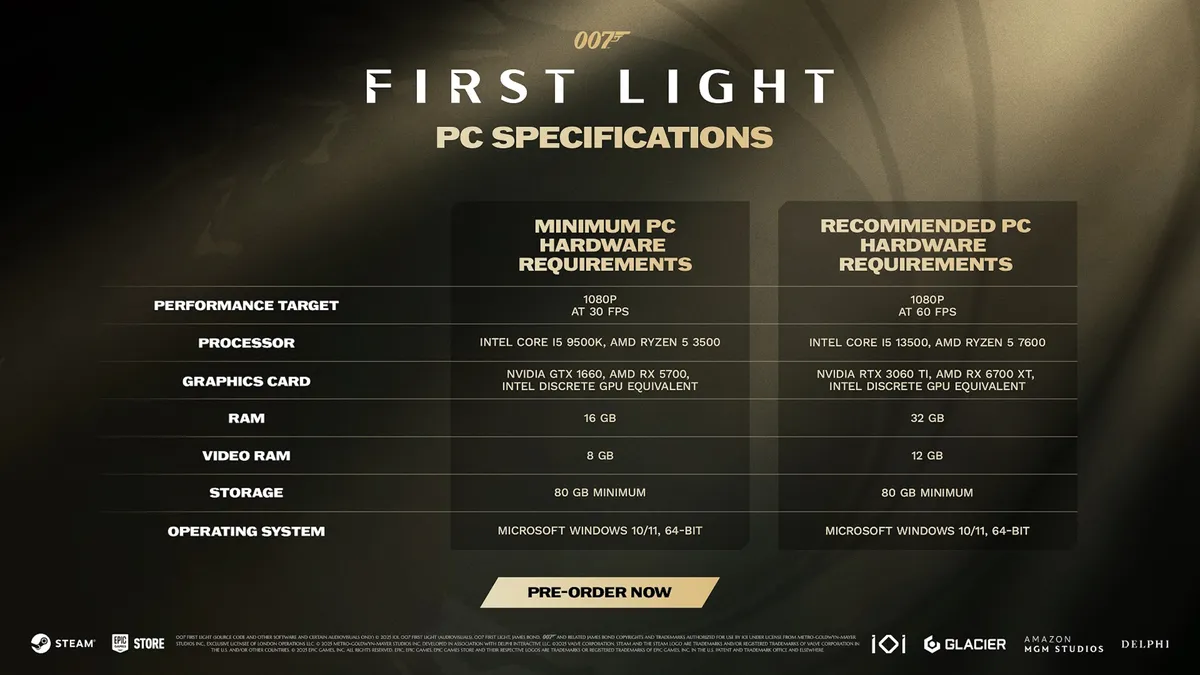
There are some caveats here. The minimum spec is basic enough, although the 8GB VRAM requirement on the GPU will leave RTX 2060 owners out of luck.
There are greater potential concerns with the recommended hardware, however. Requiring 12GB of VRAM for 1080p/60 fps is a bit worrying, but not as much as the fact that the RTX 3060 Ti only has 8 GB of VRAM, which questions whether IO Interactive has really tested 007 First Light fully.
There's no 4K spec listed, which is interesting, but if you've got the hardware for it you'll be able to take advantage of various bits of Nvidia technology including DLSS 4 with Multi Frame Generation, which IO Interactive said "enables us to deliver a PC experience that matches the level of quality we believe the Bond franchise deserves." As someone who paid good money to see Die Another Day on the big screen, I'm not sure I'd speak quite so confidently about what Bond fans "deserve," but I won't belabor the point.
But while IO Interactive said it has "significantly advanced" the Glacier engine, that engine has never been the best for delivering performance in the Hitman games. The announcement talks quite a bit about how much developers have worked on creating next-gen smoke, cloud, and particle effects, but I suspect the game is going lean heavily on upscaling (and possibly frame generation) to run well because those effects are heavily affected by resolution—which upscaling reduces. But it's likely 007 First Light players will have to rely on those technologies to run at frame rates higher than 60, especially at resolutions beyond 1080p.
Following a delay in December, 007 First Light is set to launch on May 27 and is available for pre-purchase on Steam and the Epic Games Store.


You must confirm your public display name before commenting
Please logout and then login again, you will then be prompted to enter your display name.