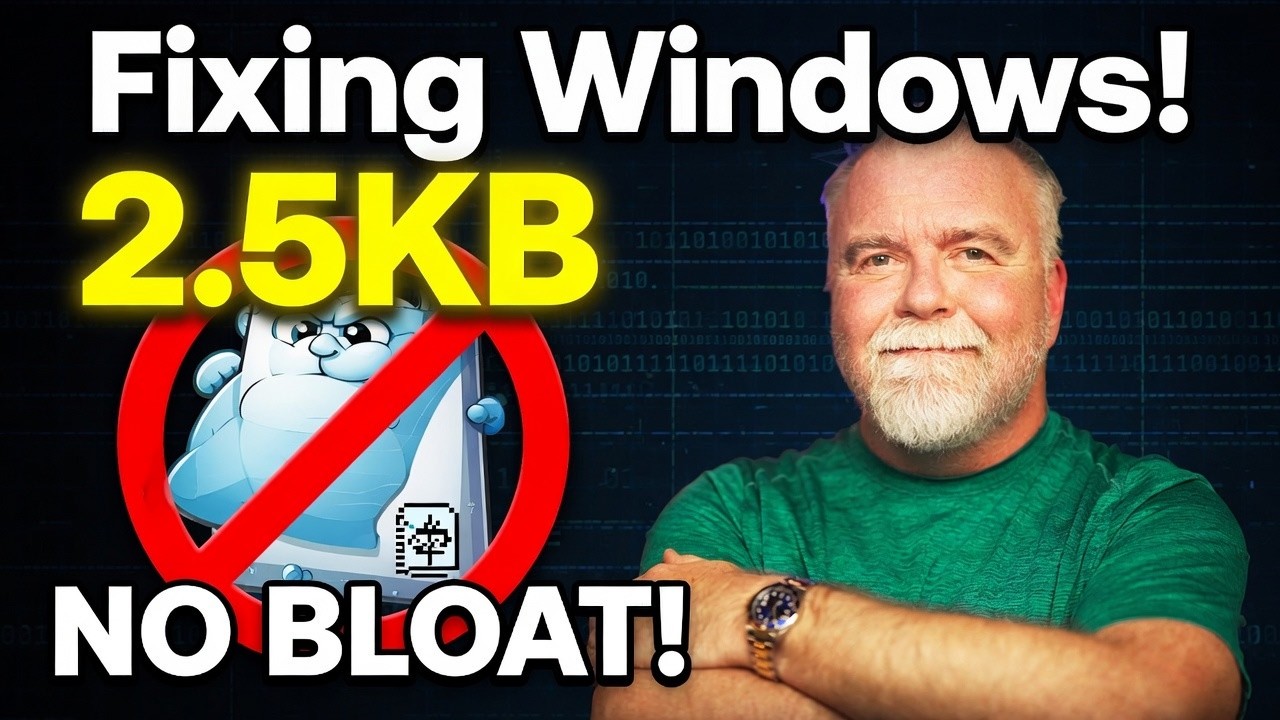
Once nothing more than a basic text editor, Windows Notepad has been expanded in recent years to become almost a fully-fledged word processor. For some people, the little tool has become synonymous with Microsoft's penchant for bloat and unnecessary changes, so one former Redmond coder decided to do something about it.
The person in question is Dave Plummer, and we've written about his past work and exploits many times over the years. These days, he regularly posts videos on his YouTube channel, Dave's Garage, and earlier this week, he showed how he created an app that replicated the original Notepad, with the goal of keeping everything under 4 kB.
In contrast, the latest version of the Windows Notepad executable is 352 kB. Some of that file size can be attributed to additions the text editor has accrued over the years, though hacking those off won't be enough to get Notepad down to 4 kB in size.
Incredibly, though, Plummer's final program is just 2,686 bytes. Not kilobytes, just bytes. That's only fractionally larger than the games the 1977 Atari 2600 console originally launched with. So how on Earth did Plummer make it so small?
What made this possible is the fact that Windows itself carries around everything an app needs, such as menu systems and a graphical user interface. You don't need to replicate them, just call them up as and when they're required. By writing just a few lines of assembly code to tell Windows to 'show a right-click menu', standard text editor features now take up hundreds of bytes in size.

Another trick Plummer employed was using Crinkler to generate the final executable. In the 4 kB demoscene, this little compressing linker tool is near legendary. Basically, it takes all the various file objects generated by the code compiler and links them together so that they become a cohesive program; then it compresses the living daylights out of the code.
Plummer's success at creating an OG Notepad just 2.6 kB in size wasn't using any cheats or the like: all Windows applications do this, which is partly why the operating system is as big as it is. And to be fair to the current version of Notepad, the code has to be secure, readable, version-compatible, and so on. All those aspects increase the file size.
The project is a good exercise for any developer to try and replicate, but it's also a very timely one. With the global memory crisis set to rampage for many more years, game devs will need to employ similar approaches in order to keep memory consumption down. Alas, with numerous game studios at risk of being shut down, decreasing budgets plus pressures over time constraints will almost certainly mean that we won't see programmers looking to shave off every megabyte where they can.
1. Best gaming chair: Secretlab Titan Evo
2. Best gaming desk: Secretlab Magnus Pro XL
3. Best gaming headset: Razer BlackShark V3
4. Best gaming keyboard: Asus ROG Strix Scope II 96 Wireless
5. Best gaming mouse: Razer Viper V4 Pro
6. Best PC controller: GameSir G7 Pro
7. Best steering wheel: Logitech G Pro Racing Wheel
8. Best microphone: Shure MV6 USB Gaming Microphone
9. Best webcam: Elgato Facecam MK.2