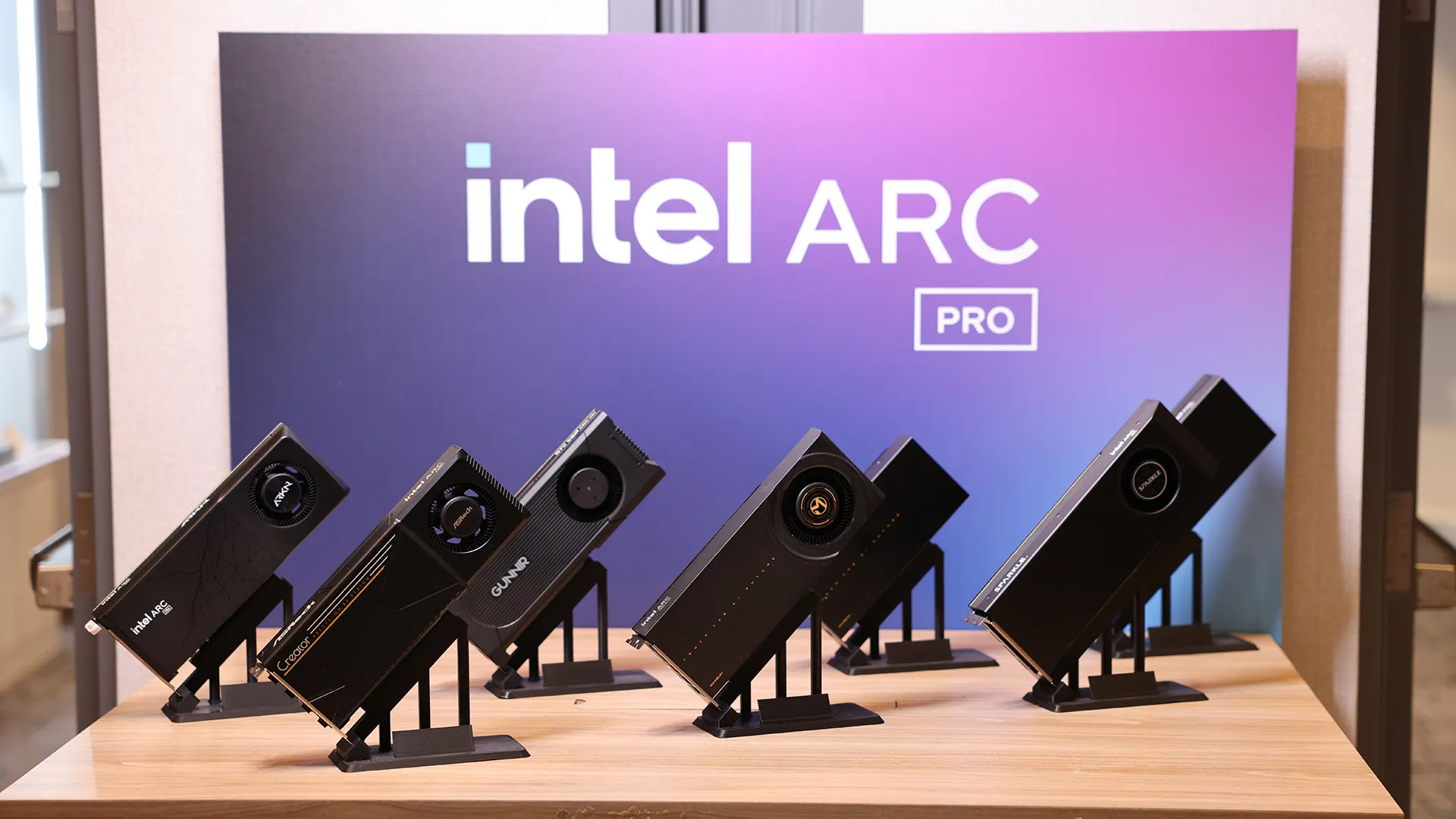
At last the mystery is over. Just how good is Intel's Big Battlemage GPU at gaming? According to the first round of comprehensive benchmarks, we're talking RTX 5060 Ti performance.
Yep, the Intel Arc Pro B70 has been benched and the results are pretty much as expected, disappointing and instructive, all at the same time.
If your home address in the last year or so has been No 1, Under Rock Avenue, allow me to recap. The Intel Arc Pro B70 uses the Big Battlemage GPU, otherwise codenamed G31.
It's the larger sibling to the G21 GPU as seen in the Intel Arc B580, Intel's second generation of graphics architecture, itself known variously as Battlemage or Xe2. And to the best of our knowledge, it was designed for gaming. But it won't ever be sold for that task.
Instead, Intel loaded B31 up with 32 GB of VRAM and is serving it up as a relatively low cost card for running local AI models, where "low cost" in this context means about $1,000 bucks.
And yet the tantalising question remains, how good would G31 have been at gaming? And now we have an answer. Or at least as close to an answer as we're likely to get.
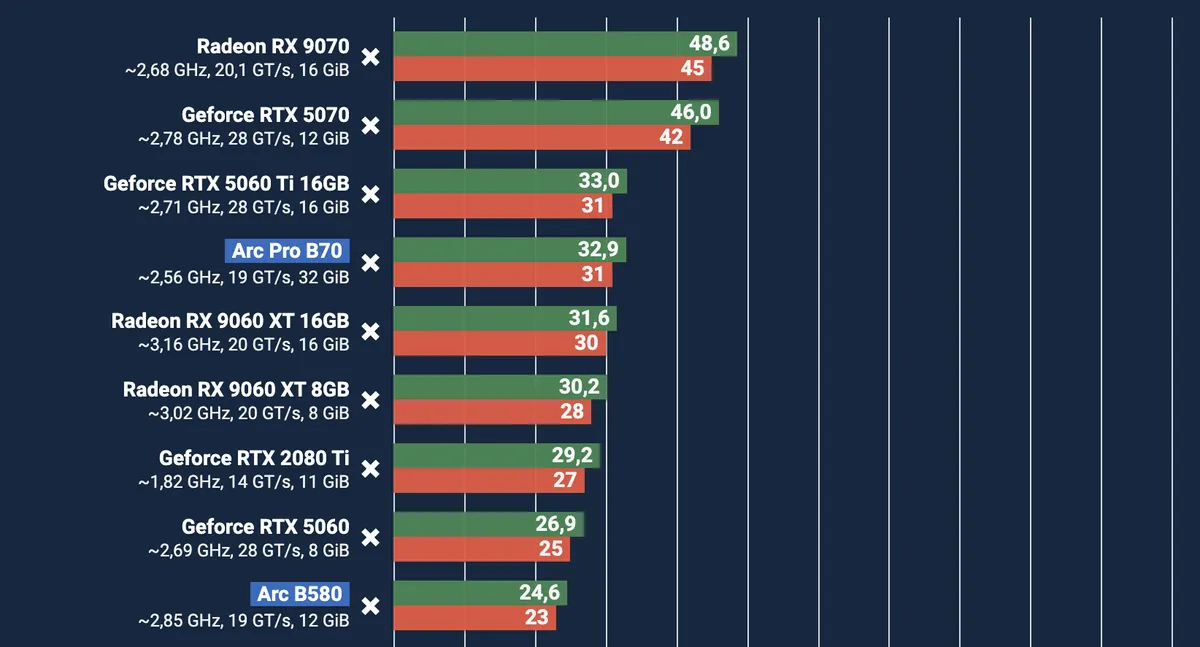
German website PCGamesHardware has run the Arc Pro B70 through its paces in a whole raft of games. And the results are pretty clear. In traditional raster gaming, it's near-as-dammit identical to an Nvidia RTX 5060 Ti 16 GB board.
Enable ray tracing or path tracing and it falls a fair bit behind the RTX 5060 Ti. In other words, it's definitely not the RTX 5070 killer—or at least RTX 5070 close competitor—we'd been hoping for.
So far, that's the "as expected" and "disappointed" bits ticked off. Yes, we were previously hoping for RTX 5070 grunt once, but more recently expectations were trimmed down to RTX 5060 levels and, disappointingly, that's where G31 has landed.
The "instructive" bit lands in terms of understanding why G31 never got released as a gaming GPU. RTX 5060 Ti performance isn't terrible. But that only scans at a certain price point.
And here's the thing. G31 is a pretty big GPU. It measures 368 mm2 using a TSMC N5-class production node. The RTX 5060 Ti? It's based on the GB206 GPU, which comes in at just 181 mm2 courtesy of a similar TSMC node. And smaller chips are much cheaper chips.
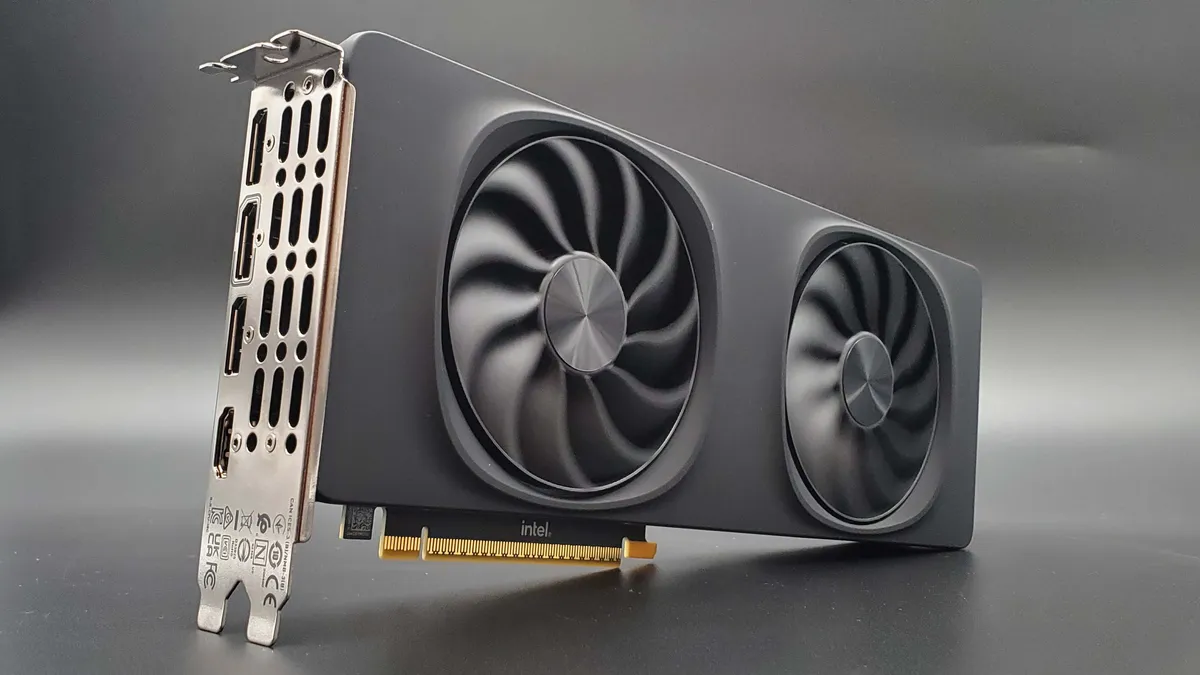
In short, the RTX 5060 TI will be dramatically cheaper to make. To put those numbers into further context, the GB205 chip in the RTX 5070 only measures 263 mm2. Even the RTX 5080's GPU, GB203, is only very slightly larger than G31 at 378 mm2.
So, yeah, that's RTX 5080 GPU-sized silicon with RTX 5060 Ti performance. Not great. Little more needs to be said regarding Intel's decision not to pitch it as a gaming GPU, albeit it's all testament to how brutally efficient Nvidia's GPUs are.
The one possible caveat is that presumably Intel hasn't leant that hard into optimising drivers for G31, so you'd think there was some performance left on the table.
However, looking at PCGamesHardware's numbers, even a best case scenario for G31 wouldn't get the job done. Why? Well, G31 has 32 Xe cores to G21's 20. That's 60% more cores.
According to the benchmarks, G31 is 34% faster than G21 in raster gaming, while the RTX 5070 is 87% faster. Even with perfect scaling then, which was always unlikely, G31 would be quite a bit slower than an RTX 5070, let alone the more comparable, in terms of die size, RTX 5080.
Better drivers would never close that gap. So, the G31 chip really is a non-starter as a gaming GPU. It's simply too big and expensive to be remotely relevant. The technical reasons are a story for another day. But in the meantime, it's all a bit of a pity, isn't it?
1. Best overall: AMD Radeon RX 9070
2. Best value: AMD Radeon RX 9060 XT 16 GB
3. Best budget: Nvidia RTX 5050
4. Best mid-range: Nvidia GeForce RTX 5070 Ti
5. Best high-end: Nvidia GeForce RTX 5090