Noctua doesn't do liquid coolers. It still doesn't today, though over at Computex it revealed a prototype for a liquid cooling product. Naturally, the air cooling company is going about it in an entirely different way to the norm. Its liquid cooler has no pump.
Noctua's design hopes to offer effective cooling despite lacking this one key component. Rather than a pump above the cold plate or embedded beside the radiator, Noctua's design harnesses a two-phase thermosiphon.
"I guess you're familiar with the basic concept of thermal siphons and fluid circulation being created due to density differences because of heat input?" Noctua's representative Jakob Dellinger asks me.
"Yes," I confidently reply, though Dellinger explains to me the details anyway. Here's how it works—for your benefit, not mine. Obviously.
"So in Italy or Greece, you see those rooftop water heaters? Yeah, thermosyphon base, heat the water, and then start circulating. And that's exactly what happens here, except for a difference that it's a two-phase thermosiphon."
"So when the working fluid is over the CPU, it will evaporate and go through the vapour tube up into the condenser, where it cools off, condenses back to liquid state and then flows back the return line back to the evaporator to eventually evaporate again."
It sounds a lot like how a heatpipe works with a GPU or CPU cooler—something Noctua knows very well. Nevertheless, it's teamed up with an aviation cooling company called Calyos to work on the thermosiphon project.
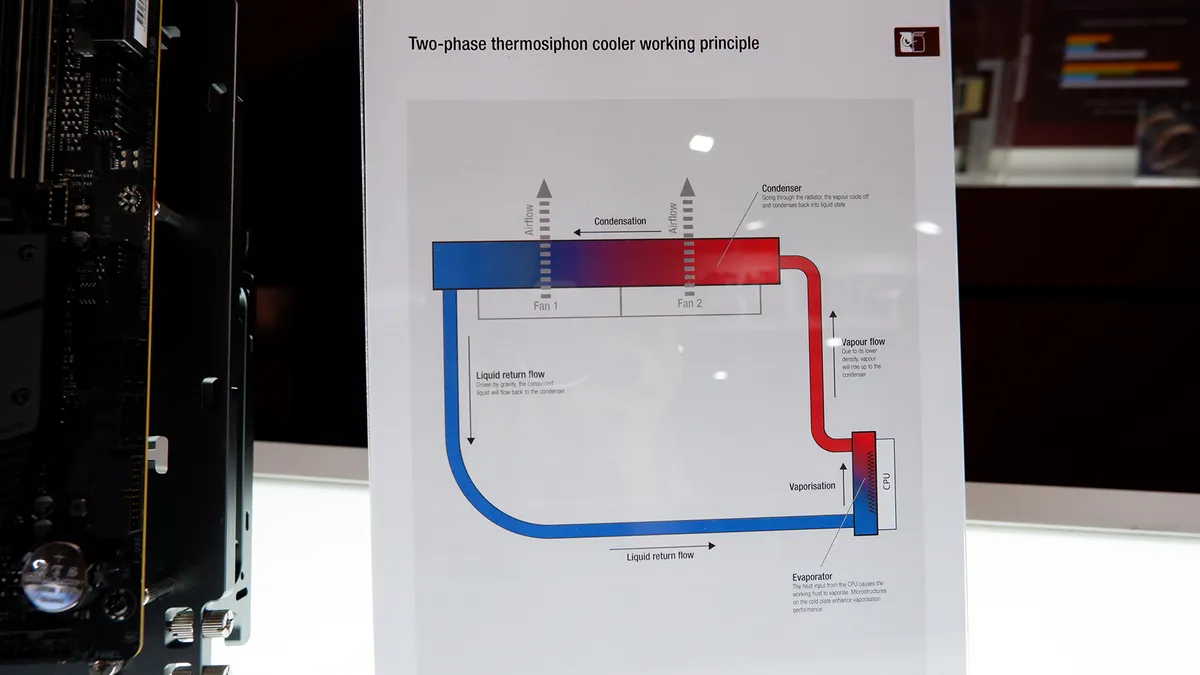
"The reason why this is so such a promising technology is due to the latent heat of vaporisation.
"So when you have a pot of water, it takes, I don't know, maybe 10 minutes to bring it to boiling, but it will take probably two hours to evaporate the whole amount of water. So there's just so much more heat capacity in that phase change process. And this is what we're utilising for cooling here."
Effectively, a lot of heat can be absorbed before vaporisation takes place. That's headroom for shifting heat away from a power-hungry CPU.
The goal is "AIO level performance", albeit without any of the downsides of an AIO cooler. Essentially, no pump means no pump noise, vibration, or risk of failure.

Though a thermosiphon has one potential drawback. It relies on gravity. The 240 mm or 360 mm radiator would need to be top-mounted within a chassis to work. Also it's not so much a drawback, per se, but there are still fans attached to the radiator on the thermosiphon prototype—if you were hoping for fully-passive, you best look elsewhere, such as the NH-P1.
It's one helluva concept, anyways. Noctua won't put an ETA on when it might arrive, however, the prototypes are "already looking very good."