
 Join The Club





SteamOS is what keeps the Steam Deck and Lenovo Legion Go S as some of the best handheld gaming PCs, despite the former's outdated hardware. Valve's own operating system is also set to power the forthcoming Steam Machine. Though it's a Linux-based OS in its own right, with its own updates, and a big one has just landed…
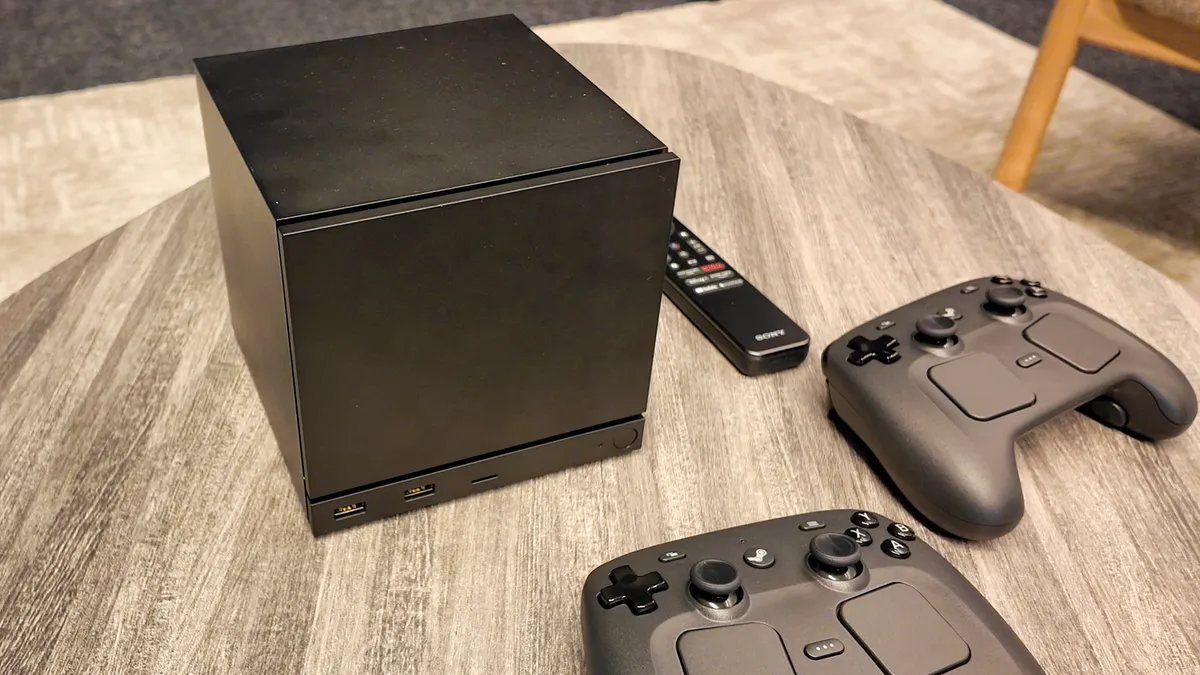
In SteamOS 3.8.0 Preview, initial support has been added for the Steam Machine. While neither the price or release date of living room box has been confirmed, we do know the living room box comes with a Zen 4 CPU and a semi-custom RDNA 3 GPU. Support for these architectures should be pretty well baked into Valve's OS already, however, as the patch notes also confirm more up-to-date support for AMD/Intel platforms and third-party handhelds.
There's a lot in this update. Two points in the patch note, in particular, stand out as good news for anyone hoping to load SteamOS onto a non-Valve device:
- Improved compatibility with recent Intel and AMD platforms
- Greatly improved video memory management with discrete GPU platforms
The Steam Machine has a discrete GPU, hence further support makes a lot of sense, but it also gets us closer to Valve's vision of an actual Steam Machine. Not just the pre-packaged box, but the concept of sticking SteamOS onto your own hardware. We've tried SteamOS on a couple of devices over the past few years and it's yet to feel like the best option—Bazzite or another Linux distro is often a better pick.
Article continues belowWe might be a ways off a wider release of SteamOS, and one that's ready to roll on a range of hardware, but in the meantime, Valve has made good on bringing further handheld support to the OS. There are a lot of improvements here for non-Valve handhelds, especially the Lenovo Legion Go 2.
- Power button short and long presses now supported across a wide variety of devices
- Improved controller support for OneXPlayer F1 series, GPD Win 5, GPD Win Mini, Anbernic Win600, OrangePi NEO, and Lenovo Legion Go
- Added controller support for OneXPlayer X1 series and Lenovo Legion Go 2
- Added system and controller firmware update support for the Lenovo Legion Go 2
- Added preliminary charge limiting support for Legion Go, Legion Go S, and Legion Go 2 - currently only accessible in Desktop Mode
- Added controller RGB LED color settings for the Lenovo Legion Go 2
- Added controller, TDP control, and speaker audio support for the ASUS ROG Xbox Ally series
- Reduced handheld controller input latency from 5-8ms to 100-500us
- Night mode, color vibrance, and color temperature sliders in Steam now work on Z2E and later AMD APUs
- Seamless boot fixes for Z2E and later AMD APUs
- Automatically handle internally rotated display for some third-party handhelds
- Improved motion control support for handhelds with BMI260 IMUs
- SD card reliability improvements for some third-party handhelds, including ASUS ROG Xbox Ally, Legion Go 1, Legion Go S, Legion Go 2, and MSI Claw
- Fixed washed out colors for Zotac and OneXPlayer handhelds with OLED
- Fixed some GPU hangs on Phoenix APU devices (Tales of Arise, Octopath Traveler II)
- Fixed ASUS ROG Ally power consumption from fingerprint reader while shut down
A couple of us at PC Gamer have tried adding SteamOS to various Windows-powered handhelds over the years, to mixed success. There are two things that tend to trip us up: screen rotation and audio drivers. Sometimes you can get around it, sometimes you can't, but I'm hopeful that further support baked into the OS should start to make a SteamOS switch more viable.
SteamOS has also been updated to Wayland by default. Wayland being a protocol that organises how applications are seen and interacted with. It's not a GUI, rather the protocol for displaying stuff—a display server that ensures display is coordinated between applications. The alternative, X11, is much older and largely being replaced in Linux distros by Wayland. I'm no expert on display servers or protocols, but it's a good thing that SteamOS has made the switch; providing everything plays nicely with Wayland.
KDE Plasma, the desktop environment used by SteamOS by default, is also being updated to support Wayland. This bringing with it support for HDR and VRR on external displays, per-display scaling, and rotated displays.
Is it time to update your Windows-powered handheld gaming PC to SteamOS? You might make a better go of it with this updated version of SteamOS, though we still think Bazzite is a great alternative. We're fans of Linux for handheld gaming, though it can lead to some less than ideal results on some devices. If you prefer not to tinker, Microsoft is rolling out a handheld-friendly version of Windows.

1. Best overall:
Lenovo Legion Go S SteamOS
2. Best budget:
Steam Deck
3. Best Windows:
Asus ROG Xbox Ally X
4. Best big screen:
Lenovo Legion Go
5. Best compact:
Ayaneo Flip DS

You must confirm your public display name before commenting
Please logout and then login again, you will then be prompted to enter your display name.

