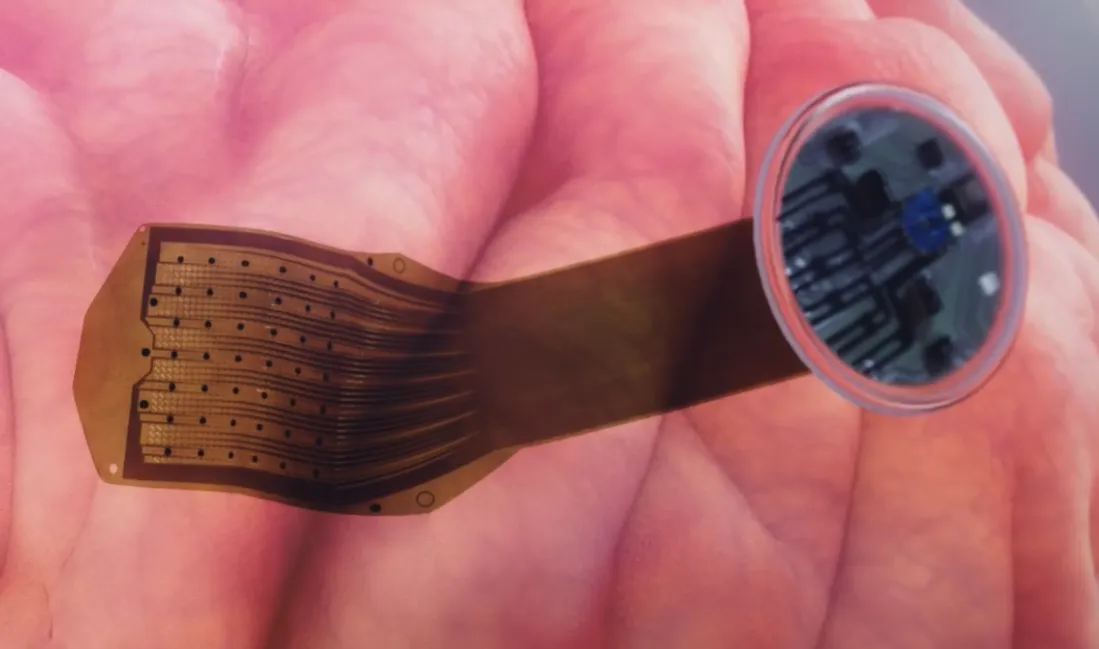
Precision Neuroscience, a specialist in brain-computer interfaces, has laid claim to a new record for the number of surgically-inserted electrodes in a human brain. At 4,096 electrodes, Precision reckons it has doubled the previously published figure of 2,048 set last year by a group of researchers headed up by Hao Tan.
For context, Elon Musk's Neuralink currently tops out at 1,024 electrodes for its brain-computer interface (BCI). Is electrode count the be all and end all for BCIs? Colour us clueless, for we have no idea. But it certainly get you bragging rights.
Whatever, much like other BCI outfits Precision Neuroscience aims to restore functions, "such as speech and movement to millions of severely paralysed people."
As it happens, Precision Neuroscience was co-founded by neurosurgeon Ben Rapoport, previously a co-founder of Neuralink. Several other senior Precision Neuroscience are also Neuralink alumini.
Where Precision Neuroscience seemingly departs from Neuralink is its attitude to invasiveness. "We believe that it’s possible to interface with the brain without damaging the brain," Rapoport says.
Notably, he has reportedly also discussed how his concerns over safety and the invasiveness of implants contributed to his departure from Neuralink (via Ars Technica).
Anyway, to set the new record Precision Neuroscience surgically implanted four of its latest Layer 7 Cortical Interface thin-film microelectrode arrays, each containing 1,024 miniature electrodes into an an unnamed subject's brain during surgery for a benign brain tumour in April.
Precision says that its thin-film microelectrode array is engineered to conform to the brain's cortex without damaging tissue. Thousands of channels can be delivered anywhere on the brain's surface using its patented, minimally invasive insertion method.
As for how it works, when the brain processes information or initiates an action, it generates electrical signals. The thin-film electrodes can capture these signals at micron scale, providing a view into the brain’s activity. More electrodes means more data, a higher resolution picture of brain activity, if you will.
“This record is a significant step towards a new era. The ability to capture cortical information of this magnitude and scale could allow us to understand the brain in a much deeper way,” Rapoport said after the procedure.

Best gaming PC: The top pre-built machines.
Best gaming laptop: Great devices for mobile gaming.
Notably, Precision's device does not penetrate the brain at all—it's a film that sits on top of the outer cortex. Insertion is said to only require a thin slit in the skull through which the ribbon-like Layer 7 Cortical Interface device can be threaded. If it needs to be removed, Precision claims it can slide off the brain with causing any harm.
By contrast, Neuralink's BCI device utilises thinner-than-hair wires that are implanted three to five millimetres into the brain by a surgical robot. Neuralink reported earlier this month that 85 percent of the wires retracted from the subject's brain within weeks of surgery. Consequently, it plans to go deeper, to eight millimetres, with its second subject.
Which approach will win out or if, in fact, both more and less invasive technologies will be needed for different applications is anyone's guess. But we're not expecting to be controlling our games with the power of pure thought just yet. Especially not if it requires implants in our heads, no matter how small the slit...