One thing you get from Supermassive Games that you just can't get from other horror games is a cinematic experience. I like to joke that the premise of these games is simply: 'What would you do if you were in a horror movie', and Directive 8020 stays along those lines as it dumps players in what is essentially John Carpenter's The Thing, but in space.
Aboard the Cassiopeia you follow a group of scientists and explorers, plus one billionaire on their maiden voyage towards a new possible home for humanity. But your travel is rudely interrupted by some strange extraterrestrial lifeform that steals people's identities and then tries to kill off the crew.

The story is made even more suspenseful by its episodic structure, as each episode usually ends on some disastrous cliffhanger or 'oh shit' moment. The end of episode four was the latter for me, as I failed a quick time event during an altercation with one of the monsters, and the character I was playing ended up with one less eye. Whoops.
Splitting the story up into eight is certainly new for The Dark Pictures. But creative director Will Doyle explains that it seemed like the logical next step on the journey to giving players that "feeling you have when you are sitting down and watching a limited TV show."
"We always want to make it feel like you're playing a movie or a TV show," Doyle reiterates. "So [Directive 8020] has a really interesting mix of what we call lean forward and lean back gameplay. You'll have moments where you're like, 'Okay, this is a cinematic narrative scene. I can sit back and enjoy it a little bit more like a movie or TV show,' but you still get to make really, really important decisions throughout that. Then that's interspersed with lean forward moments where you have to avoid an alien, or now search the ship for clues—it's a really interesting mix."
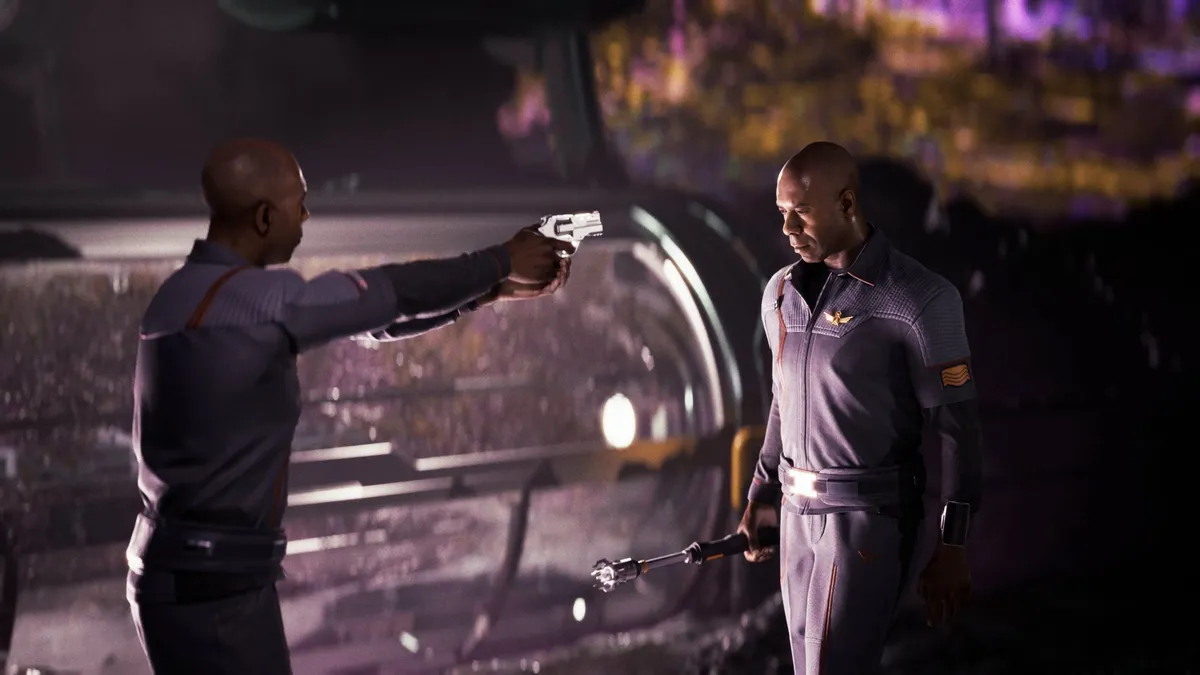
There's plenty of those 'lean forward' moments in episode one, which I played back in August and episode four which I got to check out for the recent preview. In fact, one of the best parts of the 'lean forward' moments is that they'll sometimes catch you by surprise. Directive 8020 does such a good job of convincing you it's a TV series that moments where you need to urgently take over made me jump out of my seat as I forgot about the controller sitting in my hands.
"I think it also gives the story a really interesting edge," Doyle adds. "We always ask ourselves, as designers, would this happen in a movie or a TV show. And it's a really useful lens to look at the story through, or look at the gameplay through, because if it starts to feel too gamey, it kind of pulls you out of that. If you keep the reality of what's happening, it makes everything feel a lot more serious."

But the structure isn't just useful in mimicking a TV show, it's also helpful when it comes to scheduling time for gaming. "I always want to be mindful of people's time as well," Doyle says. "So it's quite nice to know that I can sit down for an evening and go, 'let's play an episode of Directive 8020' and know that it's going to last a fixed amount of time. I can schedule my life around that."
There are so many ways to play Directive 8020, the beauty is that you can do it at your own pace.
Finding a good stopping point in games can be hard, I should know, I'm currently playing Pokopia, a game I regularly find myself playing long into the night because there's always just one more little task to get done. So having a stopping point at the end of each episode is certainly helpful.
But also don't have to adhere to that pause. There are so many ways to play Directive 8020, the beauty is that you can do it at your own pace. I've already decided that my first playthrough will be driving by instinct alone. I'll not use the turning point mechanic that lets you go back and redo choices or actions, instead letting myself naturally progress through the story, and just wait and see where I end up. Everyone's probably going to die, but I've made my peace with that.
However, I'll use the turning point mechanic continuously through my second run, completing each possible outcome as I progress through the story, filling out the spider's web of events so I can see every possible outcome. That way I can understand not only where I went wrong, but also how badly I messed up.