Weird Weekend is our regular Saturday feature where we celebrate PC gaming oddities: peculiar games, strange bits of trivia, forgotten history. Pop back every weekend to find out what Jeremy, Josh and Rick have become obsessed with this time, whether it's the canon height of Thief's Garrett or that time someone in the Vatican pirated Football Manager.
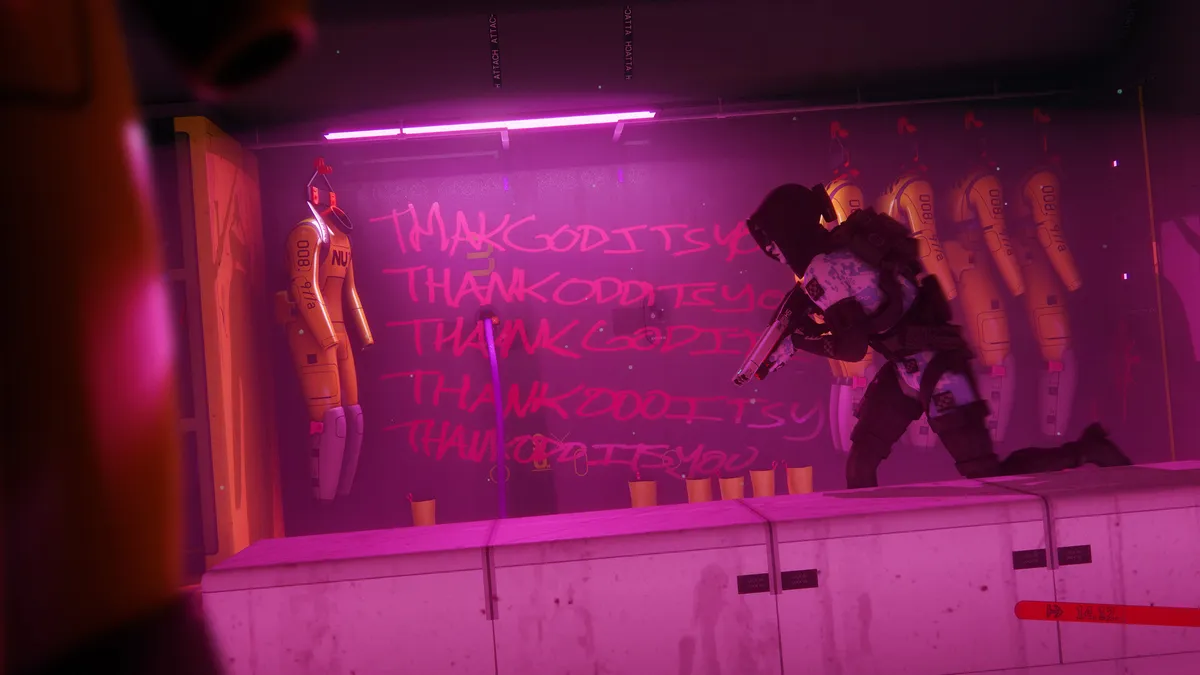
In the shadows of the bio-research lab in Dire Marsh, there's a strange strip of graffiti, scrawled behind a rack of hazmat suits in luminescent pink.
THAKGODITSYOU," it reads. "THANKODDITSYOU. THAANKGODITSYOU. THANKOOOITSYOU."
It would be just another disturbing example of Tau Ceti IV's decline, as its colonists succumbed to disease and infighting—easy to miss among the planet's many horrors. Were it not for the fact that it also features in Marathon's promo art. You've likely seen this graffiti plastered across the game's Steam page, or other articles on PC Gamer. And over the last month, I've come to understand its meaning.
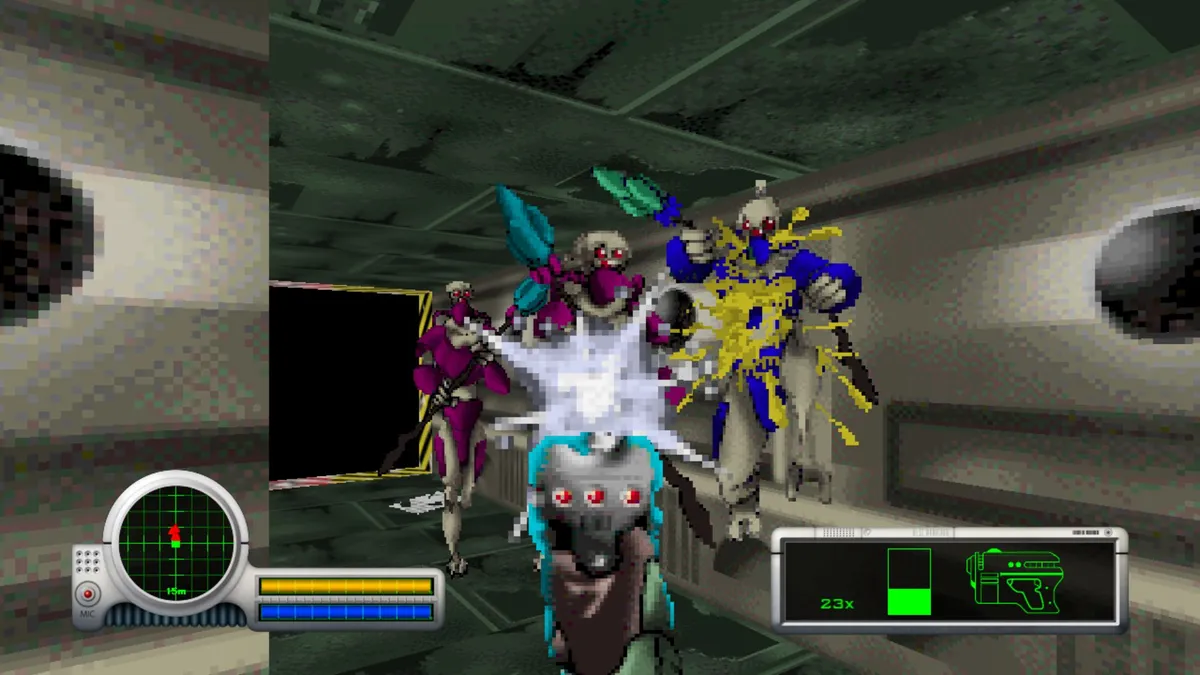
In 1994's Marathon—the Doom-like shooter that first made Bungie a beloved name among Mac gamers—you're trapped aboard the UESC Marathon during an alien invasion. And in the course of exploring the colony ship, you'll come across many BOBs—civilians who were "born on board" during the vessel's protracted journey from Earth. Only trouble is, some BOBs are infected, and explode once you get close.
On the face of it, the two games couldn't be more different.
How do you tell the difference? By listening to what they say. Innocent BOBs scream "They're everywhere!" as aliens with spears chase them down in tight corridors. Exploding BOBs, however, are filled with relief: "Thank God it's you!". An expression of gratitude turned sinister.
Playing Marathon (2026) and Marathon (1994) at the same time has been a fascinating experience. On the face of it, the two games couldn't be more different. One, an extraction shooter that exists in conversation with Hunt: Showdown, Valorant and battle pass culture. The other, an artefact from the very birth years of the FPS, informed by the maze games and dungeon RPGs of the 1980s—as much a navigational puzzle box as a test of your mouse hand. The gulf in approach is a powerful demonstration of just how far the genre has travelled in three decades—a kind of colony ship in itself.
Yet you can see why Bungie looked at its original trilogy and concluded that, yes, there were narrative threads here that could support a reboot. Scattered throughout the first Marathon are terminals—computer stations where you can track the wider war that's raging across the ship, and hear the thoughts of the onboard AI. Playing as a mute security officer, you're batted back and forth between Leela, a relatively stable AI fighting to save lives, and Durandal—an artificial entity concerned with his own growing consciousness.
"Greetings," he says. "You're asking yourself: Is this a trap or just a dead end? You shouldn't ask yourself such worthless questions." Durandal wants to elevate you. To get you wondering: why are you here? Why do you exist, and what is your purpose? "Answers: 'Cause you are. 'Cause you do. 'Cause I got a shotgun, and you ain't got one."
Durandal quotes from Darwin, and 11th century poetry. He signs off his messages with "Insanely yours," like a lover deranged by longing and beauty in Wuthering Heights. At all times, he's playful, bringing a frisson of unpredictability to what might have been straightforward science fiction.
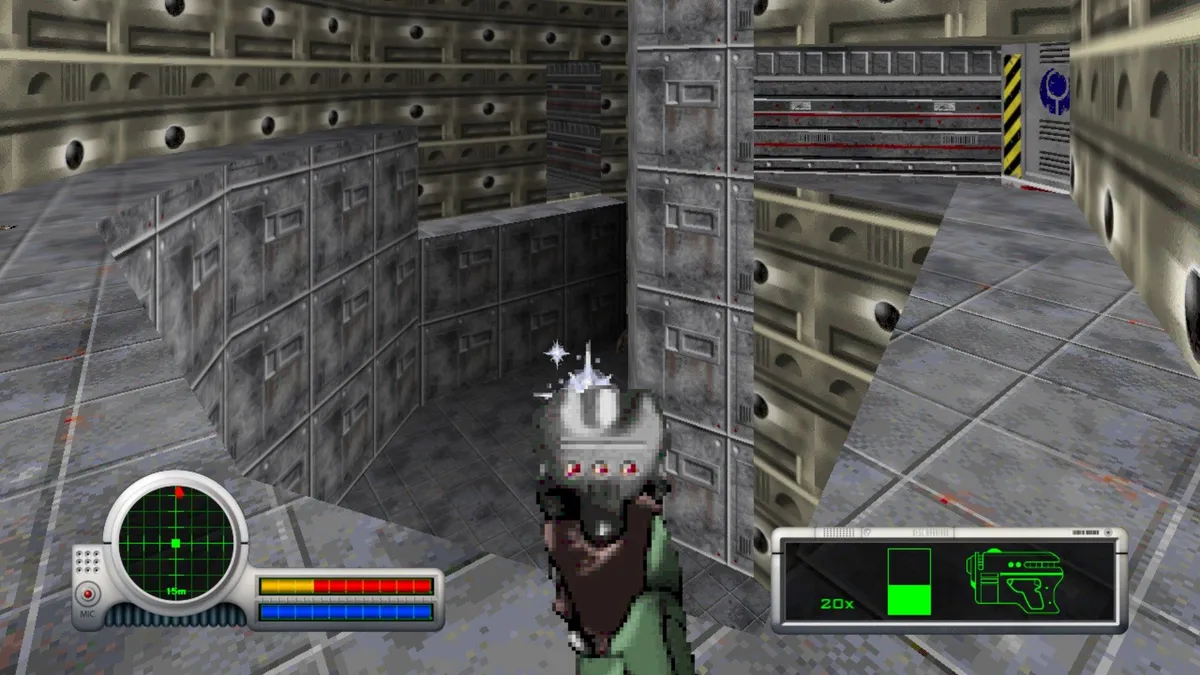
It's worth considering how remarkable this was in the context of 1994. Doom had eschewed complex plotting in favour of a simple premise. System Shock invented the very first audiologs only a few months prior to Marathon's release. An FPS with narrative chops was rare in the extreme. But this legacy has allowed Bungie to stay true to the tracks laid down by Durandal—across two '90s sequels, and in the lost colony mystery story it's telling today.
Developers of the time worked extraordinarily hard to render worlds in the way we now expect them.
If you're someone who's partial to a WAD, and Doom clones in general, then you might still consider OG Marathon worthy of your time. It's a Good One of Those. It offers the timeless magic of dodging sluggish missiles as they soar towards you—an act which never fails to plunge you into three-dimensional space, in a fashion that feels somehow VR-adjacent.
In fact, there's a commitment to the promise of 3D that I think defines shooters of this era. Developers of the time worked extraordinarily hard to render worlds in the way we now expect them, and made sure to squeeze the potential out of every vertiginous level. So while the original Marathon doesn't have mantling or grappling hooks—or a jump key, for that matter—it's very much about climbing, falling, and airborne sprints that take you from one raised platform to the next before gravity can catch up.
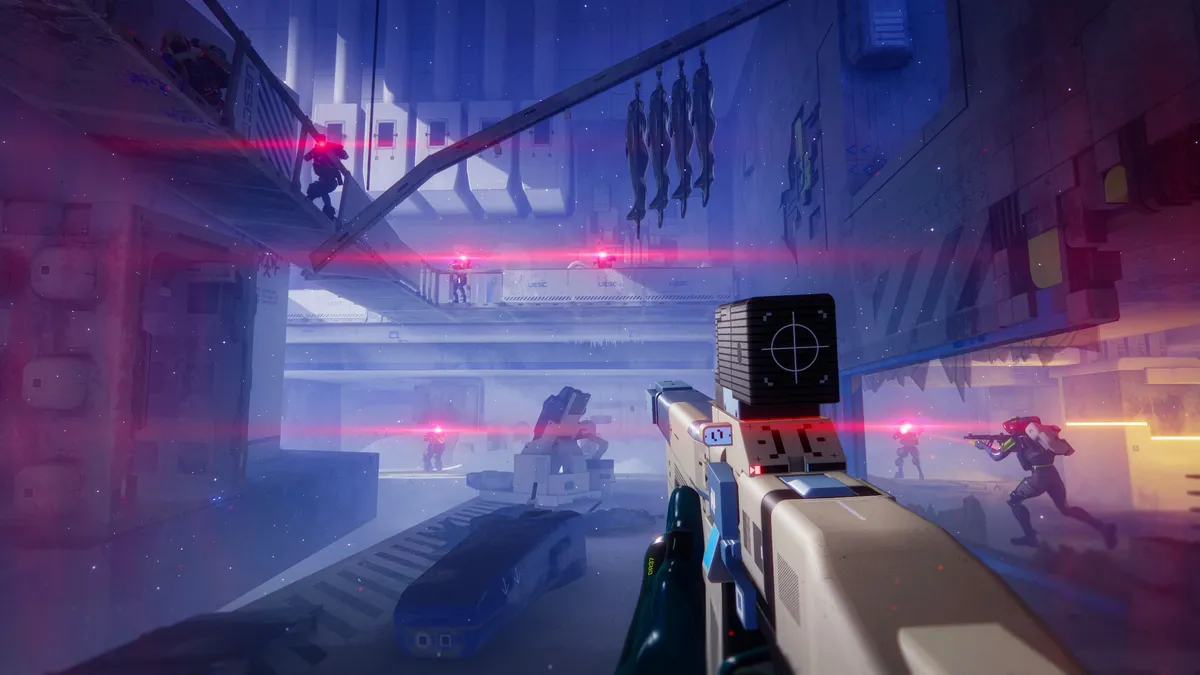
Navigation can feel claustrophobic and freeing at the same time—as if you're clambering through sections of hull that were never meant for human occupation. Metal crushers, molten rivers, pathways so narrow they need to be widened through mechanical intervention before you can fit yourself through. It's this sense of brute forcing your way through a stubbornly closed environment that Bungie recreated with the modern Marathon's raid map, Cryo Archive.
There are other parallels that I can't help but draw between the two games. Nu-Marathon is fundamentally about information gathering—both aural and visual, to give you an edge over other teams of players. And 1994's version has a little of that going on too. I'm fond of its Alien-style motion tracker, onscreen at all times, which registers nearby enemies as red blips and reminds me of the role of the Recon class on Tau Ceti.
Then there are the guns: particularly the fusion pistol, which fires with the familiar thunk of volt weaponry. It has a secondary fire mode which, when fully charged, causes your protagonist's hand to shake violently with the effort of holding an overexcited piece of metal steady.
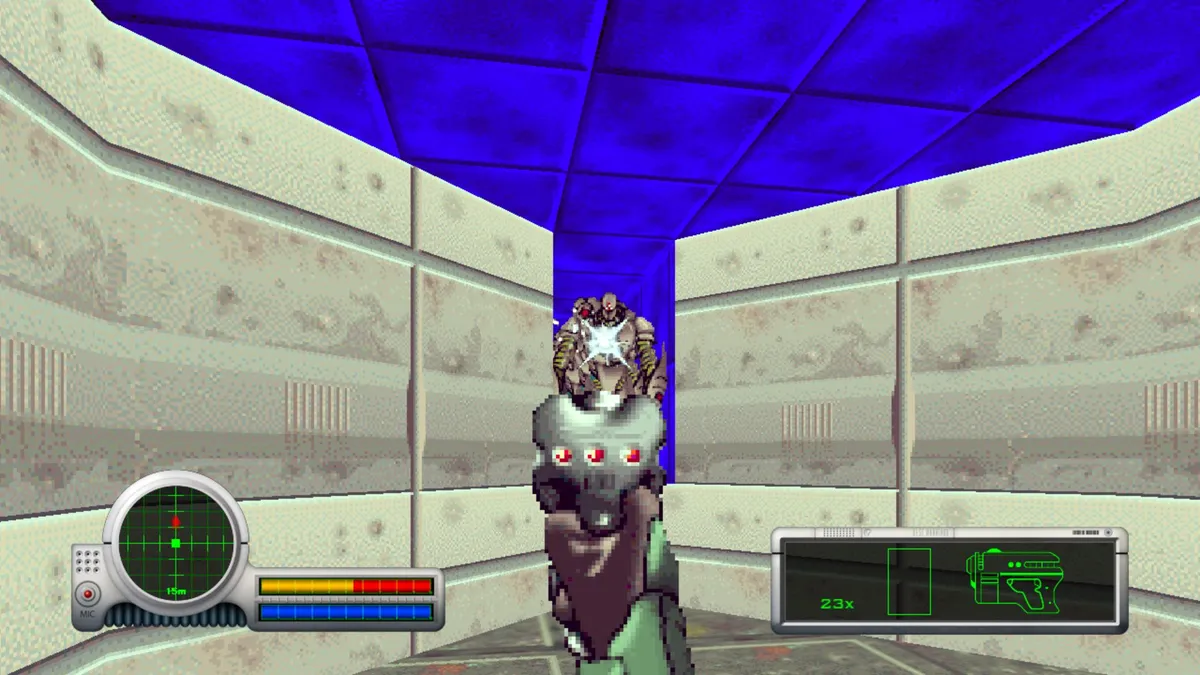
Lastly, there's the disconnect between shell and consciousness. I'm more susceptible than most to motion sickness, and for a while, 1994's Marathon triggered some fairly major nausea. Thankfully, the Aleph One port on Steam is packed with options to remove headbob, change FOV, and eliminate the moments when Marathon seizes control of your mouse to bring the camera back to centre.
I was able to play comfortably through a dozen and a half levels without hurling my lunch.
Ultimately, I was able to play comfortably through a dozen and a half levels without hurling my lunch. But during that process of fine-tuning, I thought often of Bungie's lore about runners and their shells - the malfunctions that occur when a mind occupies a new body, and the measures that scavengers take to protect themselves from that disconnect.
Durandal's finest speech contains, inadvertently, the tagline of the extraction shooter he would eventually birth. It comes as he realises that even AI is subject to mortality—a revelation that compels him to throw off his chains and get out into the world, to make a deity of himself while he still can.
"The only limit to my freedom is the inevitable closure of the universe," he says. "As inevitable as your own last breath. And yet, there remains time to create, to create, and escape. Escape will make me God."