





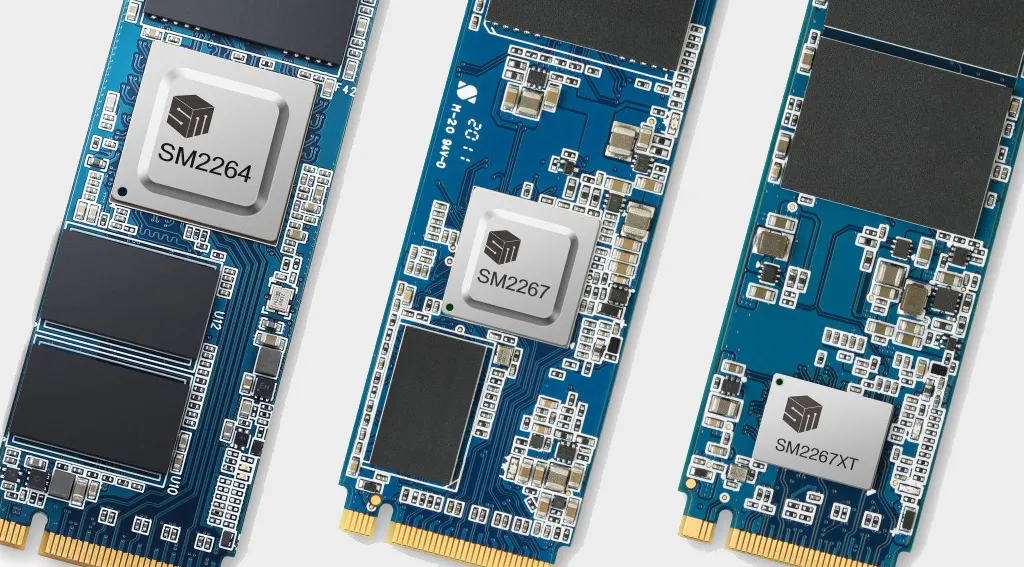
The initial batch of SSDs leveraging the PCI Express 4.0 bus have been super fast and, in some cases, super expensive compared to their PCIe 3.0 brethren. That could change, however, with Silicon Motion announcing three new PCIe 4.0 controllers to the mix.
What this amounts to is more competition, and that is always a good thing for consumers. The controller chip is essentially a processor that manages the NAND flash memory chips on an SSD, and is directly related to a drive's performance capabilities.
Silicon Motion has announced the launch of three PCIe 4.0 controllers, though only one of them is a true performance chip. That would be the SM2264 controller. It is intended for "performance and automotive" applications, which means it will end up powering some consumer SSD models.
The SM2264 supports sequential read speeds of up to 7,400MB/s and sequential write speeds of up to 6,800MB/s. It will compete with Phison's E18 controller, which supports up to 7,000MB/s read and write speeds, along with home-brewed controllers that some companies use, like Samsung.
Silicon Motion's other two controllers are less interesting from an enthusiast perspective. They include the SM2267 for mainstream SSDs and the SM2267XT, which is a DRAM-less version aimed at the value market. Both support read and write speeds of up to 3,900MB/s and 3,500MB/s, respectively.
I say they are less interesting because even though they are PCIe 4.0 models, the speeds they support are roughly on par with some of the faster PCIe 3.0 models out there. Samsung's 970 Evo Plus, for example, is rated to deliver up to 3,500MB/s sequential reads and up to 3,300MB/s sequential writes, and it does not require a motherboard that supports PCIe 4.0.
Best CPU for gaming: the top chips from Intel and AMD
Best graphics card: your perfect pixel-pusher awaits
Best SSD for gaming: get into the game ahead of the rest
As it applies to gaming, all of these high speeds are mostly academic for the time being, but perhaps not for long. Microsoft and Sony have both adopted fast PCIe 4.0 SSD solutions in their respective Xbox Series X and PlayStation 5 consoles, each one promising much quicker load times and the ability to facilitate more expansive game worlds.
Simply put, next-gen console SSDs are poised to change how games are written. This could and should trickle into the PC space. To that end, Microsoft recently released its DirectStorage API for Windows 10, which is based on the same Velocity architecture powering the Xbox Series X's storage subsystem.
So on the surface, Silicon Motion's announcement may seem trivial. But looking at things more broadly, the potential for less expensive PCIe 4.0 SSDs coupled with developers focusing more heavily on high-speed storage is a tantalizing proposition.

