





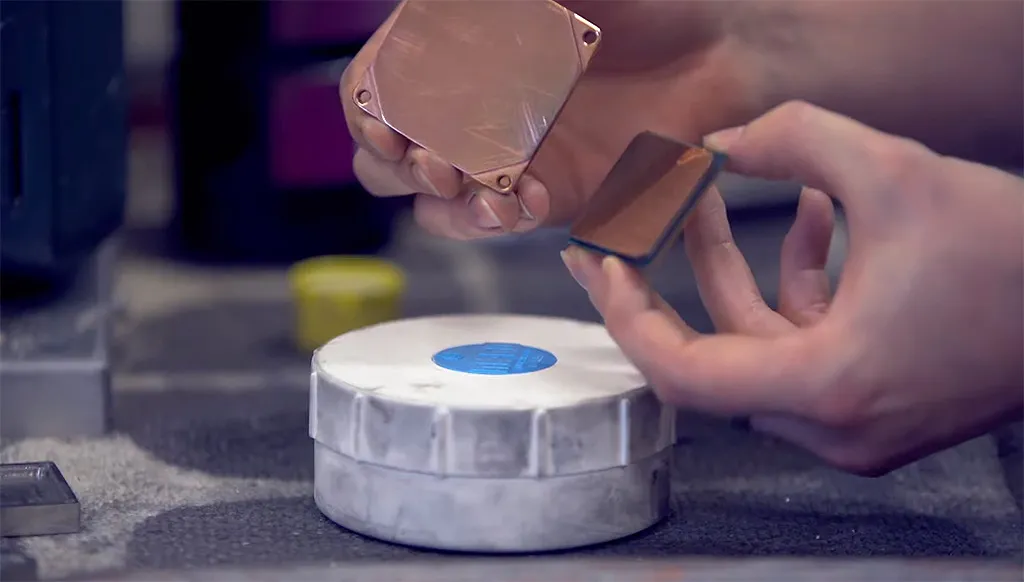
What happens when a machinist with a penchant for fine details takes on the task of lapping a 16-core CPU? The result is quite possibly the smoothest surface ever achieved on a processor's integrated heatspreader (IHS). It is so smooth, in fact, that it could probably be installed into a PC without any thermal paste.
Let's back up a moment and take a high level overview of the cooling mechanics of a CPU. The large chunk of metal on the top is the IHS, and its purpose is twofold: to protect the chip from cracking, and to pull heat up from the CPU die and transfer it to a cooling block—typically an air cooler or a liquid cooling apparatus.
However, the surface of an IHS is imperfect, as is whatever heatsink you end up attaching to it. This is where thermal paste comes into play. Thermal paste is a conductive material that fills in all the microscopic nooks and crannies in the IHS and heatsink, to facilitate a better transfer of heat.
It works well for mass consumption, but as with most things produced at scale, there is room for improvement for those with the requisite knowledge, money, and time. Enter the practice of lapping.
If you look up lapping videos and articles, the vast majority of content is really glorified sanding. It involves hand sanding a CPU's IHS for a smoother surface, and having done this myself in the past, it can indeed lower temps by a few degrees.
Simon Penrowe, a machinist with a YouTube channel, sought out to truly lap a CPU. In doing so, he "created the flattest CPU in the world," by his estimation, "bringing a Ryzen 9 3950X to within 0.3 microns of flatness error."
For reference, he says that is two orders of magnitude more accurate than what can be achieved with sandpaper alone.

He partially chronicles the process in a 10-minute video, detailing various steps in an extremely soothing voice. Seriously, I could listen to him read a phone book (remember those?).
Penrowe created his own lapping plate for this venture, which as he points out must be softer than the work piece (in this case, the CPU's metal top). It also needs to be grooved, creating a checkerboard pattern, so the shaved off bits can fall into the cracks and not disrupt the soft, flat surface.

Best CPU for gaming: the top chips from Intel and AMD
Best graphics card: your perfect pixel-pusher awaits
Best SSD for gaming: get into the game ahead of the rest
In an interview with Sweclockers, Penrowe said it took him around six months from start to finish, though he reckons someone with the benefit of his testing could accomplish the same thing in around a week. He also explained what made him interested in lapping in the first place.
"A contributing factor to my project was the knowledge that silicon temperature is a crucial factor that limits the turbo frequencies of Zen 2 processors and when I installed a second radiator without noticing any significant temperature differences from before, I started looking at alternatives solutions," Penrowe said.
Penrowe claims he did not have the time to test the temp results of his efforts and make a bunch of graphs, but teases at the end of the video that someone else now in possession of the CPU will be doing that for him. So sometime in the hopefully near future, we'll find out if it can in fact run without any thermal paste.

