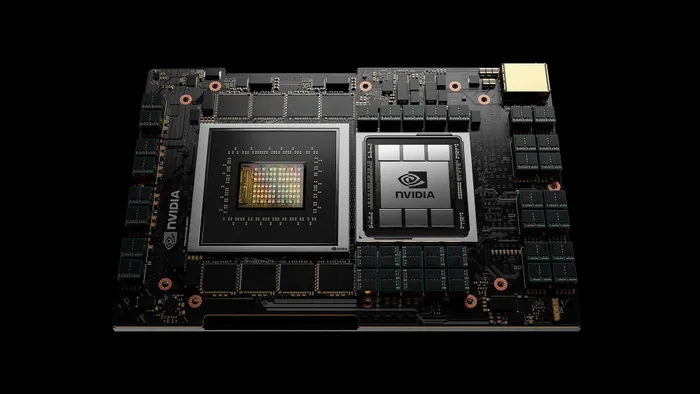
Nvidia CEO Jen-Hsun Huang has announced a brand new Arm-based CPU that Nvidia says will power the world's fastest AI supercomputer by 2023, alongside a brand new generation of graphics architecture beyond Ampere.
Leveraging a company that Nvidia is in the process of purchasing, UK-based chip designer Arm, the new Nvidia Grace CPU is set to dramatically increase system and memory bandwidth, according to Huang. That's up to 900GB/s between Grace and Nvidia GPUs, Nvidia says.
It won't find a home in your gaming PC anytime soon—it'll take more than that to dislodge the x86 standard in the desktop PC market—but it will be in use by 2023 in Nvidia's Drive Atlan autonomous vehicle SoC and the Alps supercomputer for the Swiss National Supercomputing Centre.
The Alps supercomputer will be the world's fastest for AI when it's finished in 2023. Alps will also use unspecified quantity of "next-generation Nvidia GPU" to deliver 20 exaflops of AI computing performance. Not bad, not bad.
That's a pretty spectacular speed, even by AI inference standards. Another of Nvidia's current ventures in AI supercomputers is the Leonardo system being built in Italy. This is set to become the world's fastest AI supercomputer, prior to Alps, using 14,000 Ampere GPUs. It costs roughly €240 million, and is expected to be completed later this year with full operation by 2022. That's capable of 10 exaflops of AI half-precision power, with a little hand from Nvidia's AI enhancements. The fastest AI supercomputer today is said to be Nvidia's 2.8 exaflop Selene.
That's a different metric to raw supercomputer speed, by the way. The fastest supercomputer in the world is Fugaku, which manages over 400 petaflops of performance with the commonly used LINPACK benchmark, and is found at the RIKEN Centre in Japan.
“We are thrilled to announce the Swiss National Supercomputing Center will build a supercomputer powered by Grace and our next-generation GPU,” Huang says during his GTC keynote. You can watch the live announcement and explanation from a cyber Jen-Hsun Huang over in the GTC 2021 keynote replay available here. We're still stuck in Huang's kitchen, but as you will see the Nvidia CEO has a few more tricks up his sleeve for his latest stream (read: I don't think that's his actual kitchen anymore).
There are a few more things for us in the keynote, although more so in regards to the general plan for Nvidia's GPU architectures than anything specifically gaming related.

Nvidia plans to continue Ampere, 'Ampere Next' and 'Ampere Next Next', presumably developments on the GPU architecture powering RTX 30-series GPUs today, until 2024. By 2025, Nvidia hopes to have 'Grace Next' ready to roll.
That's a pretty steady roadmap for its datacentre business, but where does that leave us gamers? It has long been rumoured that Hopper would be the name for a future GPU generation from Nvidia, so perhaps we will see that factor in with future architectures. There's certainly a chance to fully realise the tribute to computer scientist Grace Hopper there, now that Nvidia's rolled out the Grace CPU to match.