With everyone going stark raving over Amazon's new TeeVee adaption of Fallout, a pertinent question arises. Just how proto-industrial was the PC back when the OG Fallout game launched in 1997? After all, we're talking glass-tube CRT screens, ribbon IDE cables and less processing power than your bank card, right, something barely better than the monochromatic, diegetic Pip-Boy wrist computer from the game itself?
Pretty much. The minimum requirements for Fallout from 1997 make for fun reading. We're talking 16MB (yes, MB not GB) of RAM, an Intel Pentium CPU and 1MB of video memory, plus a screen capable of 640 by 480 pixels and a glorious palette of 256 colours.
Of course, any self-respecting proto-tech bro of the time wouldn't countenance mere minimum specs. So, what would the ultimate gaming rig du jour have looked like when Fallout first came out?
You'd definitely have wanted an Intel Pentium II which had the legs on the AMD K6 of the time. You'd probably have been looking at a mighty 300MHz model.
Back in the day, Anandtech found that the PII was over twice as fast as the K6 in the obligatory Quake II timedemo, cranking out a buttery smooth 66fps at 640 by 480 to the K6's laggardly 25fps.
If that choice was straight forward, choosing a video solution back then was much harder. It was the early days of dedicated graphics for the PC and the market was a veritable wild west of competing standards, formats and form factors.
For starters, you had the choice between an old-school PCI card or one of those new-fangled AGP or Accelerated Graphics Port beasts. Yup, a specialised port just for graphics.
You also had to decide if you wanted a card that could do both 2D and 3D rendering, or split those duties across different boards. As it happens, it was the Creative Labs 3D Blaster and its 3D-only 3Dfx Voodoo 2 chip that gave peak results for 3D rendering in Anandtech's late '97 testing, though the Voodoo 2 didn't go on sale until February 1998.
Its 66fps in the Quake II timedemo walloped the next best board based on Nvidia nascent Riva 128 chip, which could only manage 37fps. Other graphics chipset choices at the time included ATI's 3D Rage Pro, the PowerVR PCX2, Rendition Verite V2100, 3DLabs Permedia 2 and the Matrox Millennium II. You certainly didn't lack for choice, that's for sure.

Of course, the ultimate solution at the time would have been two Voodoo 2's running in SLI or Scan-Line Interleave, which not only doubled rendering throughput, but also upped the maximum supported resolution to a giddy 1,024 by 768.
Now, just to head off any outraged comments at the pass, the OG Fallout was not, of course, a 3D game. Apparently, a 3D engine was considered at the time of development, but the technology wouldn't have allowed the kind of detail and artistic vibe that developer Tim Cain, who worked alone on the game for six months before gradually enlisting help from colleagues at Interplay, desired.
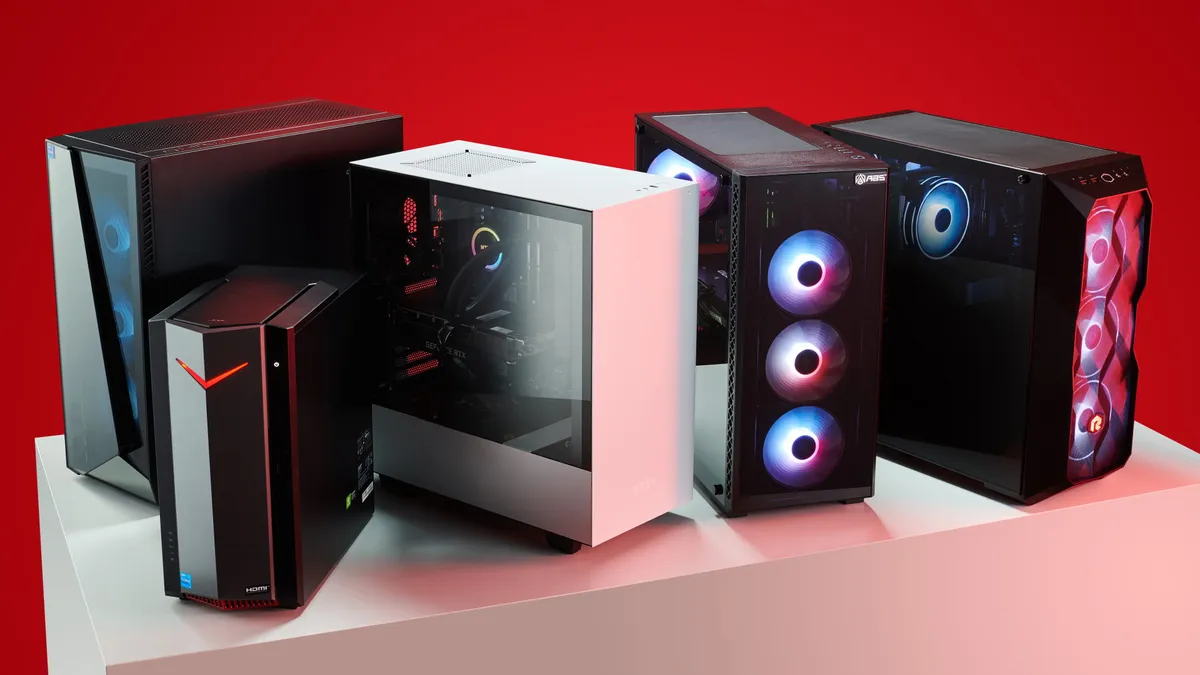
Best gaming PC: The top pre-built machines.
Best gaming laptop: Great devices for mobile gaming.
Instead, Fallout was developed using oblique projection to give a somewhat 3D feel to what was ultimately a 2D engine. The rest, as we're obliged to recount, is history.
As for how it performed on the hardware of the time, that's pretty hard to dredge up from the annals of history. And frame rates arguably don't apply to a 2D projection title like Fallout in the same way they do a full 3D game.
So, we cannot categorically attest to how the various video chipsets of the day compared when running Fallout. But maybe that's something for the comments below.
For the record, my first graphics card was an Nvidia Riva TNT2, which didn't appear until 1999 and was built on TSMC 220nm silicon. As for the rest of the rig, you probably had 32MB of RAM, maybe a 5GB IDE hard drive, and maybe a 17-inch CRT capable of something crazy like 1,600 by 1,200 and sporting a Sony Trinitron-derived tube that was flat in the vertical axis. Those, truly, were the days, eh?