


How many world maps have you mercilessly painted your colour over the years? It’s the nature of being a 4X head that you’re responsible for a gazillion settlements razed, countless dynasties toppled, and innumerable civilizations living in misery under heavy taxes and unreasonably vast construction projects for the Great Pyramid, Angkor Wat and the Colosseum, all at once. If the guilt of your past megalomania weighs heavy, BioEden offers redemption.
Its layout and principles will be familiar to any 4X player, but in fact it prefers to be known as a ‘4R’ – restore, relax, revive, recycle being the tenets that replace the Xs.
Restoration is the ultimate objective here. You’re trying to restore a polluted planet back to health so that its indigenous species can thrive on it. The relax principle is more of a design cue that makes itself felt in the audio and pacing, since you’re not pressured by invading rivals and mistakes are fixable.
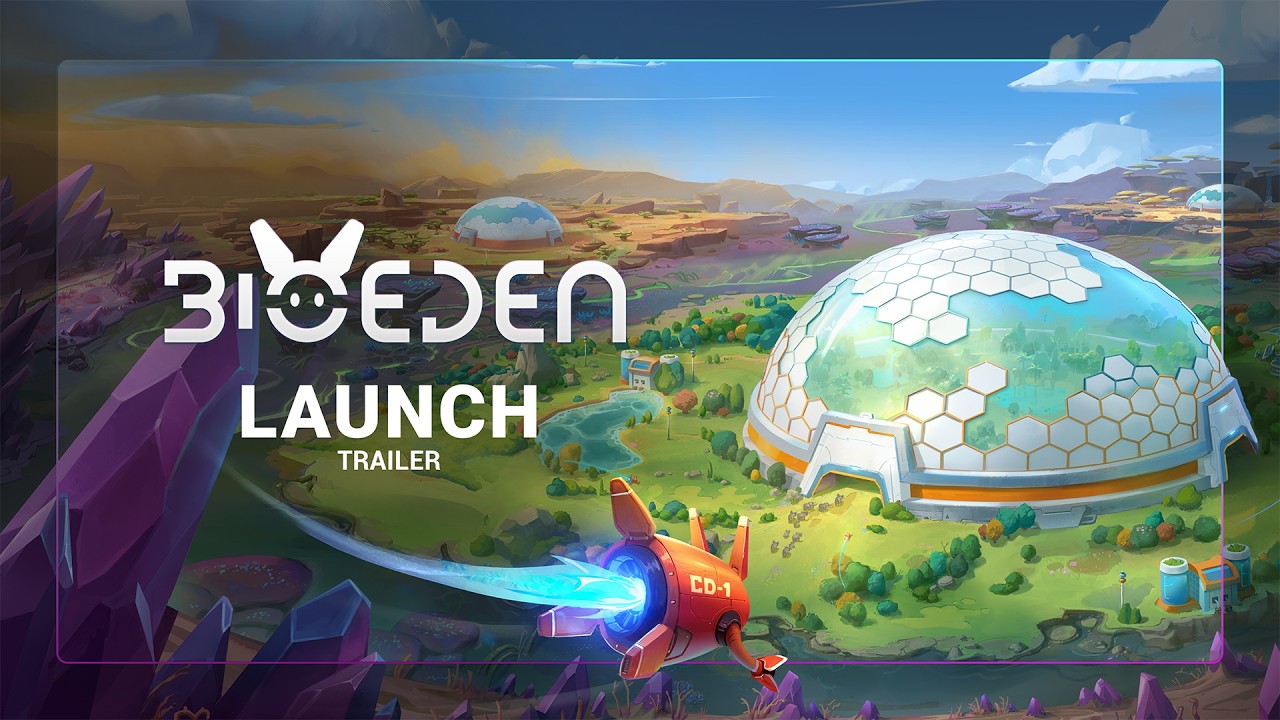
Revive refers to the re-wilding phase that takes place when you’re ready to release your species from their domed habitats and let them loose to reclaim the whole planet outside them.
And finally, recycling. This is a biggie in BioEden because everything you construct has a net negative impact on the planet. You can offset that by recycling buildings and recovering spent resources.
If that sounds like the wholesome nourishment your conquering-addled soul needs, here’s a quick guide to what you actually do in BioEden.
Guilds
At the start of each new campaign, you’ll get to choose between the technology, nature, exploration, restoration and mystic guilds. Each offer their own unique perks themed around their name, like the technology guild’s +2 starting orbs or the exploration guild’s larger starting area. The first time you play, though, you’ll want to pick the training guild, headed up by Charles the friendly robot, who’ll take you through the game’s tutorial campaign.
Basic principles

Your ultimate goal is to restore polluted planets so that they can support wildlife again. To do that, you need to build the habitats that each animal requires in order to live and evolve, while simultaneously building up an infrastructure of water and electricity supply. First, within your Dome, you place an animal species' den, giving the animals an area to roam that contains the specific things they need to thrive:
Eventually your animals will do like animals do—mate and reproduce. It's not just about keeping your critters breeding like bunnies in the confines of the dome, however, but to make the planet itself—polluted and barren at first—an environment they can thrive in. You'll need to build the infrastructure to depollute the planet: mine its naturally noxious resources, purify the lakes and rivers, and reclaim the land. There's a fine balancing act here, because each structure you build ticks up the pollution, which increases the chances of environmental disasters like dust storms and wildfires. The solution is to decommission and recycle buildings you no longer need, restoring the planet to its natural state before releasing your animals back into it.
How to evolve animals

Begin by building an incubator for a particular species. When you select that species, you’ll see that they need a few requirements to be met before they can evolve. That usually means a food source and water for a start, but some species have more specific needs too, such as the froglike Ributs, which require sprinklers to keep their skins nice and slimy, or landowls—which look like distant descendants of the D&D owlbear—which you'll have to build heaters for to attain their ideal temperatures. Some predator species will even hunt other species in your dome, so you'll sometimes need to be brutally expedient in your dome planning by making sure that their roaming areas overlap.
Note that a species’ requirements might change as they evolve, so you need to keep an eye on their habitat to ensure they’ve got everything they need.
How to build water and electricity supply networks

To keep those cosy natural habitats ticking over within the habitat dome, you need to venture out beyond the dome into the planet’s surface. With a double right-click, your view switches from the optimal conditions of the dome to the toxic wastes of the outside. Grim out there, isn’t it? But not to worry – that’s what you’re here to fix.
Scout out for water sources like rivers and lakes. Chances are that they'll be poisonous, but don't worry—you'll eventually research a water cleaner system to heal them back to their natural azure sparkle. Place a water system by that source, and then hook it up to your grid by via network energy nodes—combined power and water lines, essentially—to transport water back to your dome and other parts of your network that might need it.
Once construction’s complete, you’ll see lines appear to indicate the flow of water and electricity between your structures.
What next?

Level up your infrastructure by adding new elements to it, like waste miners. These structures harvest mineral resources from specific hex tiles among the polluted planetary surface outside the dome, and much like the Tiberium in Command & Conquer, those minerals are a finite resource.
Unlike Westood’s RTS, however, when the waste miners have harvested all the resources from that tile they actually leave it rejuvenated, allowing grass and trees to flourish in the mined cluster of tiles. When there’s nothing left to mine, remember to recycle your waste miner structures to get your resources back and keep those pollution levels in check.
As you increase the number of structures across the planet surface, you’ll need an ever-more powerful energy grid. Erect solar power stations around the surface and connect them to your other structures to keep the proverbial lights on.
How to unlock new species
After you’ve got your first few species bounding around happily in their habitats, you’ll next want to turn your attention to unlocking new critters by finding DNA fragments.
To do that, you need to work your way through the biome knowledge tree, a naturalist take on the traditional research tree, that’s subdivided by specific Biomes. But to start that archetypally 4X journey along the branches of the tech tree, you'll first need to build a Research Center, which generates research points that subsequently unlock levels in the tech tree.
You'll also need to search the planet for ruins and sanctuaries, and extract their respective points—Technology and Biotech points—using the Study Lab. This two-pronged approach to science offers something a little different to the typically passive 4X tech journey, making the research process a bit more involved and tied to exploration.
What’s the endgame?

When you’ve created the right conditions for your species outside the dome, you can let them loose and watch them thrive in the wider planetary habitat. Keep sending antennae out there to unlock new areas, keep unlocking new species, keep cleaning up the planet. And don't forget about your guide either, as fulfilling their quests can lead to unique buildings and perks to help you in your environment-rebuilding mission.
Eventually, your planetary exploration may lead you to find another dome, which—depending on its biome—may prove a more suitable environment for certain kinds of animals than your existing one. Like every good 4X, BioEden is replayable too, with each of the five guilds supporting different playstyles and challenge levels. Also, in each run, you'll only ever see three of BioEden's five biomes (and the animals unique to each one), so the proccy-generation means that you're bound to have a meaningfully different playthrough each time.
It’s a chill take on management and 4X games, with refreshingly responsible principles. If you’re still sore about that nuclear war with Gandhi or the inbreeding nightmare of your last Crusader Kings III save, this is your ticket to a sustainable, relaxed, wholesome mission in management land.
BioEden is available September 3rd on Steam, PS5, Xbox Series, and Switch 2. A demo covering the tutorial campaign is available now.
