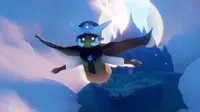
After the critical success of its emotional, musical adventure Journey in 2012, Thatgamecompany's creative director Jenova Chen had aspirations to reach a much broader audience of players. Journey was popular on console, with an audience that Chen jokingly described as men in their 30s who were conveniently journalists and awards judges, but "teenagers hated Journey," he said. I must have been an outlier.
So Thatgamecompany decided to make an MMO, a genre that's definitely popular with teens, but rarely synonymous with the wholesome, friendly experiences with strangers that Journey was known for. During an interview at GDC earlier this month, Chen told me all about the challenges of designing a non-toxic social space in Sky: Children of the Light, just ahead of its PC launch.

"There are so many things currently wrong with how the internet was designed," Chen told me. "As a designer, I'm just really pissed that people are so careless when it comes to maintaining the culture of a space." He said that too many online spaces, from YouTube comments sections to online games, are geared so that people are constantly encouraged to seek out the biggest reactions—by being shocking, trolling, or downright offensive. When given so much power to affect those around us, it's as if we revert to some primal baby state, seeking constant social feedback for good or ill.
Chen had been thinking about this problem back during Journey's development too. During his GDC talk this year, "Designing to Reduce Toxicity in Online Games," Chen described the many iterations of Journey's core systems that it took to ensure that players would see each other as friendly collaborators instead of competition for resources. In the end, Thatgamecompany nailed it—all my memories of Journey are those magical moments with an unknown other player patiently guiding me through a tough area or walking into the light together at the game's end.
"When we made Journey, that very person who was teabagging another person in Call of Duty was suddenly posting on our forum to say: 'For that person who I was playing with, I'm so sorry I had to go. My mom called me for dinner,'" Chen says. "That's the same player who was a nasty person in another game. So I realized that nobody is born toxic. It's really just the environment we formed."

Cultivating an anti-toxic environment became a critical part of Sky's development. TGC utilizes tools for reporting and resolving offensive messages, but Chen said that his goal for Sky was to introduce positive, preventative measures rather than reacting after damage is already done.
"One of the most useful things we're doing is that you have to earn your rights to apply your social power."
Jenova Chen
"You have to get a permit to get a shotgun, right?" (Thatgamecompany is based in the US, where this isn't universally true, but for the sake of the argument let's pretend you do.) "But shotguns are given to too many babies who are new to the online community. They have no understanding of social norms but they are basically blasting very controversial sentences because they're eliciting maximum feedback." Public text chat, for instance, is a staple in other MMOs that Sky just does not have. "One of the most useful things we're doing is that you have to earn your rights to apply your social power," Chen said.
One of Sky's cornerstones is what Chen calls a "dual consent" system of socializing. In Sky, everyone you see around you is initially an indistinct silhouette. To even see one another's in game appearance you need to both hold a candle out to each other signaling your agreement to interact. To become official friends, you both have to actually spend a candle, Sky's main progression currency. To unlock additional interactions like emoting together, sending text chats to each other, and eventually teleporting to one another, you have to continue spending candles. They aren't preventative rates, because you're always continuing to earn candles as you play and explore, but offering them up to befriend another player is a signal of trust and goodwill.

The most another person can annoy you without your express permission is by flying around erratically nearby and making Sky's universal chirping noise in whatever voice tone they have equipped. I did once nickname a person "wailer" because they were using the most annoying voice setting and just chirped constantly as we flew together but even that was just my own private joke since players can't see what you've named them and you don't see their real username. The hidden nicknames are just another way that Thatgamecompany has attempted to reduce the "maximum feedback" players are capable of getting from one another.
They've not always gotten it right. During his talk on toxicity, Chen described one implementation of the social benches in Sky—places where players can sit together and exchange text chat. For a period of time, benches could fit eight players at once, a group audience that represented a tantalizing opportunity for the reaction-seeking baby brain. There was a briefly notorious "eggplant boy," a player who would sit on a full bench and spam the eggplant emoji to a group of other players chatting. So now the chat benches are back to a one on one experience.
It's now been almost five years since Sky: Children of the Light initially launched as a mobile app, and I've got high hopes that TCG's anti-toxic design will hold up to the coming influx of PC players despite our reputation. And if not, it's still going to be in early access a while yet.
Sky: Children of the Light is a free-to-play MMO that's been in open beta on mobile and consoles. It launches in early access on Steam on April 10.