


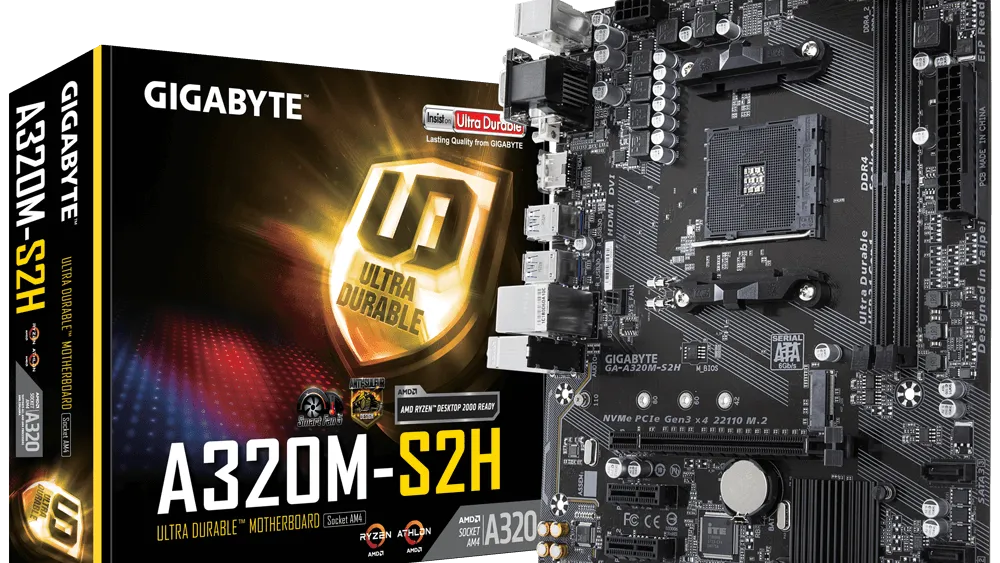
Ahh, the A320 chipset. It’s not exactly the chipset of choice for most gaming rigs, but it can run a low to mid-range CPU as well as any other AM4 motherboard. Thanks to Tom’s Hardware, news comes that Asus and Gigabyte have enabled Ryzen 5000 series support on many of their A320 boards. This means A320 users have an upgrade path that could bring large performance gains while skipping the need to buy a new motherboard.
The A320 was always a budget chipset. Motherboards using it tend to include little, if any VRM cooling, and lack the connectivity or features of B350 and X370 boards. But, thanks to the low power characteristics of the Zen architecture, you could have run something like a Ryzen 1700 with a high-end GPU and not lose much performance.
One of the many ways to keep the cost of the boards down was to incorporate low-capacity BIOS chips. Given the huge number of AM4 CPUs, not all of them can be supported. To get around this, manufacturers appear to have dropped support for Bristol Ridge processors. These are pre-Ryzen AM4 APUs so it’s unlikely that support for them will be missed.

Black Friday 2021 deals: the place to go for the all the best early Black Friday bargains.
We checked the support pages for several boards, and it seems as though popular 5000G series processors are not yet supported. With their strong integrated graphics performance, dropping a Ryzen 5 5600G or Ryzen 7 5700G into an A320 board would provide a big step up for gamers on a budget. Interestingly, the much rarer 4000G series of processors are supported.
A gamer on a budget could upgrade to a Ryzen 5000 CPU with 32GB of RAM. Throw in whatever GPU you have laying around and you’ll have a capable little gaming machine.
Many boards even support the Ryzen 9 5950X processor! We certainly wouldn’t recommend that combination—a 16-core processor paired with a board with no VRM cooling whatsoever is fraught with danger. Stick to a 65W class CPU like the Ryzen 5 5600X and you’ll be fine. If you’re upgrading from a first-generation Ryzen CPU, you should experience a rather dramatic improvement.
It appears that some A320 boards have not added support for Ryzen 5000, so if you are considering the upgrade, definitely check the support page for your motherboard to see if there’s a BIOS update that includes 5000 series support. And don’t forget to keep an eye on our Black Friday CPU deals page. A 5600X maybe be on the receiving end of a steep price cut.

