Our Verdict
8 TB of PCIe 5.0 storage comes with a colossal price tag, but thanks to an incredible hardware combo, the G5 delivers some chart-topping exemplary performance for the cost.
For
- Outstanding all-around performance
- Impressively efficient
- Fastest 8 TB drive we've seen
Against
- US availability is absent
- Random 4K could be better
- Brutal price tag
PC Gamer's got your back Our experienced team dedicates many hours to every review, to really get to the heart of what matters most to you. Find out more about how we evaluate games and hardware.
SSD prices are not very stable right now. While not hit anywhere near as bad as memory, we're seeing price increases on many SSDs on a pretty regular basis. So if the prices here don't match up when you read this, that's likely why. We recommend using a price checker tool, such as CamelCamelCamel, to see if you're still getting a good deal.
I think I've tested every single combination of controller and NAND flash found in all of the top-end PCIe 5.0 SSDs at this point. At least all of them, trying to match or break parity with Sandisk's WD SN8100, that is, all pinching a little bit of the drive's tech while they do it. Yet this is the first SSD I've found that kind of does manage to do that, yet in a very weird, roundabout way.
It's been well documented at this point just how good that SSD is; nonetheless, we've not yet seen it in an 8 TB capacity, which is exactly what Kingston is bringing to the table here. Perhaps there's no market demand for it as far as Sandisk is concerned, perhaps it's tariffs getting in the way, or it got sidetracked by its weird and wonderful breakup with WD, but Kingston's taken that same tech and ramped it all the way up to 11, increasing capacity, delivering in some areas, and falling short in others.
So, unlike the Kioxia Exceria Plus G4, which had the same 218-layer BiCS8 TLC NAND but a different controller, or the Acer Predator GM9000, which had the same Silicon Motion SM2508 controller but different NAND, the G5 unabashedly has both as standard. A clone of its SN8100 father. And it's that 218-layer BiCS8 NAND that's the driving force behind this drive—particularly the density.

Capacity: 8 TB
Interface: PCIe 5.0 x4
Memory controller: Silicon Motion SM2508
Flash memory: Kioxia 218-Layer BiCS8 TLC NAND
Rated performance: 14,800 MB/s sustained read, 14,000 MB/s sustained write
Endurance: 4800 TBW
Warranty: Five years
Price: $N/A | £1,000
It was developed and designed by Kioxia and SanDisk, who have had a long-standing joint memory development and manufacturing venture. Its BiCS8 technology is impressive because of its increased vertical layered density (compared to BiCS6), allowing Sandisk and Kioxia to fit more dies into a single 3D package.
This improves efficiency, performance, latency, and maximum capacity, but it's also impressive because the technology manages to increase the efficiency of the lateral size too, making the die footprint even smaller.
What that means is that you can effectively fit 4 TB of high-performance NAND into a single chip on the stick, and stack two of those side-by-side, giving you 8 TB to play with, without having to go to a dual-sided design. That's given the Kingston Fury Renegade G5 the unique advantage of being compatible with consoles as well as PCs, as despite having such a ridiculous capacity and dedicated DRAM, it's still only single-sided.

Don't let the marketing numbers confuse you, either. Comparing that 218-layer NAND to something like Micron's 276-layer TLC or SK Hynix's 238-layer isn't a fair comparison, and that shows in the performance too, as both those technologies, when paired with the SM2508 8-channel controller, struggle to keep up, particularly when it comes to random 4K performance.
So, let's talk benchmark results then. The sequential performance on the G5 is outstanding. In fact, it beats the SN8100, delivering 14,830 MB/s on the read and 14,136 MB/s on the write. That's 100-200 MB/s higher than the SN8100. In a similar vein, the Crucial T710 (Phison and Micron's flagship SSD currently) similarly can't keep up with just 14.1 GB/s on the read and 13.2 GB/s on the write as well.
| Header Cell - Column 0 | Kingston Fury Renegade G5 | Crucial T710 2 TB |
|---|---|---|
3DMark Storage - Index | 5541 | 4,553 |
3DMark Storage - Bandwidth (MB/s) | 937.26 | 771.23 |
3DMark Storage - Access time (µs) | 32 | 39 |
CrystalDiskMark 7.0.0 - SEQ1M Q8T1 Read (MB/s) | 14830 | 14145 |
CrystalDiskMark 7.0.0 - SEQ1M Q8T1 Write (MB/s) | 14136 | 13181 |
RND4k Q1T1 Read (IOPS) | 24660 | 25449 |
RND4K Q1T1 Write (IOPS) | 82538 | 86534 |
Final Fantasy XIV: Shadowbringers - Total loading time (seconds) | 6.626 | 6.834 |
Peak temperature (°C) | 63 | 70 |
PC Gamer test bench
CPU: AMD Ryzen 9 9900X | RAM: 64 GB (2x32GB) Team Group T-Create Expert DDR5 @ 6000 C34 | GPU: Nvidia GeForce RTX 4080 Super | Motherboard: Asus ROG Strix X870E-E Gaming WiFi/NZXT N9 X870E | CPU Cooler: Asus ROG Ryujin III 360 ARGB Extreme | PSU: 1200W NZXT C1200 (2024) 80+ Gold | Chassis: Geometric Future Model 5
Things get a little more interesting on the random 4K performance, however, with the G5 only managing 101 MB/s on the read and 338 MB/s on the write. That read is fairly average for this drive, and about on par with the T710, although nowhere near the SN8100's staggering 119 MB/s read speed.
The big difference, though, is temperature, as despite its dual package setup, the G5 manages to keep itself cool at a markedly chilly 63 °C. With both the T710 at 70 and SN8100 at 75, being considerably higher.
All that translates into fantastic game load times as a result, with an average Final Fantasy score of 6.626 seconds overall. That is the second fastest drive I've tested with that benchmark, although it is worth bearing in mind that FF XIV does prefer larger capacity drives to load from.

✅ You've got a massive games library and a bank account to match: Cool, efficient, stupidly quick and with outstanding capacity all on a single-sided drive, the G5 delivers on almost every front, except affordability
❌ You want a cost-effective, well-rounded drive: It's good, seriously good, but there are better options out there available at lower capacities that won't destroy your bank account to purchase.
The G5 is only held back, really, in three areas. Firstly, its random 4K read performance is a little low compared to the likes of the SN8100 (likely a conscious decision made by Kingston for efficiency's sake, in the firmware to keep temperatures low and compatibility broad), and secondly, well, availability. And price.
At the time of writing, US stocks are slim to non-existent, and in the UK, you can only pick one up for £1,000 at Scan. That's not particularly cost-effective at £0.12 per GB, but you are getting more performance than other 8 TB SSDs.
On paper, the G5 is phenomenal. It obliterates benchmarks, in no small part thanks to that superb combination of controller and NAND flash, and yet, for this particular number with its gargantuan capacity and price tag that follows suit, we inevitably fall back onto that same question.
Do you really need 8 TB on a single drive? Or would something like a 4 TB or even a 2 TB still be enough? You'd still get the same hardware setup, the same stellar performance, but for far less.
1. Best overall:
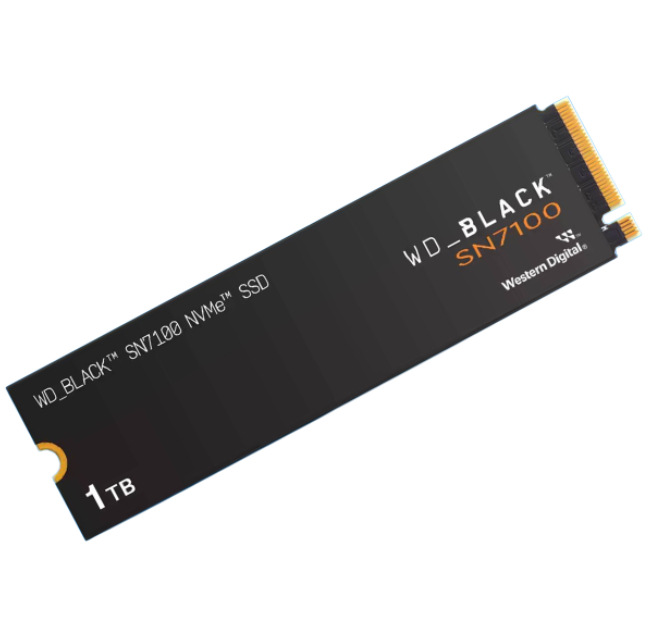
WD_Black SN7100
2. Best budget:
Biwin Black Opal NV7400
3. Best PCIe 5.0:
WD_Black SN8100
4. Best budget PCIe 5.0:
Crucial P510
5. Best 4 TB:
TeamGroup MP44
6. Best 8 TB:
WD_Black SN850X
7. Best M.2 2230:
Lexar Play 2230
8. Best for PS5:
Silicon Power XS70
8 TB of PCIe 5.0 storage comes with a colossal price tag, but thanks to an incredible hardware combo, the G5 delivers some chart-topping exemplary performance for the cost.

You must confirm your public display name before commenting
Please logout and then login again, you will then be prompted to enter your display name.