Warning: Spoilers for Fallout Season 2 Episode 8!
Fallout Season 2 wrapped up today, ending with a few questions answered and a whole lot more questions raised—including a big one (literally) in a post-credits sequence at the very end of Episode 8.
Without getting all the way into spoilers for the episode, Fallout Season 2 ends with some of the characters looking out over New Vegas as a new war begins brewing—a war we'll have to wait for Fallout Season 3 to see.
Article continues belowBut wait a minute… wasn't there another war in the works? A different war than the one approaching New Vegas? What's happening with that?
We've heard nothing about that situation since the fourth episode of Fallout Season 2, and it's not revisited in the season finale… unless you sit through the credits.
What is Liberty Prime?

Like so much from the Fallout series, Liberty Prime pre-dates the Great War. Liberty Prime was a superweapon, a massive robot created by the United States to battle China in occupied Alaska—the war we saw Cooper Howard fighting while wearing power armor in Fallout Season 2. The U.S. built Liberty Prime allegedly because China had created giant combat robots called "Warmachines"—though there was never concrete proof of these robots and this idea may have been created by the U.S. government itself to justify building their own.
Liberty Prime appears in both Fallout 3 and Fallout 4.
"Liberty Prime will be the very embodiment of American military might—a walking, talking, nuke-tossing hero who will remind the world what it means to be a super power," said pre-war general Constantine Chase.
The problem with a giant robot is that it needs a suitable mobile power supply, and the U.S. wasn't able to design one. They could only power some of Prime's different capabilities at the same time—if it had enough power to walk, for instance, it couldn't also fight—so Liberty Prime was never put into service before the Great War.
Liberty Prime after the Great War and the events of Fallout 3

After the bombs fell, the robot sat unused in Washington D.C. until the Brotherhood of Steel found it over 100 years later, though they couldn't get it fully operational (except for its voice module, which constantly delivered anti-communist propaganda at full volume) even after decades of trying. Again, getting all its systems powered up using a mobile power supply proved to be the problem.
Finally, using fusion technology, the Brotherhood got Liberty Prime fully functional and with the help of the Lone Wanderer (the player in Fallout 3) successfully deployed the giant robot against the Enclave at the Jefferson Memorial in Washington D.C. The robot continued to be effective in combat, though eventually the Enclave destroyed it with a missile strike from an orbiting weapons platform.
Liberty Prime in Fallout 4
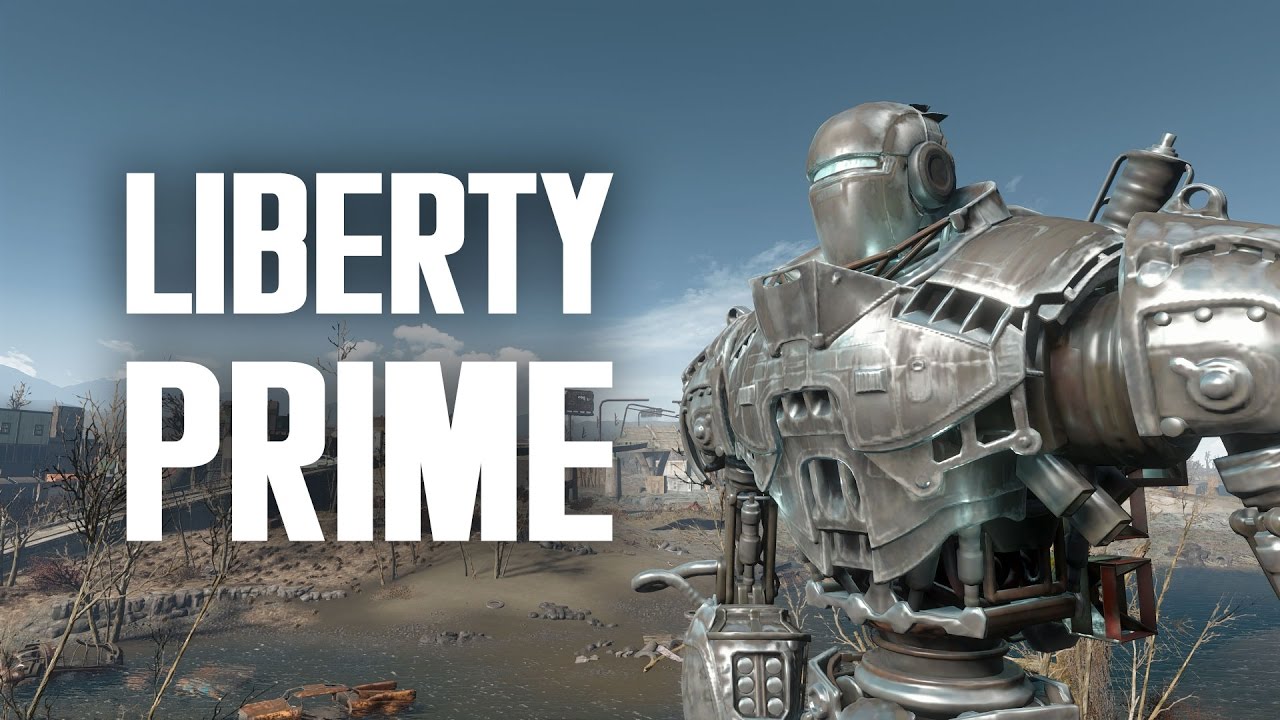
In Fallout 4, the Brotherhood of Steel rebuilt Liberty Prime, this time in the Commonwealth at the Boston Airport. Called Liberty Prime Mark II, if the player sides with the Brotherhood, the robot gains upgraded weapons like improved eye lasers and the capacity to throw tactical warheads.
The robot was used by the Brotherhood to help destroy the Institute, marching through the streets, saluting war memorials, and still broadcasting anti-China propaganda at full volume. It uses its lasers to bore a hole into the Institute's underground facility, though it is too big to enter it. After defeating the Institute, it can be seen patriotically patrolling the airport.
So, what's Liberty Prime Alpha?

This is about 10 years after Prime stomped its way through Fallout 4, and Elder Quintus has uncovered blueprints for Liberty Prime Alpha, which implies he has instructions for the first prototype of the eventual Liberty Prime robot—or, depending on how you interpret the word "Alpha,' it might be the biggest and baddest Liberty Prime robot ever. The civil war of the Brotherhood of Steel is clearly not going well for the west coast factions, so Quintus wants to build his own Liberty Prime to turn the tide.
I know a lot of Fallout fans were hoping to eventually see Liberty Prime back in action in Season 2, but looks like we'll have to wait. We don't know exactly where this Brotherhood civil war is taking place, but one thing is for sure: Quintus is going to need an advanced power supply if he wants to activate Liberty Prime Alpha. That could mean the war over New Vegas could culminate in the giant robot stomping around on the Vegas Strip in Season 3—if Quintus can take the cold fusion diode back from Mr. House, that is. We'll find out!
What are RobCo, General Atomics, and Mass Fusion?
As seen on the blueprints, these are major pre-war companies in the Fallout universe. RobCo Industries was Robert House's company that designed computers, robots (like protectrons and securitrons), and software, not just for consumers but the U.S. military. General Atomics built industrial robots (like Mister Handy and Mister Gutsy) and weapons like laser rifles. Mass Fusion was an energy company, producing fusion cores and fusion engines. Makes sense that these three companies were all integral in designing a giant combat robot, doesn't it?


You must confirm your public display name before commenting
Please logout and then login again, you will then be prompted to enter your display name.