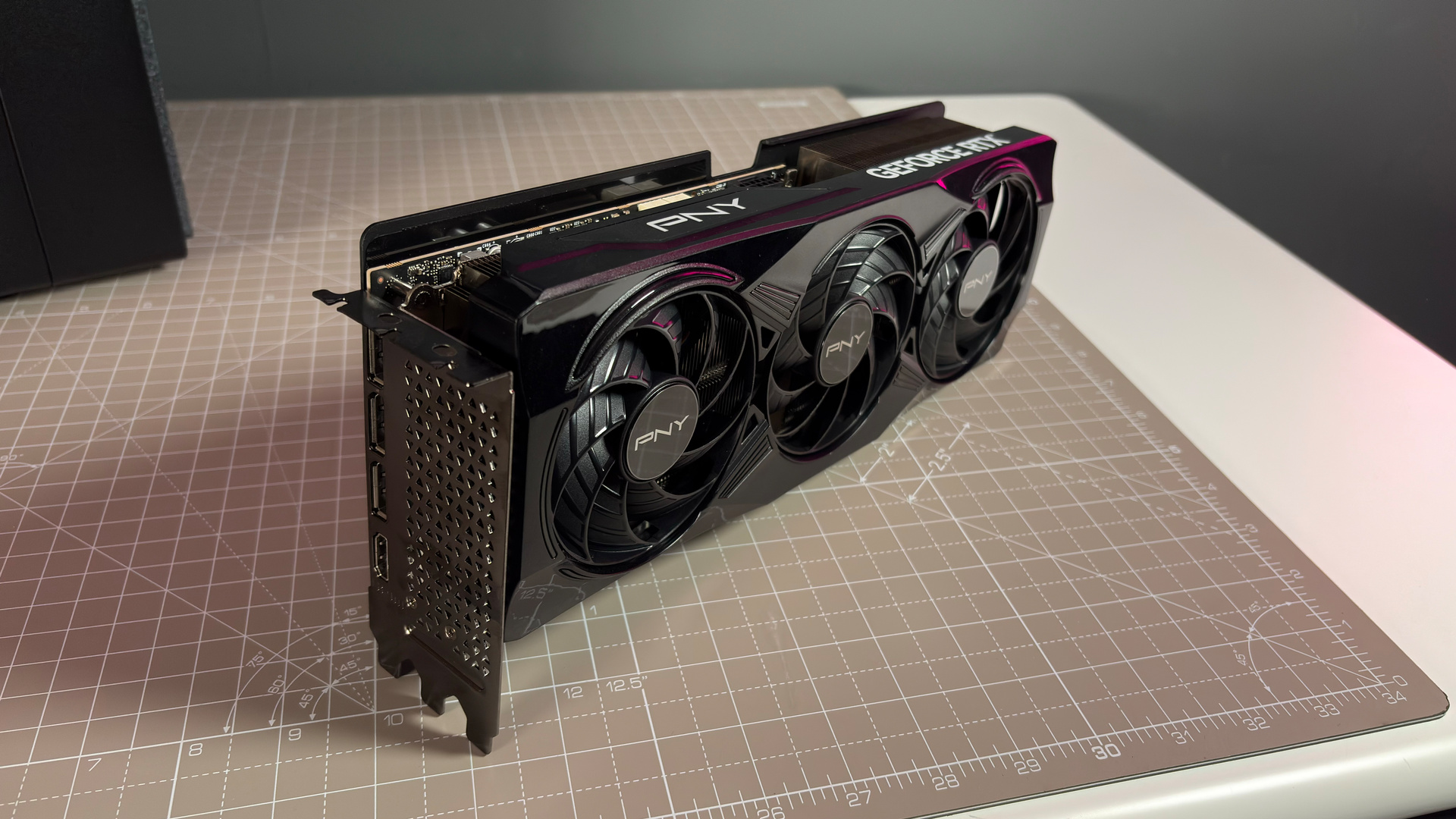
Our Verdict
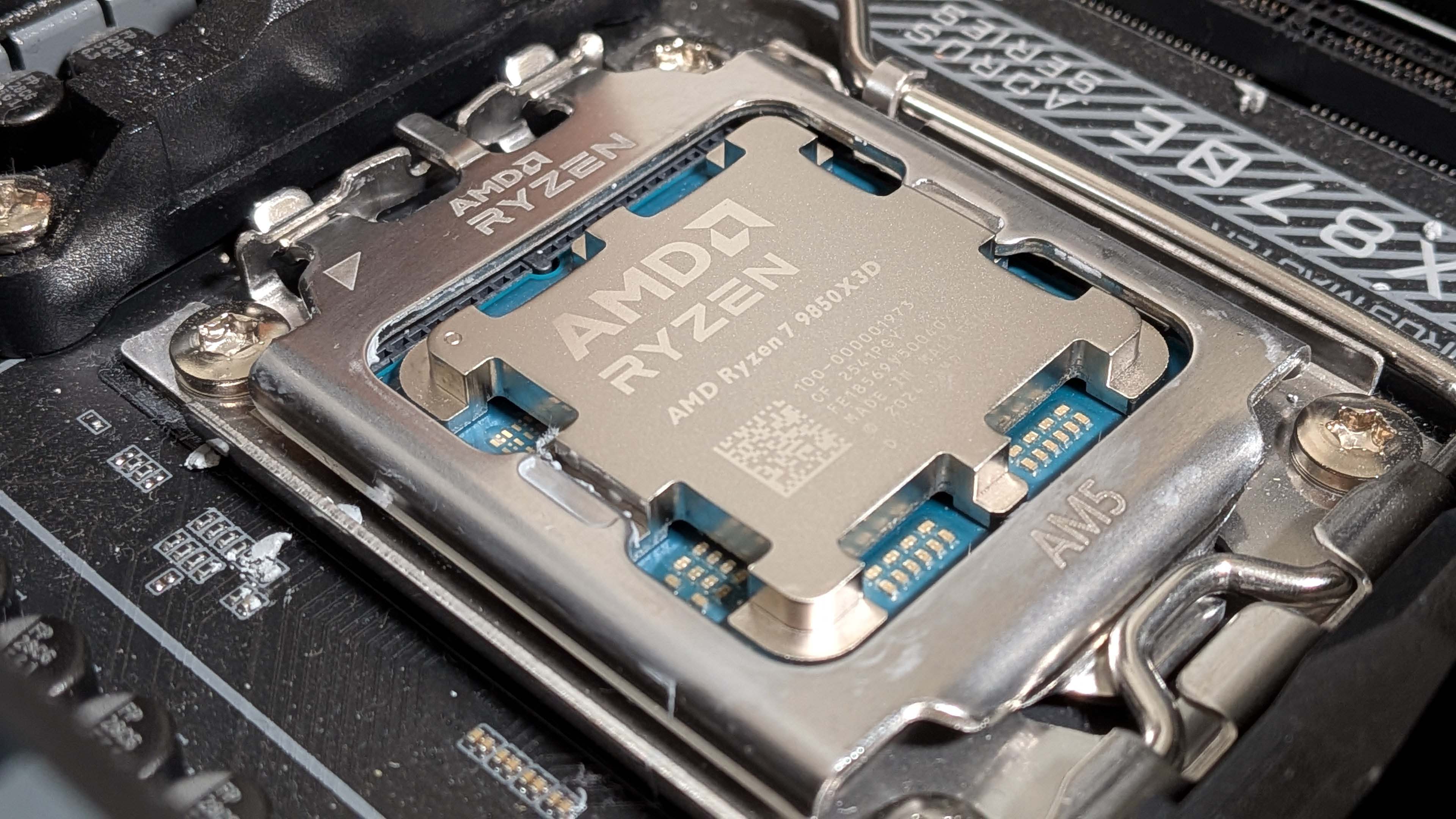
The Ryzen 7 9850X3D is still as great a gaming processor as its 9800X3D forebear. That's to be expected given they are identical bar the 5.6 GHz boost clock. But while that doesn't deliver much beyond 2% higher performance you're paying in terms of a 40%+ power draw in games.
For
- Still a stellar gaming chip
- No 3D V-Cache compromise
- Little price premium
Against
- Runs a little hotter
- Runs a lot thirstier
- Doesn't deliver much over the 9800X3D
PC Gamer's got your back Our experienced team dedicates many hours to every review, to really get to the heart of what matters most to you. Find out more about how we evaluate games and hardware.
Nostalgia is a potent thing in the technology world right now. And I say that as someone with a brand new Commodore 64—a faithful replica of my very first computer—sat beside my desk. AMD is smart enough to understand this, to understand the way the cosy old days tug at the heart strings of PC gamers, especially in a difficult time where the past we yearn for is fully rose-tinted.
So we shouldn't be surprised to see the red team taking us back a decade with its thoroughly nostalgic new CPU, the Ryzen 7 9850X3D. It's taking us back to a different time when one processor company was so dominant it could stand to release barely iterative versions of its top processors because it had precisely zero true competition.
| Header Cell - Column 0 | AMD Ryzen 7 9850X3D | AMD Ryzen 7 9800X3D | AMD Ryzen 7 9700X |
|---|---|---|---|
Cores | 8 | 8 | 8 |
Threads | 16 | 16 | 16 |
Base clock speed (GHz) | 4.7 | 4.7 | 3.8 |
Boost clock speed (GHz) | 5.6 | 5.2 | 5.5 |
Base power (W) | 120 | 120 | 65 |
Peak Power (W) | 162 | 162 | 88 |
L3 cache | 96 MB | 96 MB | 32 MB |
MSRP ($) | 499 | 479 | 359 |
✅ You want the absolute fastest gaming CPU around: It is marginally faster than the 9800X3D and often the 9950X3D, too.
✅ You want theoretically the most reliable 3D V-Cache chip: by virtue of its bin-sorting for the most robust chips for overclocking, the 9850X3D should be the most reliable version.
❌ You care about power draw: the extra thermal load isn't too much of a concern unless your cooler gets shouty, but the 43% higher gaming power draw is not a good look.
❌ The 9800X3D remains in plentiful supply: it may not be a huge price premium, but with costs how they are today, every penny counts.
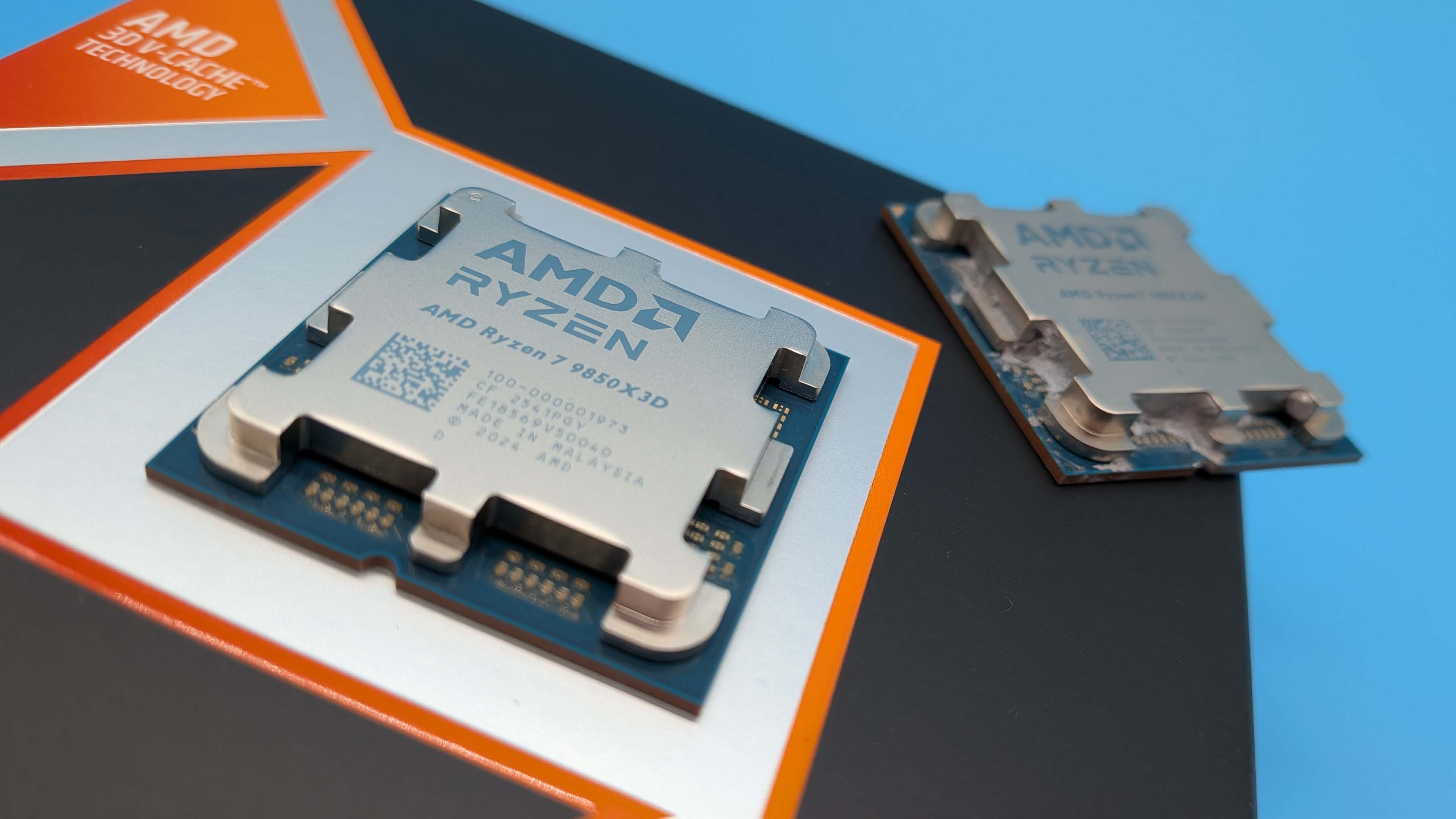
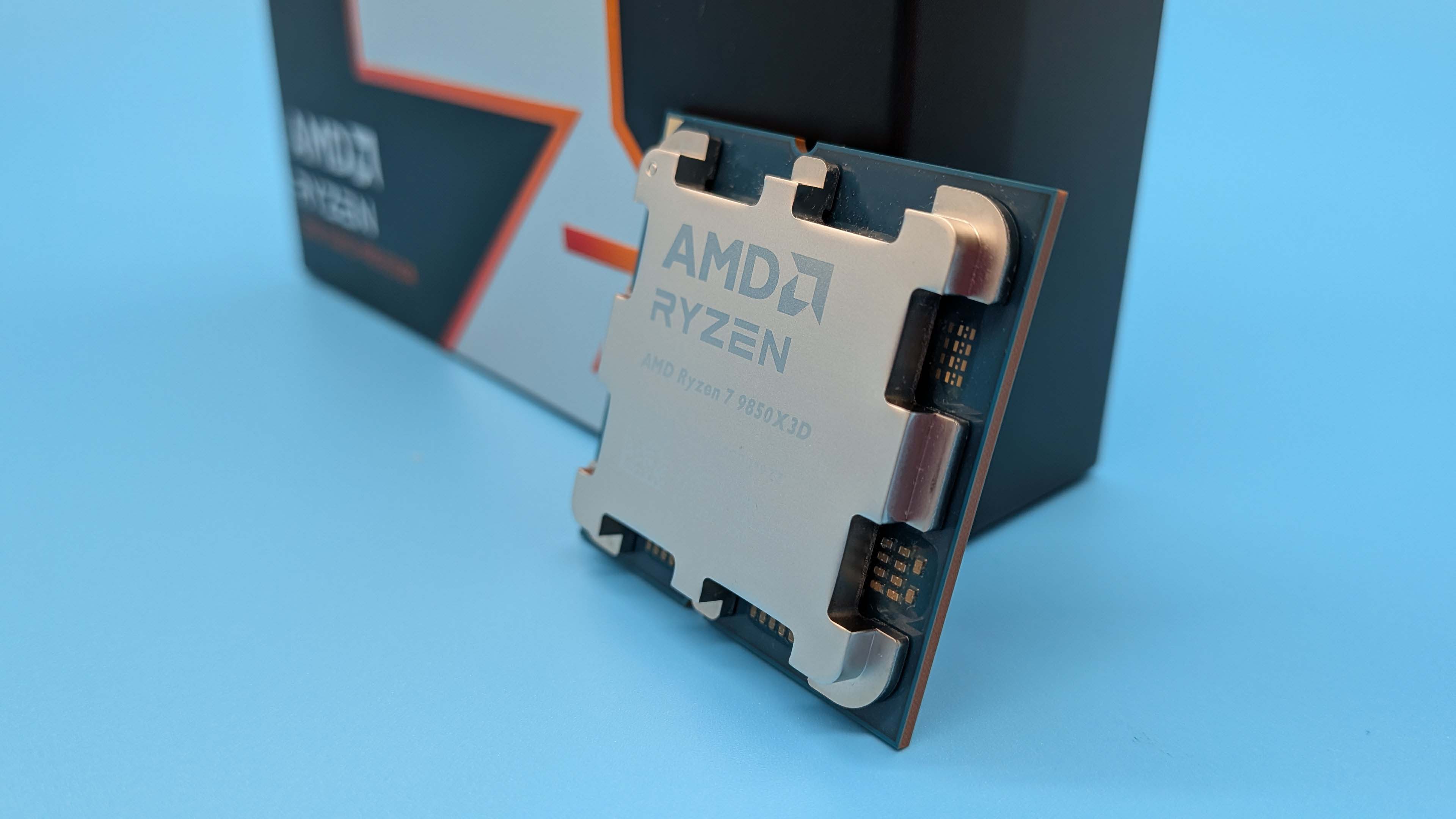
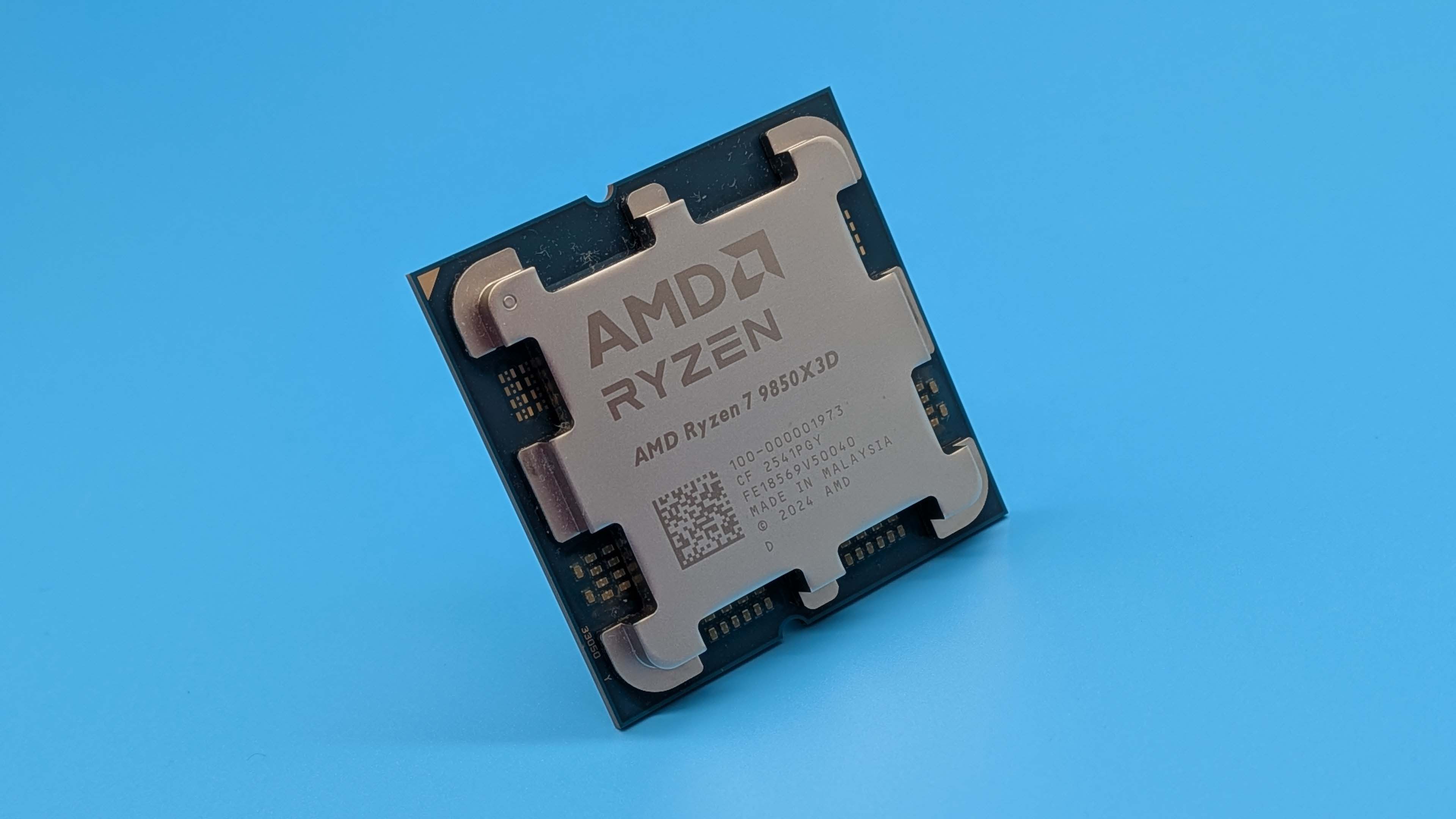
Thankfully, it's still one of the best gaming CPUs you will ever slap into your gaming PC, precisely because AMD hasn't tweaked the formula for the sake of it. The 9850X3D is sporting every feature that has made the 9800X3D our top processor pick since it launched. It's still using the Zen 5 architecture, is manufactured on the same 4nm TSMC process, and most importantly is using the second-gen version of AMD's transformative 3D V-Cache technology.
The current way it approaches the layering of an extra dollop of speedy L3 cache into its processor designs is what has allowed AMD to release a version of arguably its best ever gaming CPU with a seriously high clock speed out of the box. The original method, which honestly felt like a bit of a proof-of-concept approach rather than a considered design, dumped the extra L3 cache directly on top of the chip's core complex die (CCD). This was relatively simple to implement, but restricted how much heat it could stand sitting in between the CPU cores and the cooler.
This means first-gen 3D V-Cache chips are clocked far lower than their extra cache-less counterparts and are also restricted when it comes to overclocking by the end user. The second generation design, however, literally flips that around and has the L3 cache layer sitting underneath the CCD.
This means the hot little CPU cores get the same level of access to the PC's cooling array as standard processors, and now we can have both higher clock speeds and overclocking fun times.
For the uninitiated, the benefits of the extra chunk of L3 cache are most keenly felt in gaming terms, where massively increasing the cache—here, tripling the amount over a similarly eight-core Ryzen 7 9700X—means the CPU has to go dipping into the slow world of system memory far less often, which increases performance in processor-heavy games.
You only have to look at the relative Baldur's Gate 3 and Homeworld 3 performance between the 9850X3D, the 9700X, and the top Intel chip of today, the Core Ultra 9 285K to see what a difference 3D V-Cache can make. It's also become useful in the datacentre world, where fluid dynamics and other simulations hugely benefit from extra cache memory—that's why you'll see EPYC chips rocking 3D V-Cache, too.
This is all why an AMD 3D V-Cache CPU has been our pick as the best gaming chip for many years now.
But if you were hoping the combination of that extra on-die memory and a clock speed increase would amount to even higher gaming performance then prepare to be underwhelmed.
When I first tested the 9800X3D back in the twilight days of 2024, I squeezed a 5.58 GHz stable overclock out of our review sample without much trouble or fancy cooling, and that actually delivered consistently higher clock speeds than the 9850X3D does in games. And still the frame rate needle barely moved in terms of relative performance between stock and overclocked performance.
High-end gaming performance
Nvidia RTX 5090
| Product | Value |
|---|---|
| AMD Ryzen 7 9850X3D | 15607 CPU index score, 36624 Overall index score |
| AMD Ryzen 7 9800X3D | 15997 CPU index score, 36925 Overall index score |

It's the same case here where, if you're very lucky and pick out some games that really respond to 3D V-Cache—and you're rocking a system with a high-end graphics card inside it—you might be able to see something in the region of a 2.5% frame rate increase. I tested the 9800X3D against the new 9850X3D using the RTX 5090 big boi just to take all possible GPU load out of the equation, and that's literally as good as it gets.
If you're sporting a more middle-of-the-road GPU, however, then the results are far more mixed, and interestingly not consistently in favour of the higher-clocked chip, either. Our standard CPU testing has historically used an RTX 4070, which is fast enough to mostly deal with 1080p gaming happily, while still being a pretty standard card.
Gaming performance
Nvidia RTX 4070
| Product | Value |
|---|---|
| AMD Ryzen 7 9850X3D | 16029 CPU index score, 17054 Overall index score |
| AMD Ryzen 7 9800X3D | 16116 CPU index score, 17052 Overall index score |
| AMD Ryzen 7 9800X3D (@ 5.58 GHz) | 11231 CPU index score, 16041 Overall index score |
| AMD Ryzen 7 9700X | 13239 CPU index score, 16437 Overall index score |
| AMD Ryzen 9 9950X3D | 17099 CPU index score, 17084 Overall index score |
| Intel Core Ultra 9 285K | 17668 CPU index score, 17338 Overall index score |
But you can see that in gaming terms it's more of a lottery here. With Cyberpunk 2077 it's largely equal, with Baldur's Gate 3 the older chip takes the lead, and then you're getting maybe a few extra fps on average with the rest. Though I will say it's more regularly ahead of the Ryzen 9 9950X3D than I expected.
When you shift away from 1080p the numbers get even more smoothed out between the different 3D V-Cache chips.
Productivity and processing performance
| Product | Value |
|---|---|
| AMD Ryzen 7 9850X3D | 142 Single-core index score, 1358 Multi-core index score |
| AMD Ryzen 7 9800X3D | 133 Single-core index score, 1307 Multi-core index score |
| AMD Ryzen 7 9700X | 131 Single-core index score, 1148 Multi-core index score |
| AMD Ryzen 9 9950X3D | 139 Single-core index score, 2347 Multi-core index score |
| Intel Core Ultra 9 285K | 141 Single-core index score, 2390 Multi-core index score |
But, if it's just a $20 (or at today's prices more like $30) difference in price, then there is certainly an argument for picking the newer CPU and swallowing the small price premium. The argument runs thus: The new 9850X3D might just be a higher-clocked 9800X3D, but it will be picked from only the best cores that would otherwise make up a 9800X3D, or even a similarly high-clocked Ryzen 9 9950X3D.
With there still being reports of 9800X3D chips dying in certain motherboards—with both AMD and board makers still vying over who's to blame—and recent reports of a 10% failure rate in a single internet cafe, maybe having that extra reliability is worth the money. You're kinda paying for the privilege of knowing this should be the most stable, reliable version of the CPU you can get even if you won't really see the impact of the clock speed bump in games.
Thermals and power
| Product | Value |
|---|---|
| AMD Ryzen 7 9850X3D | 99 |
| AMD Ryzen 7 9800X3D | 67 |
| AMD Ryzen 7 9700X | 75 |
| AMD Ryzen 9 9950X3D | 108 |
| Intel Core Ultra 9 285K | 83 |
Where you will see the impact of the higher clock speed of the Ryzen 7 9850X3D, however, is when you start to look at the thermals or power draw of the chip when gaming. For your maximum 2.5% higher frame rates the CPU is drawing 43% more power and is running 24% hotter.
Which kinda levels out the reliability argument, too. If the cores are a concern, do you really want to be driving that much more power through it?
That's where the argument for the 9850X3D over the Ryzen 7 9800X3D slightly falls down. You can save money opting for the older chip, and save money over time by using less power, though you could of course lower the clock speed to sit at the same 5.2 GHz and even that out. But then, why are you buying the 'better' chip in the first place?
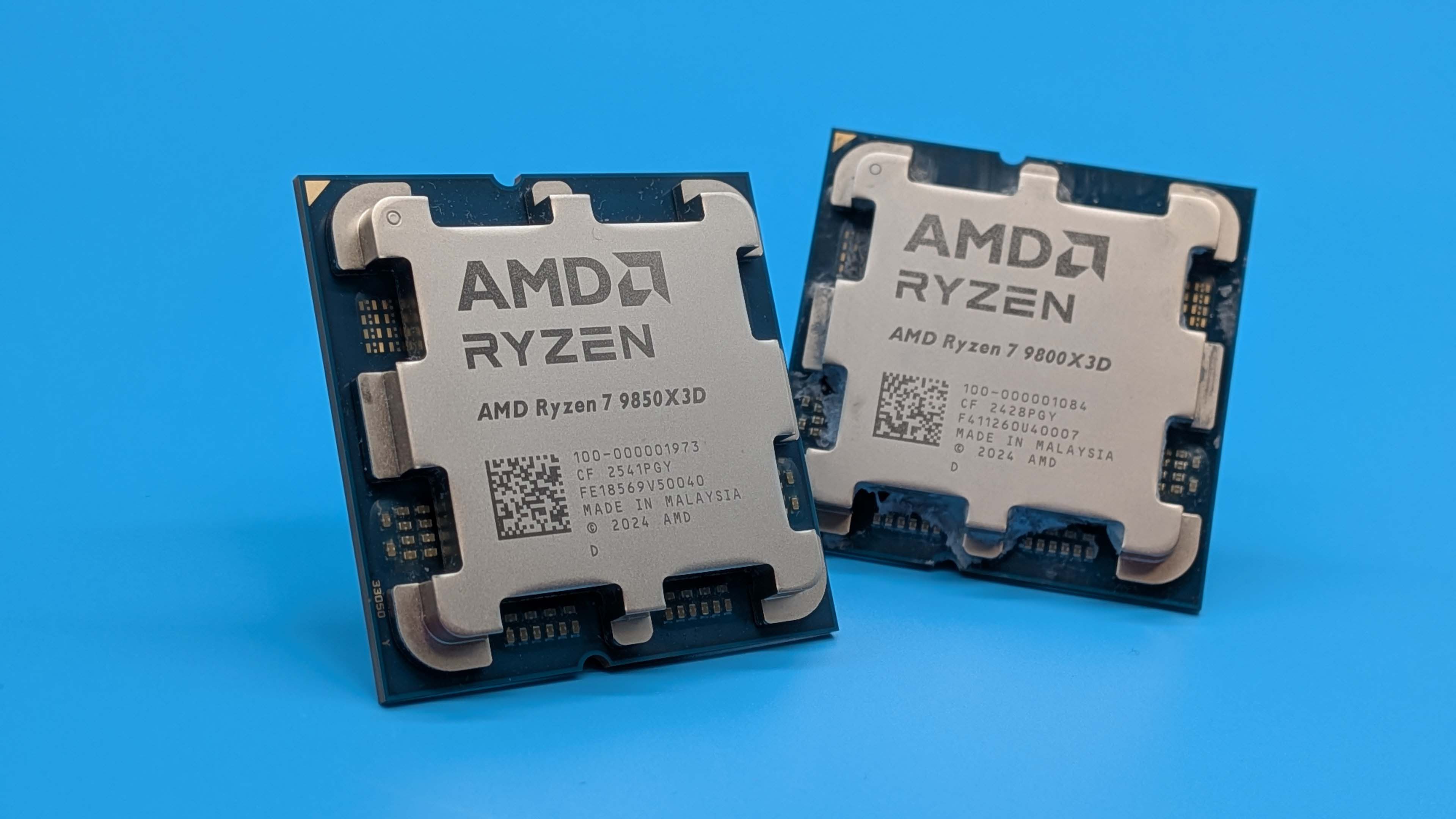
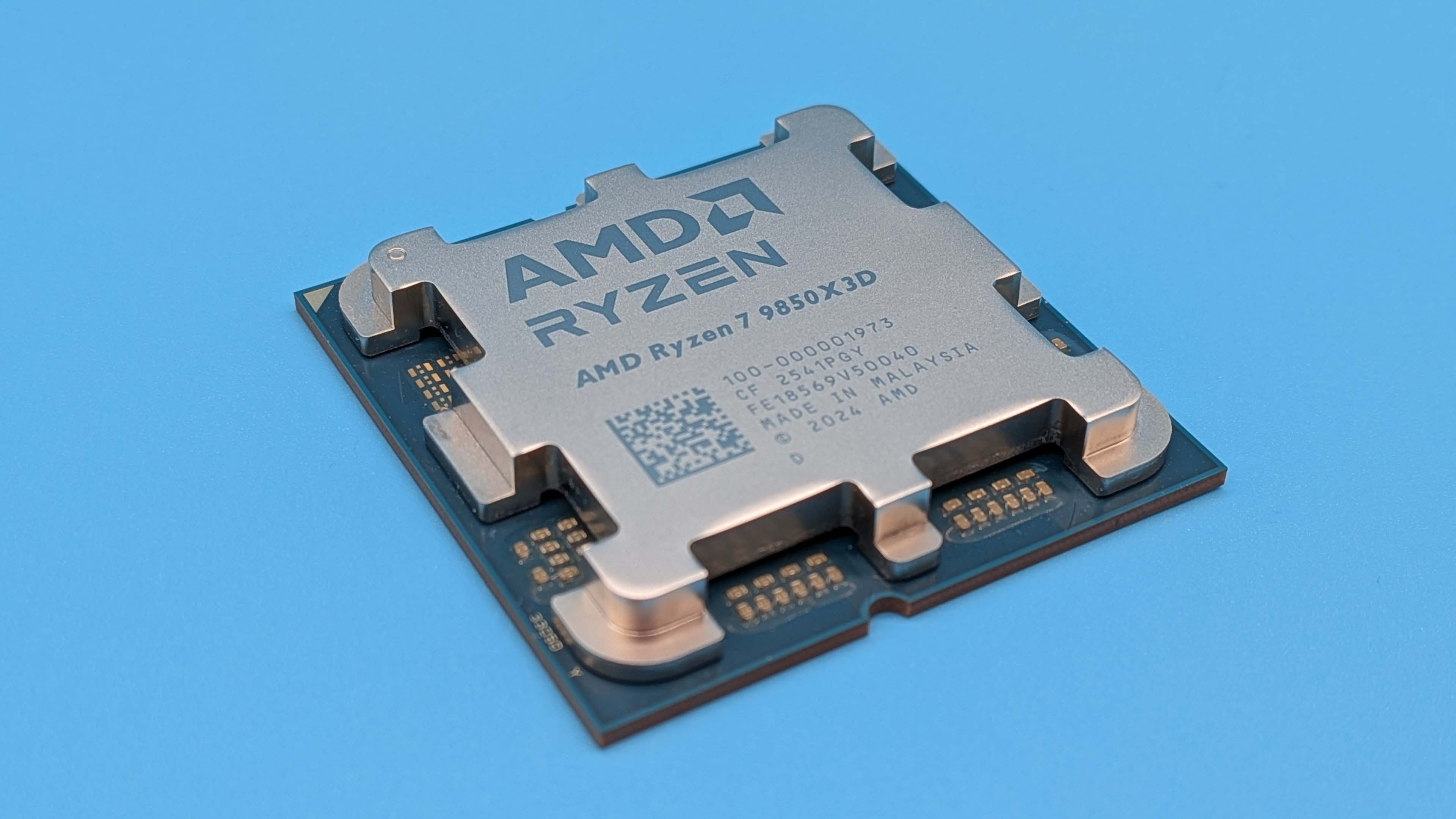
I would suggest, for an AMD running the old dominant Intel playbook, the 'why?' purely surrounds knowing it can sell new barely iterative chips with new names into system integrators to fit out new, marketable gaming rigs with some kind of 'the best just got better' tagline. And to people who absolutely must have the best, darling. Which, by the way, is also the rationale behind the vaunted Ryzen 9 9950X3D2 and its dual-CCD 3D V-Cache layout; something which AMD itself has said is of dubious benefit for gamers.
So, I guess we're left with the obvious conclusion that yes, this is pretty much the fastest CPU for gaming that you can buy. But has the best really got better? We were able to get effectively the same performance out of a manually overclocked 9800X3D 15 months ago, so I'd still argue that nothing's materially changed.
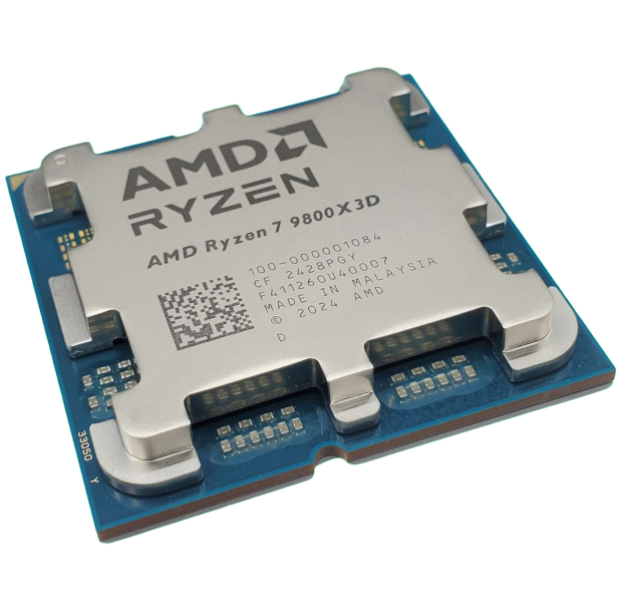
For me, while the 9800X3D is still available in decent numbers and therefore at a cheaper price, that chip remains my pick as the overall best gaming CPU I would recommend to anyone.
1. Best overall:
AMD Ryzen 7 9800X3D
2. Best budget:
AMD Ryzen 5 7600X
3. Best mid-range:
AMD Ryzen 7 9700X
4. Best high-end:
AMD Ryzen 9 9950X3D
5. Best AM4 upgrade:
AMD Ryzen 7 5700X3D
6. Best CPU graphics:
AMD Ryzen 7 8700G
The Ryzen 7 9850X3D is still as great a gaming processor as its 9800X3D forebear. That's to be expected given they are identical bar the 5.6 GHz boost clock. But while that doesn't deliver much beyond 2% higher performance you're paying in terms of a 40%+ power draw in games.

You must confirm your public display name before commenting
Please logout and then login again, you will then be prompted to enter your display name.