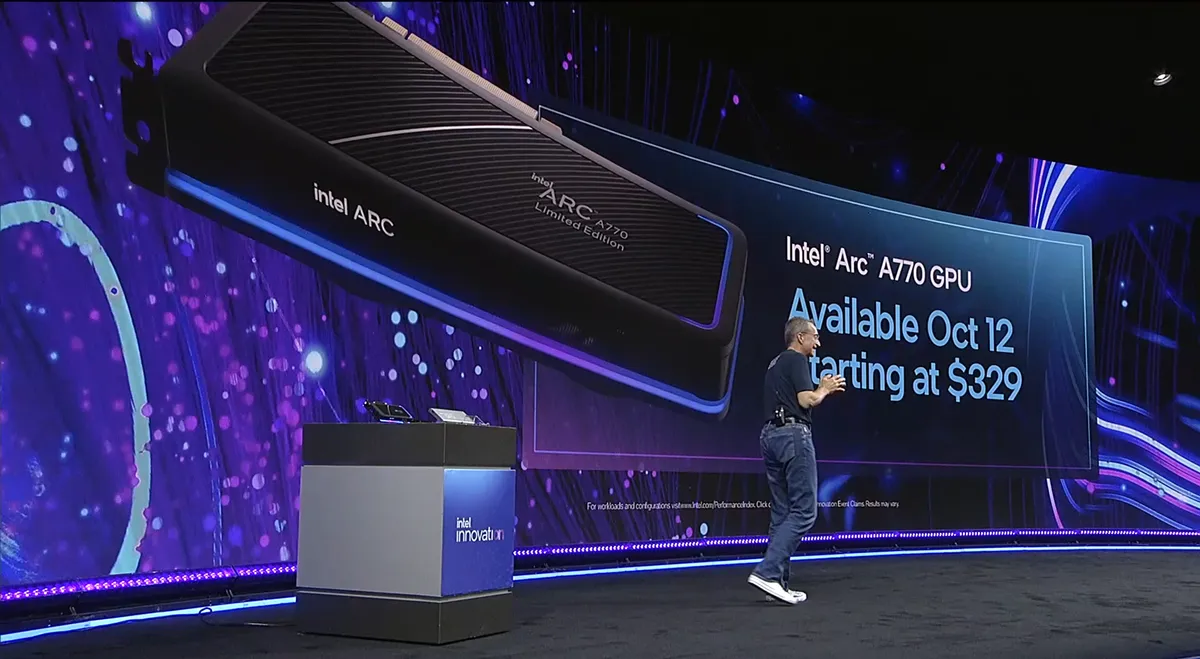
Intel is only weeks away from the launch of its Arc A770 graphics card, which promises to be its first graphics card with an eye to deliver decent performance in games. Specifically, the Arc A770 is said to compete with an Nvidia GeForce RTX 3060 in both frames per second and on price. However, it's not been an easy road to release for Intel's first generation Alchemist GPUs: the company has faced delays, difficulty with drivers, and even questions of its continued interest in graphics.
That step up from integrated to discrete was more difficult than we expected.
Pat Gelsinger, Intel CEO
But nobody said it would be easy. Intel has largely batted away any concerns over a waning interest in graphics, and from those I've spoken to at the company, it sounds like Intel is in it for the long haul.
That includes the opinion of Intel CEO Pat Gelsinger, who I recently had a moment to ask about Intel's discrete graphics venture.
"Obviously we came out of the chute weaker than we would've hoped for early in the year, and fundamentally let me explain the issue a bit," Gelsinger tells me.
"We thought we could scale the integrated software stack more directly into the discrete graphics market. And unfortunately, performance levels, gamer certifications, different game features, you know, the integrated software stack simply wasn't capable of scaling up to 5X performance of a discrete graphics requirement.
"When you're in the market it's easier to refine and add features to it, but that step up from integrated to discrete was more difficult than we expected. So our launch into discrete graphics was a bit slower than I would've liked as we've gone through this year."
Intel's Xe architecture first appeared in its mobile chips, Ice Lake and Tiger Lake, though also appeared in the low-power discrete GPUs that were more or less test vehicles for what was to come. Since then, we've had the Arc A380 and, quietly, the Arc A310. The former of which didn't receive particularly strong praise from reviewers. In a few weeks time, we'll have the Arc A770, likely followed closely by the A750.
"All that said, we think the A770 that I just announced this week and will be shipping October 12th, will be a very compelling product," Gelsinger continues. "We believe now we've fought through the majority of the software stack issues, game certification is now very high, we're getting very good response from the unique features as a part of the product. So we're now feeling comfortable that we now have a solid footing."
I do think you'll see nice improvements as we go through next year.
Gelsinger doesn't fail to note that he expects market share in the GPU market to take time: "Now I do suspect for a new category of product that it takes a few years for us to get really good." But he says that ultimately Intel's "objective is high market share."
To do that, it will need to push performance far further up the road. It's only reportedly competing with Nvidia's near entry-level RTX 3060 today, and the green team is on the verge of releasing a graphics card that pushes the bar for performance far in excess of that, the RTX 4090. AMD, too, is highly competitive at the highest level.
Perhaps it'll be the second generation of Arc graphics card, codename Battlemage, that carries the torch further for Intel in this regard when it arrives sometime next year. Though Gelsinger hints at the third generation Celestial cards being the ones to watch.
Best CPU for gaming: The top chips from Intel and AMD
Best gaming motherboard: The right boards
Best graphics card: Your perfect pixel-pusher awaits
Best SSD for gaming: Get into the game ahead of the rest
"Over my 40+ year career I've done a lot of V1 products. Every V1 product I've done has always ushered in how to make it better in V2, and by V3 you're pretty darn good. If you're dedicated and have good people working on it.
"So I do think you'll see nice improvements as we go through next year and the competitiveness of those."
Gelsinger concludes his answer by telling me that its GPU business is ultimately entwined together. Integrated, discrete, datacentre, and HPC—all of these are important steps to nailing graphics for the company. That plays into what Tom Petersen told me a month ago regarding Intel's intention for its gaming graphics cards going forward, "our discrete business is the basic technology development that goes both into the data centre and integrated GPUs."
The buzz out of Intel sure would indicate that it's not backing down from this fight.