Our Verdict
It's cheap, sure, and performance is "ok", but thanks to a splurge of old budget hardware over five years old it fails to keep up with more modern alternatives that cost only mildly extra.
For
- Decent performance
- Relatively cool
- Priced aggressively
Against
- Old components
- Load times sluggish
- Far better available for not much more
PC Gamer's got your back Our experienced team dedicates many hours to every review, to really get to the heart of what matters most to you. Find out more about how we evaluate games and hardware.
SSD prices are not very stable right now. While not hit anywhere near as bad as memory, we're seeing price increases on many SSDs on a pretty regular basis. So if the prices here don't match up when you read this, that's likely why. We recommend using a price checker tool, such as CamelCamelCamel, to see if you're still getting a good deal.
Alright, I'll come out and say it, the Lexar NQ780 is a bit average. A bit dull. Usually, when it comes to reviewing hardware like this, particularly SSDs, there's always something to write about. Something that's slightly interesting, or some weird quirk that the manufacturer has tweaked a certain way that's led to some curious performance metric in one manner or another. With the NQ780, though, that's kind of not the case.
This isn't the best SSD of 2025, not by a long shot. It performs and delivers speed in the same manner that the Samsung 990 Evo Plus did when I reviewed that back in October of 2024, or the Crucial P310 did in January of this year. And it's aimed at that market too. It's a budget solution for those more interested in cheap capacity over speed and load times. It's not particularly awful, it's just outpaced or on par with practically every other PCIe 4.0 drive that's come before it, and it's done this around eight months late to the party.
Its biggest advantage is its pricing, and, although I'm writing this review in the midst of the carnage that is November (thanks, Black Friday), Lexar's aggressive RRP gives the NQ780 one hell of an affordability score. Namely, it's $0.07 per GB in the US and £0.06 per GB in ol' Blighty. With updated pricing across my benchmark database, that is one of if not the lowest price per gig I've seen to date. If it stays that way (a lot of drives are increasing in price right now due to the ongoing memory crunch, that might be its saving grace).

Capacity: 4 TB
Interface: PCIe 4.0 x4
Memory controller: Innogrit IG5236
Flash memory: Intel 144-layer 3D QLC NAND
Rated performance: 7,000 MB/s sustained read, 6,000 MB/s sustained write
Endurance: 2400 TBW
Warranty: Five years
Price: $264 | £253
So, now we've got that one interesting element out of the way, let me bore you with the remarkably mundane hardware situation we're looking at here. The NQ780's a bit of an oddity in its component setup. There's no Phison, Maxiotek, Silicon Motion, or Sandisk controllers here; instead, we're greeted with an Innogrit IG5236 eight-channel 12 nm controller, which was initially launched waaaay back in 2020. It's all based on the PCIe 4.0 platform, M.2-2280 form factor, and it's been paired with a stack of Intel's 144-layer QLC NAND flash, which taps out at 1 TB packages. That means for this 4 TB model, we've got four on a single-sided stick (keeping in line with modern trends, making it compatible with many a laptop, console, PC, etc).
That should tell you straight away, then two things. Firstly, it's slightly toastier than most modern drives, and slightly less efficient as well, and secondly, that's a lot of old hardware trundling along in its sultry snazzy stickered form, and you'd be right. This almost feels like a stock clear-out and rebrand rather than a new release, particularly given how old that controller is.
Unfortunately, then, as you may or may not be surprised to hear, performance is what you'd expect from an SSD of this caliber. Although sequentials are initially high, once that pSLC cache fills up, she slows to a crawl.
| Header Cell - Column 0 | Lexar NQ780 4 TB | WD Blue SN5100 2 TB |
|---|---|---|
3DMark Storage - Index | 2893 | 3915 |
3DMark Storage - Bandwidth (MB/s) | 495.11 | 672.63 |
3DMark Storage - Access time (µs) | 62 | 59 |
CrystalDiskMark 7.0.0 - SEQ1M Q8T1 Read (MB/s) | 7446 | 7318 |
CrystalDiskMark 7.0.0 - SEQ1M Q8T1 Write (MB/s) | 6601 | 6687 |
RND4k Q1T1 Read (IOPS) | 17134 | 26224 |
RND4K Q1T1 Write (IOPS) | 75727 | 75158 |
Final Fantasy XIV: Shadowbringers - Total loading time (seconds) | 7.869 | 7.125 |
Peak temperature (°C) | 62 | 61 |
PC Gamer test bench
CPU: AMD Ryzen 9 9900X | RAM: 64 GB (2x32GB) Team Group T-Create Expert DDR5 @ 6000 C34 | GPU: Nvidia GeForce RTX 4080 Super | Motherboard: Asus ROG Strix X870E-E Gaming WiFi/NZXT N9 X870E | CPU Cooler: Asus ROG Ryujin III 360 ARGB Extreme | PSU: 1200W NZXT C1200 (2024) 80+ Gold | Chassis: Geometric Future Model 5
CrystalDiskMark measured seq read and write at 7,446 MB/s and 6,601 MB/s, respectively, which puts it on par with the likes of the WD Blue SN5100. Not a bad showing by any means, but drop down to some Random 4K testing, and the battle quickly shifts. The SN5100 dominates the NQ780, registering 107 MB/s on the write, versus the NQ780's paltry 70 MB/s. That figure is actually far worse than at first glance, too, as it makes the NQ780 joint second to last on that metric, across all of the 19 drives I've tested in the last 12 months. Out of 19 drives, it came 17th…
That's important because random 4K read performance is incredibly critical for us gamers, as it's generally comparable with how AAA titles read files on an SSD. Think of it like a CPU pulling a game asset from here, a texture file from there, a mesh from over yonder, audio lines from that place, and you're on the right lines. These assets aren't stored linearly (or sequentially) like with photos or videos, and the NQ780's poor showing here translates into our game load test times as expected.
✅ You don't care about game load speeds: Random 4K read performance is through the floor, and load times suffer as a result, if you're after a mass capacity drive, though, it is still remarkably cheap.
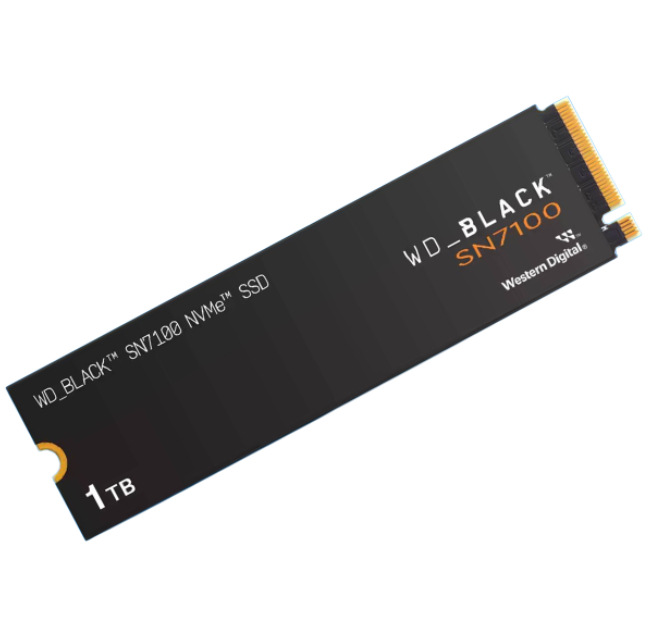
❌ You want a modern drive: Buy the SN7100, it's way better, delivering far more impressive performance than the NQ780 does, sadly.
Final Fantasy's XIV Shadowbrings benchmark chugs along at a staggeringly slow 7.869 seconds on average. Which, although again relatively quick in real-world terms, pales in comparison to its modern SSD competition. That's particularly damning as well, given FF XIV tends to favour drives with a larger capacity, and I am testing the 4 TB model here, whereas most of our results come from 2 TB models.
This thing confuses me. It almost feels like someone let an AI LLM make a business decision here. It spotted a load of cheap NAND, some budget controllers from yesteryear at a bargain price, and slapped it all together for a quick, rapid launch of a drive that just can't quite keep up with its modern 4.0 equivalents.
It's biggest advantage comes in the form of that pricing being as aggressive as it is, but I can't help but shake the feeling that you'd be far better off investing in the additional performance found in those alternatives, the SN5100, for example, has gone for only a little more (though it is now priced much higher, gah), yet delivers exemplary performance in every category by comparison, even with QLC NAND as well. You can just do so much better, and that's a problem. Releasing a drive like this today is just not enough, but industry-wide price increases might keep it in play (if it stays at this sorta price for long).
1. Best overall:
WD_Black SN7100
2. Best budget:
Biwin Black Opal NV7400
3. Best PCIe 5.0:
WD_Black SN8100
4. Best budget PCIe 5.0:
Crucial P510
5. Best 4 TB:
TeamGroup MP44
6. Best 8 TB:
WD_Black SN850X
7. Best M.2 2230:
Lexar Play 2230
8. Best for PS5:
Silicon Power XS70
It's cheap, sure, and performance is "ok", but thanks to a splurge of old budget hardware over five years old it fails to keep up with more modern alternatives that cost only mildly extra.

You must confirm your public display name before commenting
Please logout and then login again, you will then be prompted to enter your display name.