

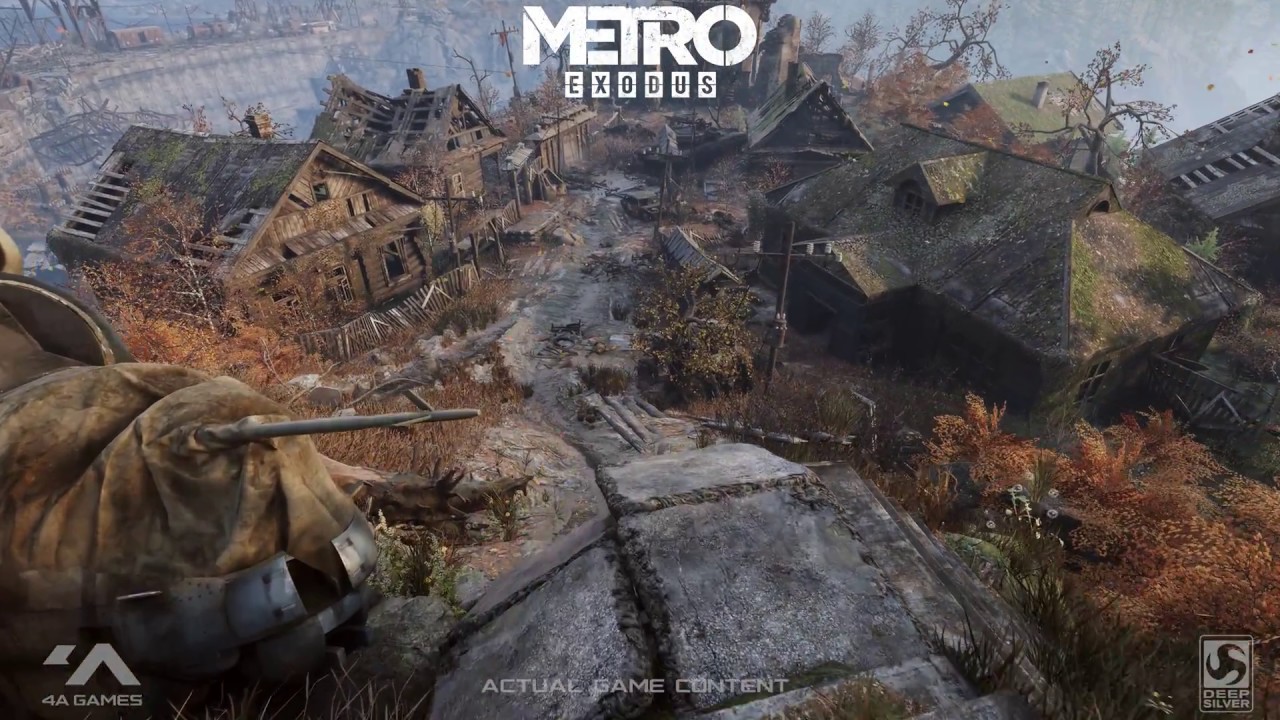
Metro Exodus teaser showcases Nvidia's new real-time ray tracing technology
The motherland is in bad shape, but it looks great.
Keep up to date with the most important stories and the best deals, as picked by the PC Gamer team.
You are now subscribed
Your newsletter sign-up was successful
Want to add more newsletters?
Every Friday
GamesRadar+
Your weekly update on everything you could ever want to know about the games you already love, games we know you're going to love in the near future, and tales from the communities that surround them.
Every Thursday
GTA 6 O'clock
Our special GTA 6 newsletter, with breaking news, insider info, and rumor analysis from the award-winning GTA 6 O'clock experts.
Every Friday
Knowledge
From the creators of Edge: A weekly videogame industry newsletter with analysis from expert writers, guidance from professionals, and insight into what's on the horizon.
Every Thursday
The Setup
Hardware nerds unite, sign up to our free tech newsletter for a weekly digest of the hottest new tech, the latest gadgets on the test bench, and much more.
Every Wednesday
Switch 2 Spotlight
Sign up to our new Switch 2 newsletter, where we bring you the latest talking points on Nintendo's new console each week, bring you up to date on the news, and recommend what games to play.
Every Saturday
The Watchlist
Subscribe for a weekly digest of the movie and TV news that matters, direct to your inbox. From first-look trailers, interviews, reviews and explainers, we've got you covered.
Once a month
SFX
Get sneak previews, exclusive competitions and details of special events each month!
Epic Games isn't the only studio doing impressive things with Nvidia's latest and greatest technology. 4A Games, creator of the wonderfully horrific Metro games, released a video of its own showcasing its efforts to bring real-time ray traced illumination to Metro Exodus using Nvidia's RTX technology.
Ray tracing is a method of rendering images that produces very realistic results, but that requires serious computational power to do so—more than you're going to find in our average desktop PC. Because of that, current approaches to global illumination in games "have had to compromise in some critical area," 4A CTO Oleksandr Shyshkovtsov explained in a blog post.
"Offline pre-rendered GI offers a great visual target, but sacrifices flexibility in production, in-game dynamics, and uses a lot of memory. Prior realtime solutions were always limited by distance of light propagation, lack of data behind objects or screen edges and produced visual issues like leaks or unnatural lighting," he said.
"But this is the point where hardware steps in bringing truly scale-independent ambient occlusion by allowing brute force tracing of multiple rays from each pixel several hundreds of meters each frame."
As we noted in our look at RTX and Nvidia's Volta GPUs earlier this week, there's a long way to go before all of this becomes mainstream. Nvidia didn't specify what hardware was used to render this trailer but the Star Wars video shown during Epic's "State of Unreal" presentation used Nvidia's DGX Station, which boasts four Tesla V100 GPUs and is currently on sale for $50,000.

Keep up to date with the most important stories and the best deals, as picked by the PC Gamer team.

Andy has been gaming on PCs from the very beginning, starting as a youngster with text adventures and primitive action games on a cassette-based TRS80. From there he graduated to the glory days of Sierra Online adventures and Microprose sims, ran a local BBS, learned how to build PCs, and developed a longstanding love of RPGs, immersive sims, and shooters. He began writing videogame news in 2007 for The Escapist and somehow managed to avoid getting fired until 2014, when he joined the storied ranks of PC Gamer. He covers all aspects of the industry, from new game announcements and patch notes to legal disputes, Twitch beefs, esports, and Henry Cavill. Lots of Henry Cavill.

