

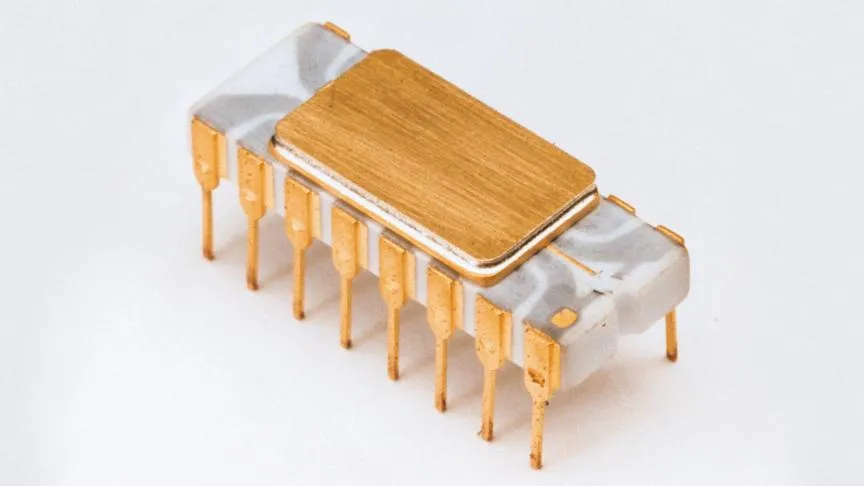
Intel celebrates 50 years of the 4004, the grand daddy of the modern CPU
A chip that led to computing as we know it.
Keep up to date with the most important stories and the best deals, as picked by the PC Gamer team.
You are now subscribed
Your newsletter sign-up was successful
Want to add more newsletters?
Every Friday
GamesRadar+
Your weekly update on everything you could ever want to know about the games you already love, games we know you're going to love in the near future, and tales from the communities that surround them.
Every Thursday
GTA 6 O'clock
Our special GTA 6 newsletter, with breaking news, insider info, and rumor analysis from the award-winning GTA 6 O'clock experts.
Every Friday
Knowledge
From the creators of Edge: A weekly videogame industry newsletter with analysis from expert writers, guidance from professionals, and insight into what's on the horizon.
Every Thursday
The Setup
Hardware nerds unite, sign up to our free tech newsletter for a weekly digest of the hottest new tech, the latest gadgets on the test bench, and much more.
Every Wednesday
Switch 2 Spotlight
Sign up to our new Switch 2 newsletter, where we bring you the latest talking points on Nintendo's new console each week, bring you up to date on the news, and recommend what games to play.
Every Saturday
The Watchlist
Subscribe for a weekly digest of the movie and TV news that matters, direct to your inbox. From first-look trailers, interviews, reviews and explainers, we've got you covered.
Once a month
SFX
Get sneak previews, exclusive competitions and details of special events each month!
On November 15th 1971, Intel released its 4004 processor. Its release marked one of the key foundations of the modern computer age. Some of the core concepts from this processor live on today in virtually every piece of technology. Without it, we might still be playing board games, or relying on pigeons for communication. Well, not really.
The 4004 was the first commercially available microprocessor and it was absolutely a pioneering piece of tech. It combined different functions onto a single silicon chip with a high operating frequency and transistor density that was well ahead of anything available at the time. It also used cutting edge manufacturing technology.
Black Friday 2021 deals: the place to go for the all the best early Black Friday bargains.
Prior to 1971, Intel primarily focused on semiconductor memory, lacking the expertise to produce a general-purpose processor. Then, in 1969, Nippon Calculating Machine Corporation approached Intel to design a processor for its Busicom 141-PF printing calculator. Intel suggested a four chip design, one of which could be programmed for various tasks. Electronics would never be the same. To meet these design goals, it hired Italian chip designer Fredrico Faggin. Faggin’s expertise no doubt helped Intel to achieve the dominant position it enjoys today. Interestingly, each 4004 die contains a tiny F.F. in the corner.
Some of the 4004's key specifications include a 740 KHz clock speed, 10 micrometer (10000nm) lithography and a total of 2300 transistors. Compare that to a modern CPU at around 4.5 GHz, 7 nanometer lithography and billions of transistors and it’s clear we’ve come a long way.
A prototype of the original Busicom calculator is on display at the Computer History Museum in Mountain View California. This not so young geek would like to visit there someday.
The technology and expertise Intel learned from designing these early chips eventually led to the release the 8086 processor in 1978, which was the processor used in IBM’s original PC. With that, the modern PC was born. The roots of our gaming machines can be traced back to these early days. Where will we be 50 years from now? Maybe Star Citizen will have a release date by then.
You won't be able to grab a 4004 on our Black Friday CPU deals page, but one of its great great great grandchildren will be worth a look.
Keep up to date with the most important stories and the best deals, as picked by the PC Gamer team.

Chris' gaming experiences go back to the mid-nineties when he conned his parents into buying an 'educational PC' that was conveniently overpowered to play Doom and Tie Fighter. He developed a love of extreme overclocking that destroyed his savings despite the cheaper hardware on offer via his job at a PC store. To afford more LN2 he began moonlighting as a reviewer for VR-Zone before jumping the fence to work for MSI Australia. Since then, he's gone back to journalism, enthusiastically reviewing the latest and greatest components for PC & Tech Authority, PC Powerplay and currently Australian Personal Computer magazine and PC Gamer. Chris still puts far too many hours into Borderlands 3, always striving to become a more efficient killer.

