Are you fed up with your limited view of the world? I don't mean what you think about current events or views on socioeconomic issues: I'm talking about your eyeballs. While the electromagnetic spectrum is infinitely wide, we can only see a microscopic slice of frequencies. But thanks to one engineering artist, you can at least visualise what the world of radio waves could look like.
I use 'look' in its broadest possible terms, though, because what Rootkid has created isn't a special set of goggles or the like. It's essentially a radio wave transceiver, named Spectrum Slit, that converts the flurry of signals around us into light, emitted by a construction that gives all kinds of Control vibes, for some reason.
But if you just want to know what it does in a handful of words, Rootkid offers the following: "The installation measures radio signals primarily within the 2.4 GHz and 5 GHz bands frequencies used by Wi‑Fi, Bluetooth, and other domestic wireless devices. Using a software-defined radio, the piece continuously scans these ranges, sampling signal strength across the spectrum.
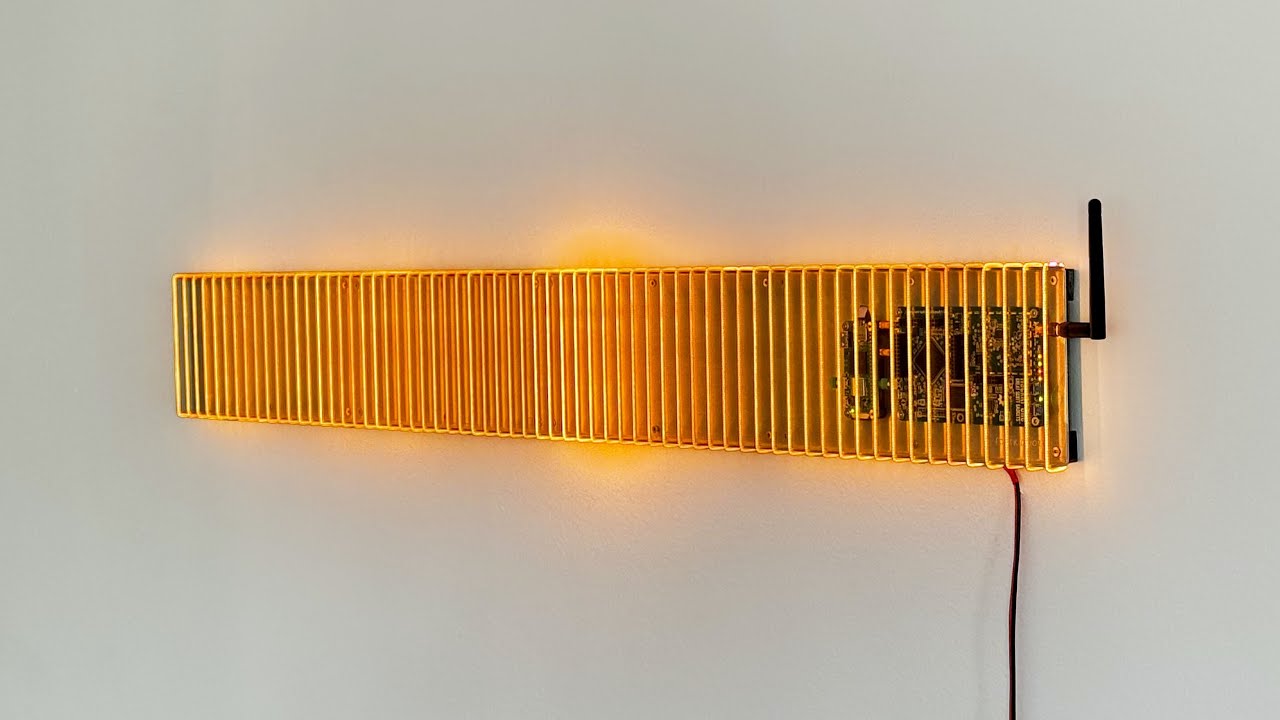
"This data is processed live and mapped onto a linear array of 64 luminous filaments arranged along a U-shaped steel structure, visually echoing scientific frequency plots. Each filament corresponds to a specific segment of the measured spectrum, its brightness directly driven by local electromagnetic intensity."
If you've not watched the video yet, you can still probably picture what it looks like in action, given just how ubiquitous radio wave transmissions are in today's world. With phones, watches, computers, televisions, and IoT devices all constantly blaring away into the ether, the Spectrum Slit is lit up like a Christmas tree the moment it's switched on.
However, it really gets going once Rootkid's come home and start using their digital devices to watch shows, message friends and family, and so on. At one point in the video, the device is so bright that it looks like an electric heater is bolted to the wall, not a clever piece of engineering art.
With the right pieces of equipment and the programming know-how, it might be possible to do something similar with your gaming PC's RGB lights. Rather than just having them static, cycling through colours, or just reacting to your CPU's temperature, it would be neat to see them flash a response to every bit of activity your computer does.

You could colour-code certain operations, perhaps, using blue for storage, red for RAM, green for processors, and so on. Admittedly, it would probably all turn into a fit-induced cacophony during a game, but it'd be pretty cool to do at least once.
Naturally, no piece of art is worth its salt without an appropriately thought-provoking declaration, and Rootkid's Spectrum Slit is happily no exception.
"[It] invites viewers to reconsider the apparent stillness of technological spaces and to confront the invisible infrastructures that sustain contemporary communication. By making the electromagnetic spectrum perceptible, the work reveals a persistent, energetic environment—an artificial yet omnipresent storm generated by human activity."
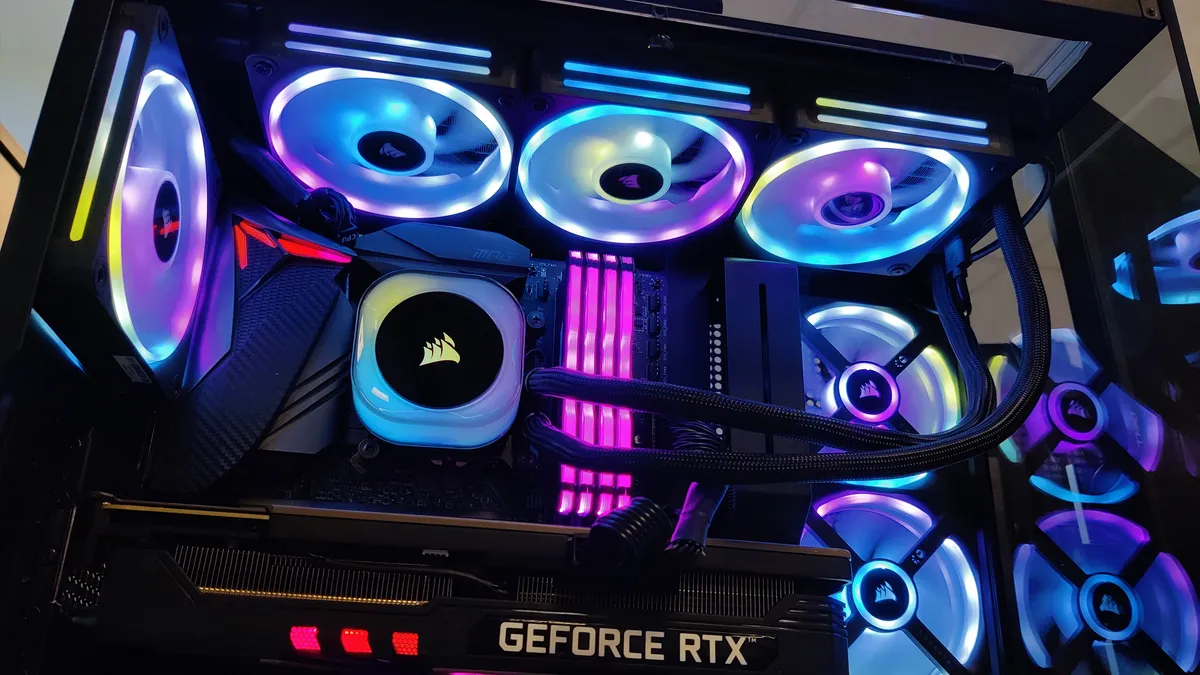
Hmm. I reckon I could do the same for my main work and gaming PC, with a Core Ultra 7 265K and GeForce RTX 4080 Super.
"Nick's Rig invites gamers to scoff at the choice of processor and consider Intel's over-promises of Arrow Lake, confronting the ever-present nonsense of tech marketing. By eschewing RGB lights, bar those in the MSI motherboard and Corsair RAM kit, the rig reveals a disdain for the modern, a conscious decision to embrace simplicity, and reveal the user's innately boring persona."
Alright, so that was utter rubbish, but I assure you: Rootkid's Spectrum Slit is anything but. It's cool, a tad spooky, and I genuinely want it.

1. Best gaming laptop: Razer Blade 16
2. Best gaming PC: HP Omen 35L
3. Best handheld gaming PC: Lenovo Legion Go S SteamOS ed.
4. Best mini PC: Minisforum AtomMan G7 PT
5. Best VR headset: Meta Quest 3

You must confirm your public display name before commenting
Please logout and then login again, you will then be prompted to enter your display name.