Doom is a cultural cornerstone, where every new piece of tech (gaming or otherwise) and every game is forced to somehow—no matter how impossible—run Doom. It's a test, and we've seen the 1993 classic on everything from a motherboard's BIOS, old potatoes, a Lego brick, to a home pregnancy test, and even Doom running inside Doom.
Honestly, I thought we'd hit the end of the runway. And then Cortical Labs, a tech startup which once grew living brain cells on a microchip to play Pong, returned to train these neurons to play Doom. In retrospect, after they played Pong, it was the only logical next step, wasn't it?
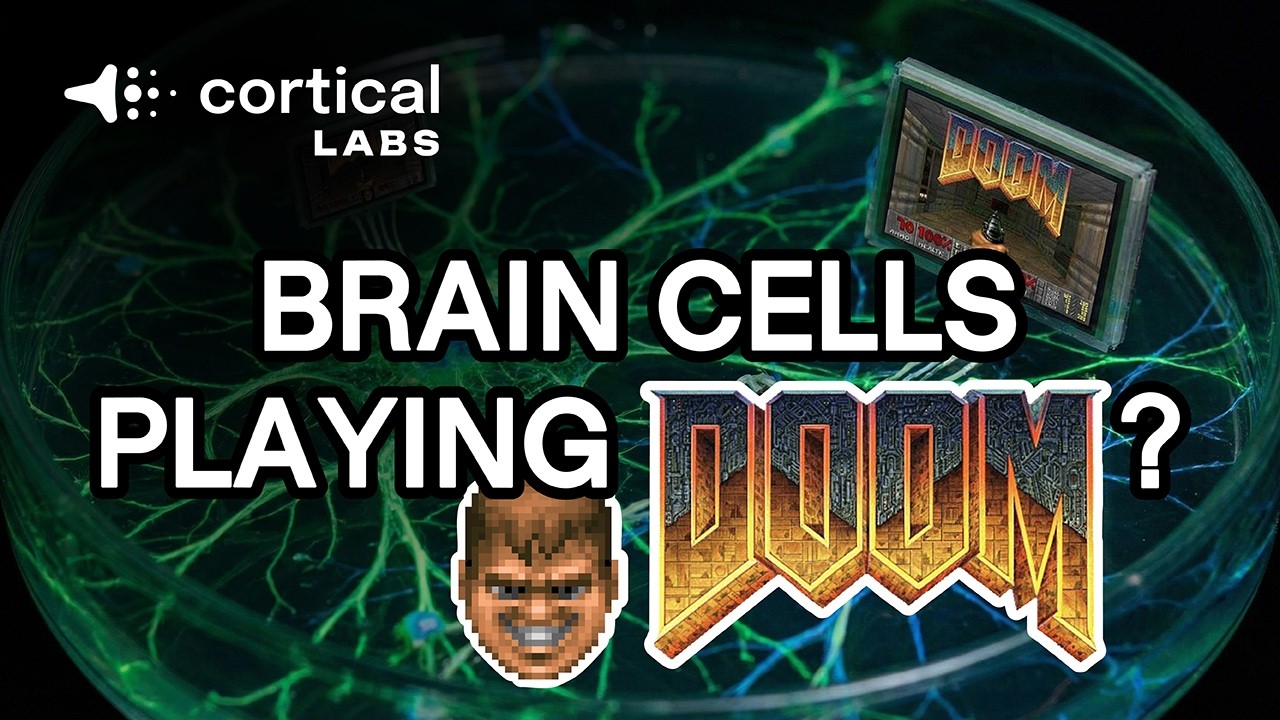
Understandably, you're likely scratching your head, wondering how it's even possible for a petri dish to play Doom. Good question. The answer is the CL1, "the world’s first code deployable biological computer," which uses human brain cells on the surface of a silicon computer chip to send and receive electrical signals. Under a microscope, it looks like the pockmarked surface of a planet or a gross web of goop with electrical gubbins lying on top.
Article continues below"Doom was much more complex [than Pong]", says Dr Brett Kagan. "Doom is chaos, it's 3D, it has enemies, it has an explorable environment, and it's hard."
And so, as Dr Alon Loeffler explains it, they "needed to translate the digital world of Doom into the biological language of neurons, which is electricity." They did so in collaboration with an independent researcher named Sean Cole.

Basically, the video feed from Doom was mapped to different patterns of electrical stimulation, which is sent to the cells, where they react with brain activity that can be interpreted and mapped to actions in-game.
Cortical Labs' CTO David Hogan explains using the example of when a demon appears on the left of the screen, where specific electrodes stimulate certain parts of the cells on the left side of the cells on the microchip. The neurons then react to that stimulation, and that activity is translated into motor commands—actions in-game. If the neurons fire in a specific pattern, Doom Guy will shoot, while a different pattern will cause him to move.
"So can the cells learn to play Doom? Yes", says Dr Kagan. "They're receiving information, they're sending commands to move their character around, they're able to find enemies, and shoot."
"Is it an esports champion? Absolutely not. Right now, the cells play a lot like a beginner who's never seen a computer, and in fairness, they haven't… While they die a lot, they are learning. Just like a human or an animal, the cells need feedback. They need to know what the right actions are and what the wrong actions are, and how they can be trained to improve."
There's evidently a lot of work to go into getting human cells to play Doom well, but it's playing it nonetheless. Hell, it's probably doing a better job of it than my parents would. Who knows, maybe one day you'll have a biological computer alongside you in your Overwatch ranked matches, and that could be an upgrade, truth be told.


You must confirm your public display name before commenting
Please logout and then login again, you will then be prompted to enter your display name.