





The time of malware generated AI art is upon us, with the first images I've spotted rivalling that of the great HR Geiger in both scale and complexity. Not only has the Twitter user who brought about this unholy union of AI malware art, Greg Linares, made some impressive snapshots of the questionable latent space in image form, they've also used their skills to design a malware generated, cyberpunk themed music album—and it actually slaps.
Though just as the throngs of past wars have inspired great artists to create their masterpieces, so too do the malware artists of our time draw from some dark inspiration.
Linares goes by Laughing_Mantis on Twitter, pulling together their malware-based AI art designs under a dedicated Malware Art profile. Each piece curated here, Linares notes that the art is generated on a heavily modified local version of Stable Diffusion v1.4 and a separate 2.0 install. Basically, he uses "strings and text from inside malware, as well as filenames, and other usable meta data in order to drive the AI art prompts."
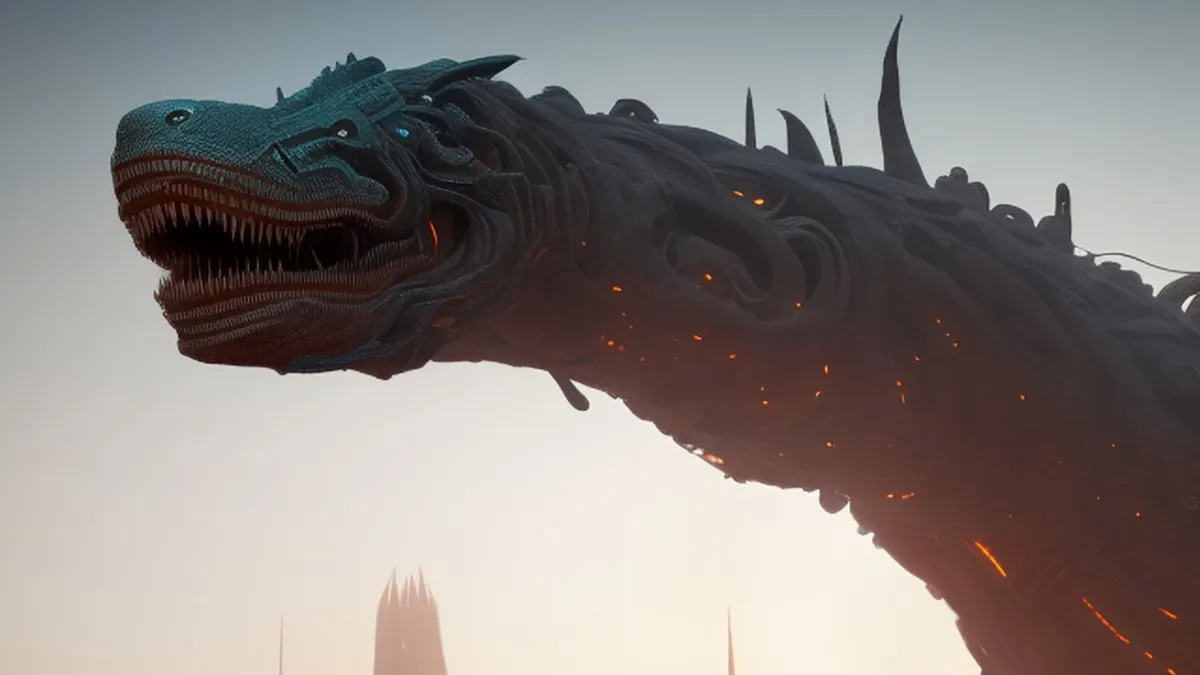
It was Linares' glorious collection of images generated using malware from the 'Sandworm group' that caught my eye in the early hours of this morning, the debugging information and test folders for which, Linares explains, were littered with Dune references—hence the Sandworms. These sinuous, cable-draped creations tower over humanity in mist-filled scenes of imminent demise, mouth agape, and hungry for flesh.
If that description wasn't enough to send chills down your spine, perhaps something a little more real-world will pique your fight or flight instinct.
These samples are based on the Sandworm group malware which had Dune references left in debugging information and test folders. This APT group is believed to be still active and has been since roughly over 10 years https://t.co/1YoLCQfZ0hDecember 6, 2022
Sandworm is a Russian advanced persistent threat (APT) group, which Microsoft refers to as Iridium and says is associated with the Russian intelligence service, the GRU. That all means this art was inadvertently designed by Russian sponsored hackers with a penchant for mystical Sci-fi references. It was this same group that is thought to have been behind the 2015 compromise of the Ukrainian electrical grid, causing mass power outages, and disrupting the energy supply of around 225,000 residents. And Microsoft is also claiming that it is supporting the recent missile attacks on Ukrainian infrastructure with cyberattacks on the same sectors.

Best CPU for gaming: The top chips from Intel and AMD
Best gaming motherboard: The right boards
Best graphics card: Your perfect pixel-pusher awaits
Best SSD for gaming: Get into the game ahead of the rest
The group is supposed to have used a tool known as Black Energy 3 which, according to Malpedia, is "associated with electricity and power generation for espionage, denial of service, and data destruction purposes." With it, the Sandworm group was able to compromise Ivano-Frankivsk power grid by siphoning operator credentials.
You can bet the malware-based music Linares created comes with the same kind of messed up origins story, since it too is based on a huge collection of malware from Twitter user vx-underground.
Speaking to Linares, they told me: "The malware generated art is kind of an ongoing process, since I'm still figuring out how to render these the best it's a little different with each malware sample, however the idea is roughly the same."
He used text inversion to make the prompts more palatable to the AI generator. "Since malware isn't always filled with the best content for generating art, by using text inversion we can train the AI to interpret certain things into more aesthetically pleasing content.
A lot of the biomechanical data is also based on shots of stuff from my dad's tool collections, mechanical parts, and Sci-fi magazine collections.
Greg Linares
"An example is 'Threading' which is in a lot of malware and pertains to multiple commands being executed simultaneously." The text inversion of threading threw up things like "biomechanical threads, wires, cables, rope, string," which is how the sandworms got their adornments.
They go on to explain that the image collections the AI was trained on included "actual photos I took of urban decay and rubble from places in Baltimore, Centralia, Seattle, San Francisco, & Tucson. Furthermore a lot of the biomechanical data is also based on shots of stuff from my dad's tool collections, mechanical parts, and Sci-fi magazine collections."
So it's not all based on doom and gloom. And despite the potential links to such destructive cyberattacks, there's no denying the beauty that's been wrought by utter devastation. It's all very metal, and I may have a new obsession.

