Join The Club





If you've been thinking, like I have, that we're still some way off seeing AI being used in games for more than just upscaling or frame generation, then it's time to think again. That's because it turns out that Ubisoft's Assassin's Creed Mirage is one of only a tiny number of games to use neural texture compression.
As someone who is very much a hobbyist in the world of 3D graphics, spending my spare time messing around in Unreal Engine and ShaderToy, I like to think that I have my ear to the ground about what games are using the very latest rendering technologies. So when I read a blog by Ubisoft (via Access The Animus on X), describing the implementation of neural texture compression in AC Mirage, I was genuinely caught out.
Article continues below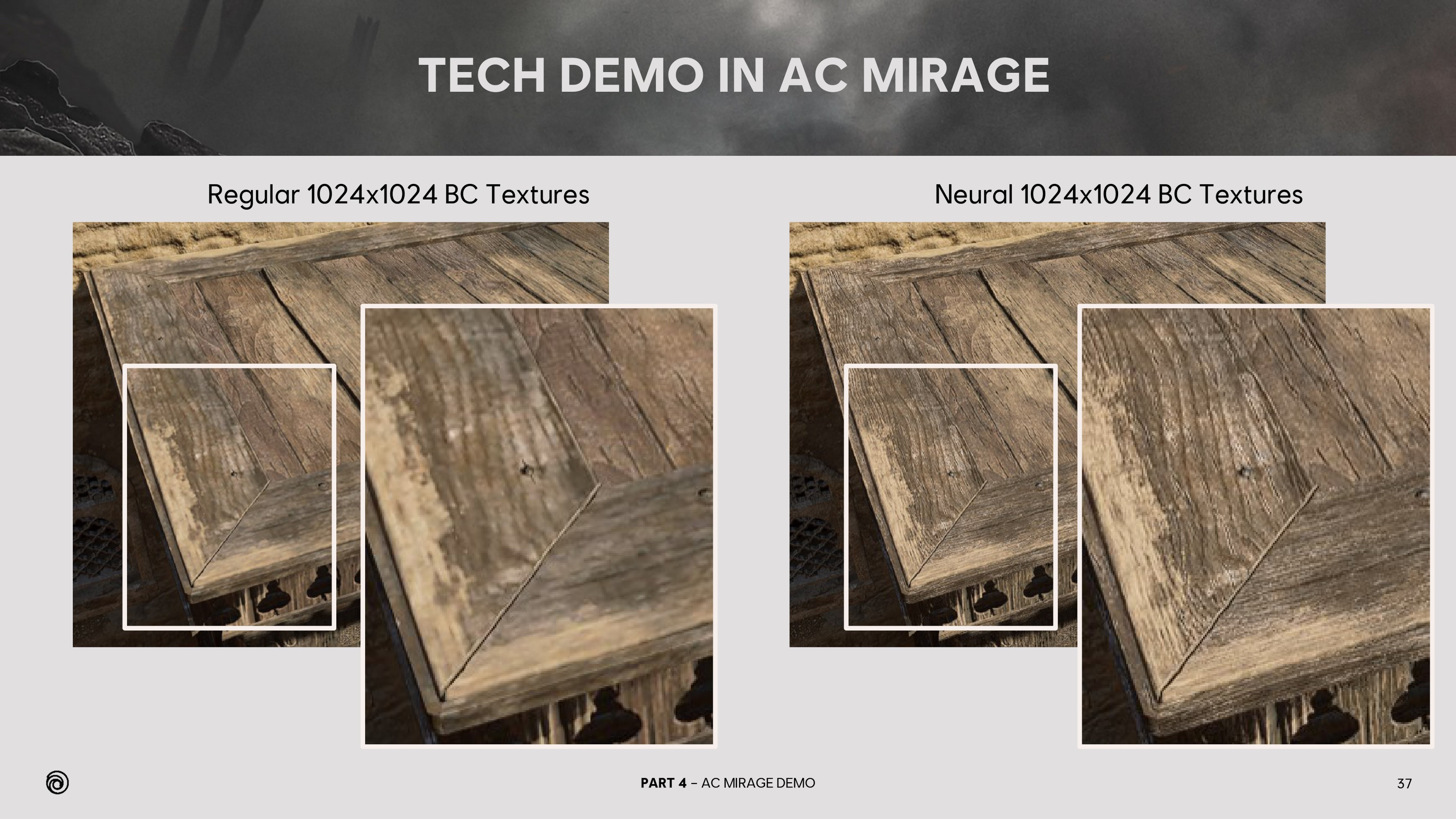
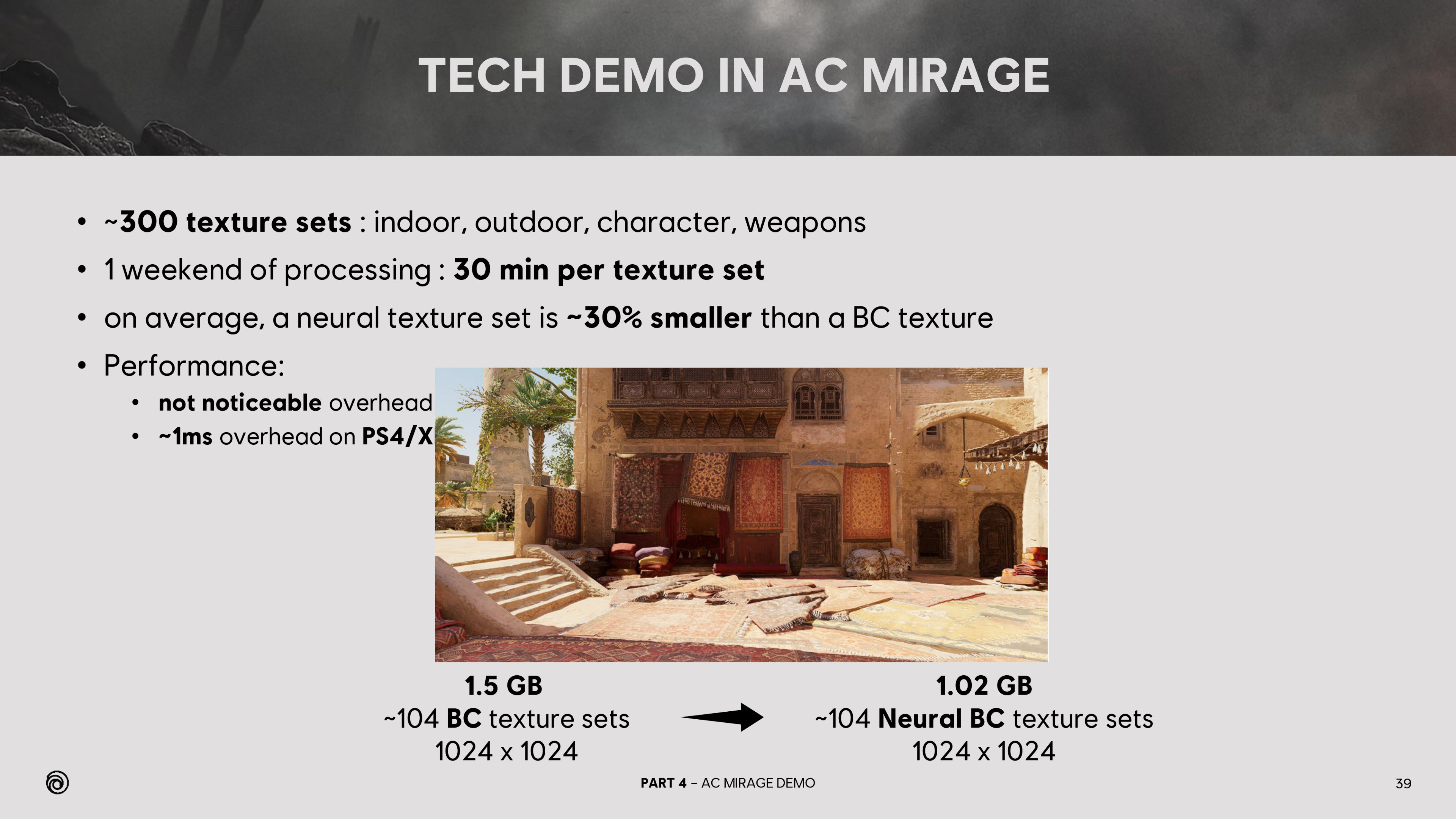
You don't get something for nothing in the world of graphics, though, and when it comes to neural texture compression, all that fancy AI stuff requires a fair bit of compute. So much so that Ubisoft only "applied [it] selectively to a subset of assets, focusing on objects with high instance counts and significant memory pressure."
Although the blog doesn't explicitly mention them, the images suggest that Ubisoft is talking about objects such as trees, furniture, and buildings. The game will have relatively few variations of them, but a typical scene will still apply lots of them around (which is what 'instances' refers to here). They'll all be using pretty much the same textures, so there will be a constant VRAM usage just for these objects.
Enter stage left, neural texture compression to cut down on that memory demand. Given the state of the DRAM and SSD market right now, you can bet your last dollar that a whole heap of game developers will be looking closely at what Ubisoft has done to see if it can help out in their games, too.
1. Best overall: AMD Radeon RX 9070
2. Best value: AMD Radeon RX 9060 XT 16 GB
3. Best budget: Intel Arc B570
4. Best mid-range: Nvidia GeForce RTX 5070 Ti
5. Best high-end: Nvidia GeForce RTX 5090

You must confirm your public display name before commenting
Please logout and then login again, you will then be prompted to enter your display name.